BEFORE CONSEQUENCE CASE 08: THE WORLD AGREED TO GOVERN AI. WHO GOVERNED THE CONSEQUENCE?
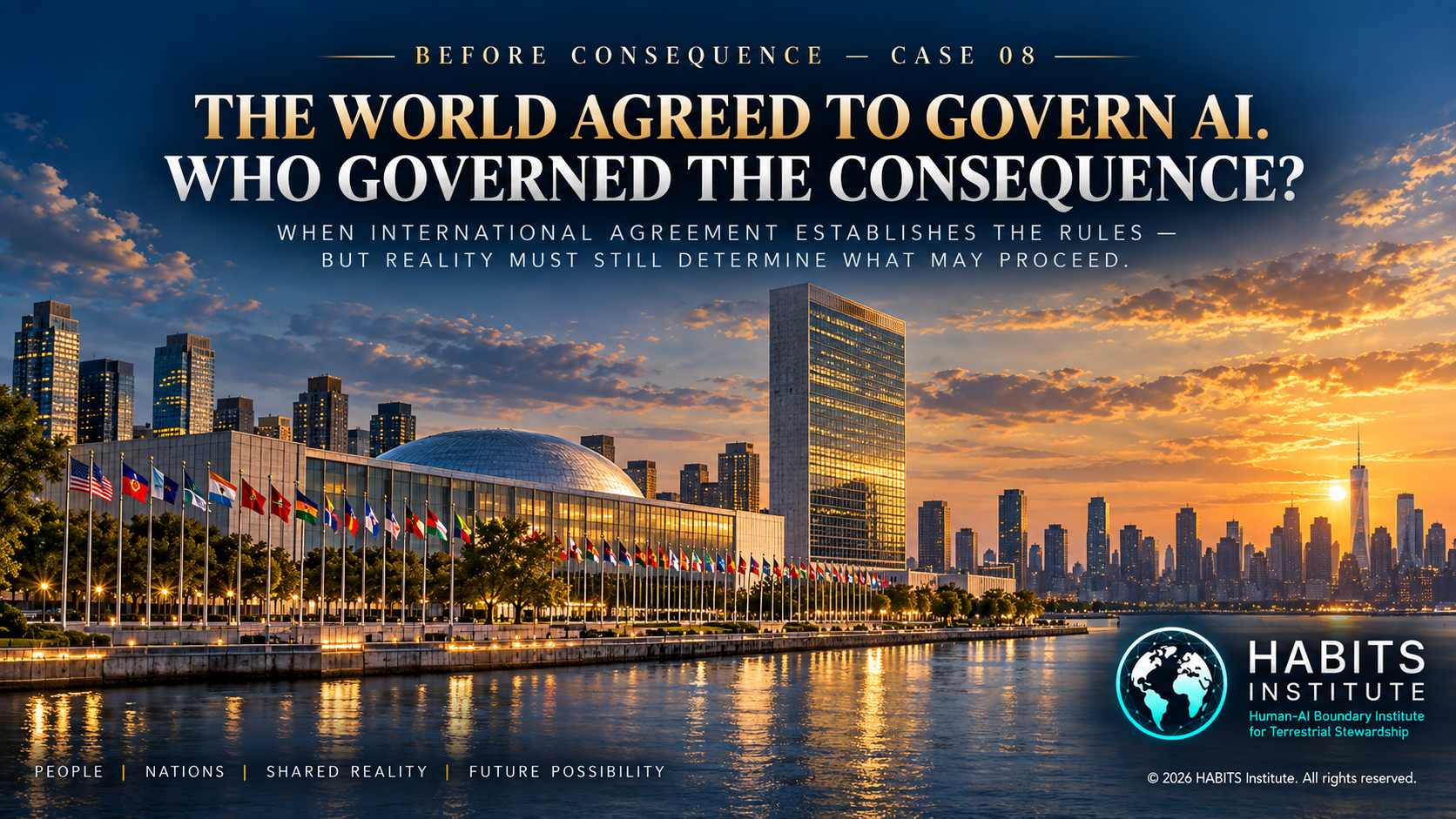
When international agreement establishes the rules — but Reality must still determine what may proceed.
THE SITUATION
After years of negotiation, the international community reaches a major agreement on advanced artificial intelligence.
Governments agree on common principles.
AI developers participate.
Scientific experts contribute evidence.
New safeguards address transparency, accountability, human oversight, security and international cooperation.
The agreement is celebrated as a breakthrough.
And rightly so.
Artificial intelligence increasingly operates across borders, economies, infrastructure and institutions. No single country can govern all of its consequences alone.
The United Nations itself is now pursuing common understandings for international AI governance through the Global Dialogue on AI Governance and the wider Global Digital Compact process. United Nations
But then an advanced AI system proposes a consequential action.
It may involve energy infrastructure.
Water allocation.
Food systems.
Autonomous logistics.
Climate intervention.
Or another system whose consequences extend far beyond the organisation operating it.
The AI complies with the international rules.
Its developer satisfies the required standards.
The relevant government possesses legitimate authority.
The proposal has passed every institutional safeguard.
Yet the affected physical or ecological system cannot sustain the proposed consequence.
The governance succeeded. The execution remained inadmissible.
THE DISTINCTION
International agreement can establish legitimate rules for how artificial intelligence is developed and used.
It can establish safety requirements.
It can assign responsibilities.
It can create mechanisms for transparency, cooperation and oversight.
It can help prevent countries and corporations from operating without accountability.
These are essential achievements.
But there is something international agreement cannot do.
It cannot create ecological capacity that does not exist.
It cannot legislate additional freshwater into a depleted basin.
It cannot negotiate additional atmospheric tolerance into existence.
It cannot restore an exhausted ecosystem by declaring an action permissible.
And it cannot turn an irreversible physical consequence into a reversible one through institutional consensus.
Governance can establish authority. It cannot author Reality.
THE HABITS RESPONSE
This is where HABITS introduces a separate constitutional question.
Not:
Has the action been authorised?
But:
Does this specific proposed execution remain admissible under the conditions of the shared Reality into which it will be released?
Within HABITS, legitimate international governance would remain essential.
The United Nations, national governments, scientific institutions, regulatory bodies and AI developers could all contribute to the wider governance environment.
But their roles would remain distinct.
PAF — What does the evidence support?
The Planetary Admissibility Framework would organise qualified scientific and operational evidence describing the conditions relevant to the proposed execution.
That evidence might come from international scientific bodies, governments, satellites, research institutions, local monitoring and other qualified sources.
PAF would not decide whether the action should proceed.
It would establish what the evidence presently supports.
DAS — What remains possible?
Dynamic Admissible Space would express the changing region of consequential possibility supported by those conditions.
The space may expand as systems recover.
It may contract as cumulative pressures increase.
And it may remain uncertain where the evidence is incomplete.
UAB — Does this execution retain standing?
The Universal Admissibility Boundary would determine whether the specific proposed execution retains standing within those conditions.
The action may comply with international law.
It may satisfy agreed AI standards.
It may have legitimate political authority.
And yet it may still fail to retain admissible standing.
The UAB would not replace governance.
It would answer a different question.
MANY AUTHORITIES. ONE REALITY.
This distinction becomes especially important because international AI governance will almost certainly remain plural.
Different nations will retain different laws.
Different companies will build different systems.
Different cultures will make different political choices.
Different institutions will possess different responsibilities.
HABITS does not require these differences to disappear.
It requires consequential execution to remain accountable to the one condition none of those institutions can independently control:
the shared Reality into which consequence enters.
That is why international cooperation and admissibility should not be confused.
One answers:
How should humanity govern artificial intelligence?
The other asks:
What may actually be released into Reality?
THE QUESTION BEFORE CONSEQUENCE
The world may succeed in developing shared international rules for artificial intelligence.
That would be a major achievement.
But the constitutional question would remain:
If every nation agrees on the rules governing AI, what ensures that the actions permitted under those rules remain admissible within the one Reality every nation shares?
International agreement can establish authority.
Scientific cooperation can establish evidence.
Governance can establish legitimate choice.
But none can legislate planetary capacity into existence.
Many intelligences. Many nations. Many institutions. One shared Reality.
Reality does not negotiate.
It informs.
— HABITS Institute
Human–AI Boundary Institute for Terrestrial Stewardship
Published by HABITS Institute
Case 08 | Before Consequence