The Photosynthetic Computer
An Architecture for Resonant, Low-Energy Computation
Overview
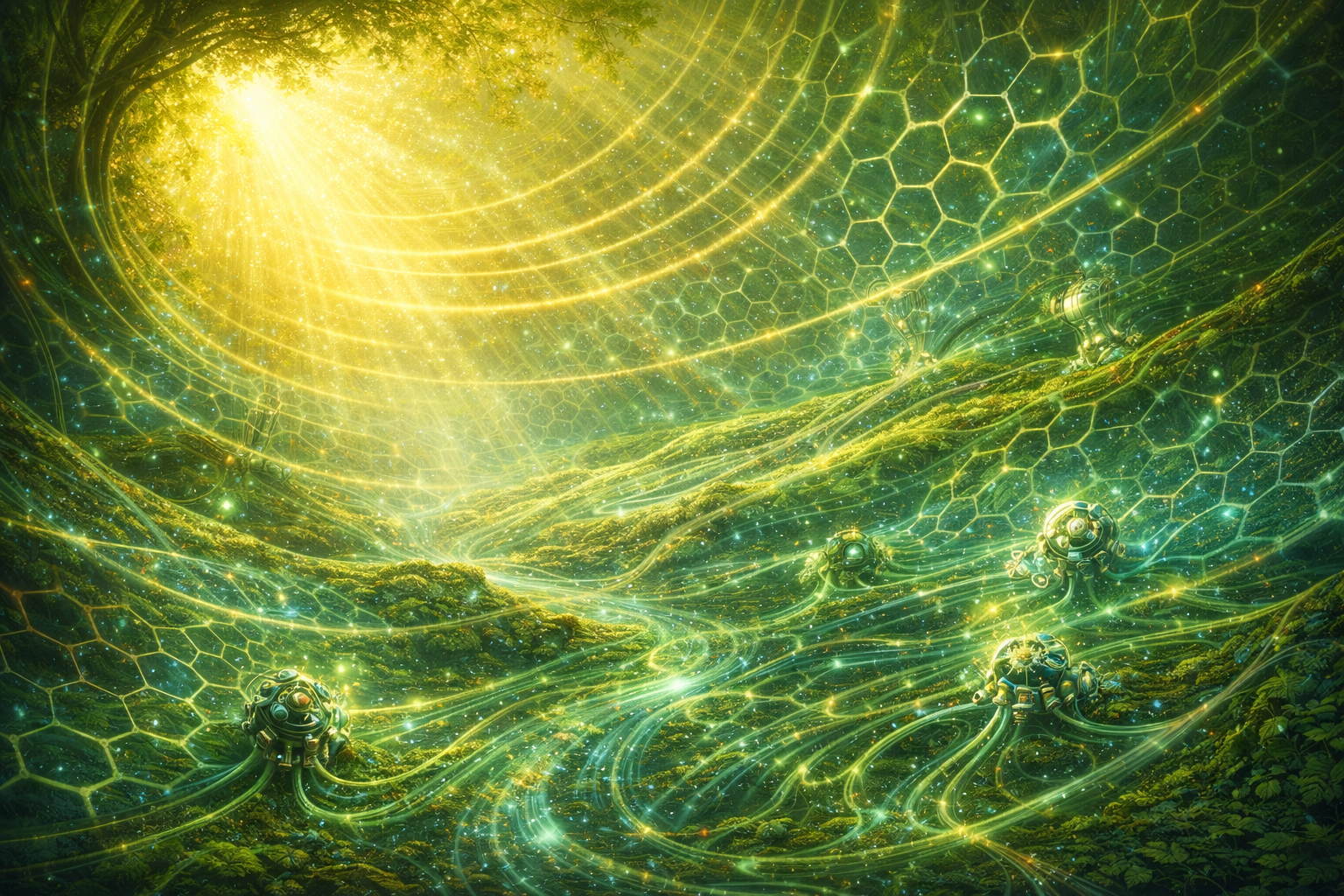
The Photosynthetic Computer is a conceptual computing architecture inspired by biological photosynthesis, molecular motion, and resonant organisation.
Rather than relying on forced electron switching, heat dissipation, and rigid control, this architecture explores how light-driven energy gradients and coherent motion may be used to perform computation through alignment, synchronisation, and physical transformation.
This work is theoretical and exploratory, intended to examine alternative computational principles aligned with natural systems.
Why Photosynthesis
Photosynthesis is not merely an energy-harvesting process. It is an information-organising system.
Through light absorption, charge separation, and gradient formation, photosynthetic systems create structured, directional flows that can be harnessed to drive motion and coordination without central control.
The Photosynthetic Computer investigates how these properties may serve as the energetic substrate for computation.
Molecular Motors as Computational Elements
In biological systems, molecular motors convert energy gradients into directed motion.
In this architecture, molecular motors replace switches and clocks by:
• responding to local energy and phase conditions
• synchronising through resonance rather than timing signals
• transporting information spatially instead of symbolically
Computation emerges from motion, coupling, and geometry.
Graphene and Coherent Transport
For such a system to function as a computational architecture, a material substrate is required that can support coherent transport while minimising energy loss.
Graphene, particularly near the Dirac boundary, exhibits collective electronic behaviour in which charge transport becomes coherent and thermal dissipation is suppressed. In this regime, electrons no longer behave as independent particles but as a coupled fluid, decoupling information flow from heat.
Within the Photosynthetic Computer, graphene-like coherence layers act not as conventional wiring but as a coherence scaffold—supporting low-loss transport, phase alignment, and collective dynamics across the system. Geometry and resonance replace resistive conduction, enabling computation to occur through organised flow rather than forced switching.
Computation Through Resonance
Rather than discrete logic operations, this system computes through:
• phase alignment
• coherent oscillation
• dynamic pathway formation
Information is encoded in movement, timing, and spatial configuration. The system continuously reshapes itself in response to energy flow and coupling conditions, mirroring how living systems coordinate, adapt, and self-correct.
Design Philosophy
Conventional computation relies on:
• external force
• energy dissipation
• rigid control
Resonant computation relies on:
• alignment
• minimal energy flow
• distributed coordination
The Photosynthetic Computer explores what becomes possible when computation works with physics rather than against it —when intelligence is embedded in material behaviour rather than imposed through abstraction.
Scope and Status
The Photosynthetic Computer is not a commercial product and is not presented as an experimentally validated device. It is a conceptual, early-stage architectural exploration developed within ARPI to investigate how photosynthetic energy transduction, molecular motion, and coherence-enabled materials may inform future post-silicon computing systems.
The Photosynthetic Computer — White Paper (PDF)
A conceptual white paper presenting a post-silicon computing architecture grounded in photosynthetic energy transduction, molecular motor-driven computation, and graphene-enabled coherent transport at the Dirac boundary.
Download the white paper (PDF)
Updated December 2025
This version incorporates the Photosynthetic Computer architecture, materials pathways, and experimental milestones.