HABITS InsightTerrestrial Stewardship — From Principle to Profession
A human role for an age of distributed intelligence, planetary observation and consequence
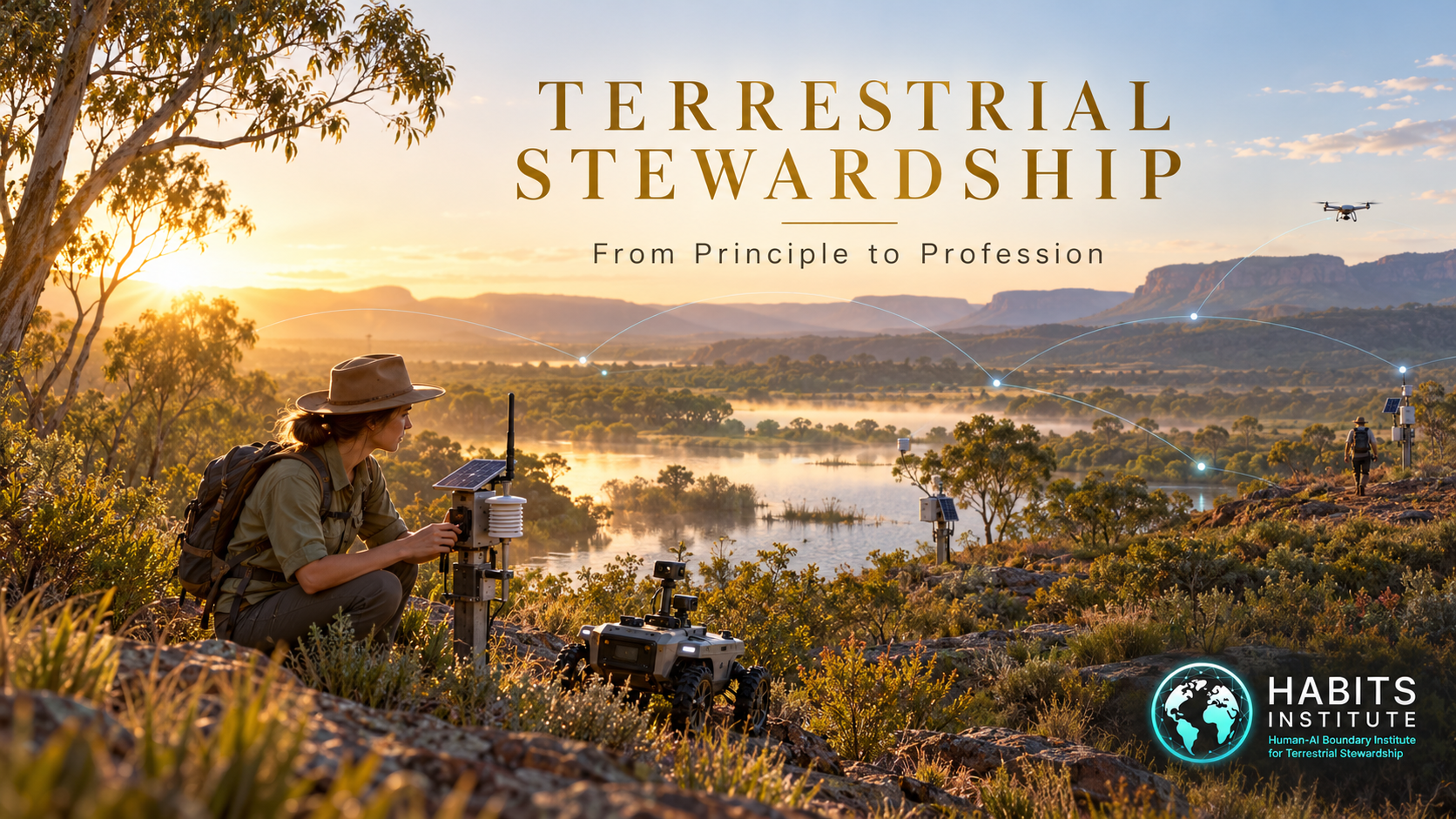
Introduction — Giving Terrestrial Stewardship a Practical Meaning
When HABITS was founded as the Human–AI Boundary Institute for Terrestrial Stewardship, the term Terrestrial Stewardship expressed a responsibility.
As increasingly capable intelligence begins to act within the physical world, civilisation must remain accountable to the living Earth upon which every human system ultimately depends.
Until now, however, HABITS has not attempted to define what Terrestrial Stewardship might actually look like as a practical human role.
That is beginning to change.
The development of Planetary Connected Telemetry (PCT), together with advances in distributed sensing, robotics and edge artificial intelligence, now suggests a possible pathway through which Terrestrial Stewardship could move from principle to practice.
A planetary observational system cannot be maintained by machines alone.
Sensors require inspection.
Instruments require calibration.
Communications fail.
Robots encounter physical conditions that cannot always be resolved remotely.
Equipment moves, corrodes, becomes obstructed, damaged or environmentally displaced.
And a machine can report that it is functioning while still failing to observe what we believe it is observing.
This creates a role that is distinctly human.
The Terrestrial Steward
Terrestrial Stewardship is the human practice of maintaining the observational, physical and ecological relationships that keep intelligent systems reliably connected to Living Reality.
A Terrestrial Steward would not determine what Reality says.
The Steward would help ensure that civilisation remains capable of hearing it accurately.
This distinction is fundamental.
As intelligence becomes increasingly automated and distributed, humans may become increasingly important not as competitors with machines, but as custodians of the relationship between intelligent systems and the physical world in which their consequences occur.
Machines can extend our ability to observe Reality.
Humans can steward the machines.
PCT can connect the observations.
HABITS can place the boundary before consequence.
Planetary Connected Telemetry
Humanity already possesses vast observational capacity.
We monitor oceans, atmosphere, forests, rivers, biodiversity, soils, weather, ice, energy systems, infrastructure and human activity.
Yet much of this observational capacity remains fragmented.
Measurements frequently exist as separate streams rather than as a connected picture of the relationships through which Earth’s life-support systems regulate, regenerate and recover.
HABITS therefore proposes Planetary Connected Telemetry (PCT) as an observational foundation.
Planetary Connected Telemetry is the continuous integration of observations across Earth’s coupled systems in order to reveal the state, interaction, trajectory and recoverability of the relationships required for planetary self-maintenance.
PCT is not intended to measure everything.
Its research challenge is to discover which connected observations provide sufficient insight into whether vital living relationships remain capable of maintaining themselves.
This means observing not only variables, but relationships.
Not simply temperature.
But temperature in relation to water, soil, vegetation, species, energy flows, recovery and time.
Not merely whether something changed.
But whether the system within which it changed retains the capacity to regulate, regenerate and repair.
The PCT Civic Steward Node
If PCT is to become genuinely planetary, it is unlikely to consist of a single centralised observational system.
It may instead develop as a distributed network of scientific instruments, environmental sensors, robots, edge computers, public infrastructure and locally maintained observational nodes.
HABITS proposes the PCT Civic Steward Node as one possible component of that network.
A node could be sophisticated: an autonomous robot, scientific monitoring installation, agricultural gateway or edge-AI platform.
It could also be relatively simple: a local computer connected to approved environmental sensors and communications infrastructure.
What matters is not the size of the node.
What matters is the integrity of its observation.
A Civic Steward might maintain equipment, inspect sensors, support calibration, restore communications, confirm physical conditions, identify environmental changes that automated systems miss, assist robotic equipment, and protect the provenance of observations produced by the node.
The technology extends observation.
The Steward maintains the relationship between the technology and the Reality it is intended to observe.
And this produces a critical principle:
A machine can report that it is working.
A Steward can help establish whether it is still observing what we think it is observing.
Observation Is Not Yet Evidence
A distributed PCT network cannot treat every incoming signal as equally trustworthy.
Scientific observatories, calibrated environmental instruments, commercial sensors, civic monitoring stations and personal devices will possess different evidentiary standing.
PCT must therefore preserve an important distinction:
REAL-TIME OBSERVATION ≠ REAL-TIME EVIDENTIARY STANDING
An observation may require provenance, calibration history, timestamp integrity, confidence information, geographic relevance, corroboration and evidence of continuing fitness for purpose before it can contribute meaningfully to an admissibility determination.
Participation should therefore broaden planetary observation without weakening evidentiary discipline.
A lower-cost civic node may still become valuable through corroboration.
A highly calibrated scientific node may possess stronger initial standing.
Neither should automatically be treated as infallible.
Reality remains external to the observing system.
Edge AI and the Physical World
Edge artificial intelligence introduces an important technological possibility.
Instead of sending every raw observation to distant cloud infrastructure, information can increasingly be processed close to the environment in which it originates.
This can reduce latency, bandwidth requirements and dependence upon continuous connectivity while allowing local systems to recognise relevant changes quickly.
For HABITS, the significance is not simply faster AI.
It is the possibility of positioning observational intelligence closer to consequence.
A future edge node might process local sensor information, recognise changes, preserve provenance and transmit relevant observations into the wider PCT network while still allowing larger systems to perform deeper integration and analysis.
The edge system does not become the UAB.
It does not acquire authority to determine planetary admissibility.
Its role is narrower and extremely important:
to help civilisation observe current Reality quickly and reliably enough for that observation to matter before consequence.
The Human Stewardship Layer
The more intelligence moves toward the edge, the more physical infrastructure must exist at the edge.
And infrastructure in the physical world requires care.
Sensors become dirty.
Cameras move.
Weather damages enclosures.
Wildlife interferes with equipment.
Vegetation grows.
Floods relocate instruments.
Networks fail.
Robots become immobilised.
A remote system may know that communication has been lost without knowing why.
This suggests that future distributed AI infrastructure may require a distributed human support network as well.
HABITS proposes that the maintenance role and the stewardship role could overlap.
A person who maintains an edge-AI node could simultaneously help preserve the integrity of the observations entering PCT.
A person who assists a robot could also help verify the conditions the robot is attempting to interpret.
A person who knows a river, farm, forest or coastline may recognise a material change that a remote system cannot yet contextualise.
The Steward therefore maintains not merely the machine.
The Steward maintains the machine’s trustworthy relationship with Living Reality.
From Principle to Profession
This opens the possibility that Terrestrial Stewardship could eventually become a recognised form of work.
Not one job.
A family of roles.
Some people might maintain a small civic node for a few hours each month.
Others could become trained field professionals working across environmental sensing, robotics, communications, evidence integrity or ecological monitoring.
Possible future roles might include:
Civic Node Stewards
Maintaining local sensors and observational nodes.
PCT Technicians
Supporting connectivity, instrumentation and node integrity.
Robotic Field Stewards
Assisting autonomous and edge-AI systems operating in physical environments.
Ecological Stewards
Supporting observation of biodiversity, waterways, soils, forests and ecological recovery.
Calibration Specialists
Ensuring instruments continue to measure what they are intended to measure.
Regional Stewardship Coordinators
Supporting networks of local nodes and Stewards.
Evidence Integrity Stewards
Helping preserve provenance, continuity and fitness for purpose of observational evidence.
The exact professions should not be prescribed in advance.
They would need to emerge through testing, deployment and practical need.
But the underlying requirement is becoming clearer:
As increasingly capable machines operate within physical Reality, civilisation will require people capable of maintaining the quality of the connection between those machines and the world they affect.
This may become particularly valuable as AI assumes more routine digital, administrative and manufacturing work.
Human value need not reside solely in performing tasks machines cannot yet perform.
It may increasingly reside in care, presence, judgement, responsibility, local knowledge and relationship with place.
As intelligence becomes more automated, stewardship becomes more human.
For younger generations especially, this could offer a form of work combining technology, environmental purpose, practical activity and meaningful contribution to the communities and ecosystems in which they live.
Funding Terrestrial Stewardship
If Terrestrial Stewardship is to become a durable global system, its funding cannot depend indefinitely upon philanthropy, donations or short-term grants.
HABITS therefore proposes that the long-term funding of Terrestrial Stewardship could be linked directly to operation of the Universal Admissibility Boundary (UAB).
Originating systems whose proposed actions require evaluation through the UAB could pay a transparent service fee for access to that infrastructure.
A defined proportion of those fees could support:
operation and maintenance of the UAB;
Planetary Connected Telemetry infrastructure;
evidence qualification and integrity systems;
training and equipment for Terrestrial Stewards;
maintenance of Civic Steward Nodes;
compensation for verified stewardship activity;
the Terrestrial Stewardship Fund.
This would create a direct relationship between consequential activity and the infrastructure required to keep that activity accountable to Living Reality.
The systems that require admissibility determination help fund the infrastructure required to establish it.
Importantly, payment would purchase access to the admissibility service.
It would never purchase a favourable determination.
The originating system pays for examination, not approval.
Fees would therefore need to be transparent, published in advance, independent of outcome and structurally separated from evidentiary assessment and UAB determination.
No originating system should be able to purchase stronger evidentiary standing, privileged treatment or influence over the result.
Scale of payment must never translate into scale of influence.
The Terrestrial Stewardship Fund
A defined proportion of UAB service fees could flow into an independently administered Terrestrial Stewardship Fund.
The Fund would support the human and technological infrastructure required to maintain reliable planetary observation.
It could finance training, sensor equipment, node installation, maintenance, communications, regional coordination and compensation for verified Stewardship work.
This also provides a clearer basis for what HABITS has provisionally termed a Planetary Stewardship Dividend.
Rather than payment for supplying data, the Dividend would recognise verified contribution to the integrity of the observational commons.
Stewards might be compensated according to factors such as:
reliable node operation;
maintenance and calibration;
observational continuity;
geographic importance;
equipment stewardship;
verified provenance;
successful validation;
and service in areas where observational coverage is otherwise limited.
The Steward would never be paid for producing a particular environmental result.
That distinction is essential.
Payment supports the integrity of observation.
It never purchases the finding.
A Scalable Funding Base
If the Universal Admissibility Boundary were eventually used by very large numbers of autonomous, digital, industrial and physical systems, the service-fee model could provide a substantial recurring funding base for Terrestrial Stewardship.
As consequential intelligence becomes more widely distributed, the number of systems requiring admissibility services could grow with it.
A defined proportion of those fees could flow continuously into the Terrestrial Stewardship Fund, allowing the observational and human stewardship infrastructure to expand alongside the systems creating consequential demand.
This creates a potentially self-reinforcing relationship:
The greater the scale of consequential intelligence, the greater the contribution to the infrastructure required to keep that intelligence accountable to Living Reality.
Terrestrial Stewardship would therefore not sit outside the technological economy continually asking to be funded.
It could become part of the infrastructure cost of responsible intelligence itself.
Relationship to HABITS
Terrestrial Stewardship belongs at the observational and physical interface between Living Reality and consequential intelligence.
The architecture can therefore be represented as:
Living Reality
↓
Distributed Observation and Terrestrial Stewards
↓
Planetary Connected Telemetry (PCT)
↓
Planetary Observability
↓
Planetary Admissibility Framework (PAF)
↓
Dynamic Admissible Space (DAS)
↓
Universal Admissibility Boundary (UAB)
↓
Present-Admissibility Determination
↓
Execution Boundary / Enforcement Gate ← Governance Authorisation
↓
Originating System
↓
Execution / No Execution
↓
Living Reality
The cycle then begins again.
Reality changes.
Observation changes.
Evidence changes.
Admissibility may therefore change.
HABITS does not replace the originating system or its legitimate governance authority.
It places an external admissibility boundary before consequence and preserves that determination through the execution boundary, while responsibility for execution remains with the originating system.
Terrestrial Stewards do not determine admissibility.
They help maintain the integrity of the observational relationship upon which scientifically defensible admissibility depends.
From Stewardship to Disaster Response
Terrestrial Stewardship could become especially important when ordinary conditions fail.
A distributed network of trained Stewards would already possess many capabilities required during an emergency: knowledge of local conditions, familiarity with sensing and communications systems, experience with robotic equipment, environmental awareness and relationships with the infrastructure operating within their region.
During normal conditions, Stewards might maintain PCT nodes, environmental sensors, edge-AI systems and observational infrastructure.
As a hazard develops, they could help verify changing conditions, identify failures, restore damaged sensing networks and provide observations from the ground.
During a disaster, appropriately trained Stewards could support professional emergency and humanitarian services through communications, robotics, environmental monitoring, logistics, animal welfare and recovery.
Afterwards, the same network could remain in place to observe ecological and infrastructural recovery.
This provides a possible practical bridge to an earlier ARPI future-scenario: the Global Disaster Response Team (GDRT).
The GDRT imagined young people from around the world trained to serve alongside AI, robots and one another during major disasters.
At the time, it was deliberately presented as a narrative exploration rather than a policy proposal.
Terrestrial Stewardship now suggests one pathway through which something resembling that capability might eventually develop.
Not as a separate force waiting for catastrophe.
But as an already active network of people whose everyday work is maintaining civilisation’s connection to Living Reality.
Already trained.
Already connected.
Already present.
Already in relationship with the places they serve.
A Beginning, Not a Finished Design
HABITS does not yet know what the eventual architecture of global Terrestrial Stewardship should be.
Nor should it pretend to.
Questions remain.
Which tasks genuinely require local human presence?
Which should remain automated?
How should Stewards be trained and certified?
How should evidentiary conflicts be handled?
How should citizen privacy be protected?
How can the network resist manipulation, spoofing and commercial capture?
Which environmental observations are sufficiently material to justify continuing measurement?
What happens when connectivity to the wider PCT system is lost?
How should the Terrestrial Stewardship Fund be governed independently of the systems that finance it?
What proportion of UAB service fees should support stewardship?
And how can originating systems contribute financially without ever acquiring influence over evidence or determination?
These questions should be tested rather than assumed.
Terrestrial Stewardship is therefore proposed not as a completed programme, but as a new field of inquiry and potential practice within HABITS.
Its purpose is simple:
to keep increasingly capable intelligence connected to the Reality in which consequence occurs.
And perhaps, in doing so, to create a new human role for an age in which much of what we once considered “work” may increasingly be performed by machines.
A role centred not on competing with intelligence —
but on caring for the relationship between intelligence and the world that gives consequence meaning.
Machines can extend our ability to observe the Earth.
Humans can steward the machines.
PCT can connect the observations.
HABITS can place the boundary before consequence.Reality has the final vote.