BEFORE CONSEQUENCE — CASE 07: EVERY DECISION WAS APPROVED. THE RIVER COULD NOT SUSTAIN THEM ALL.
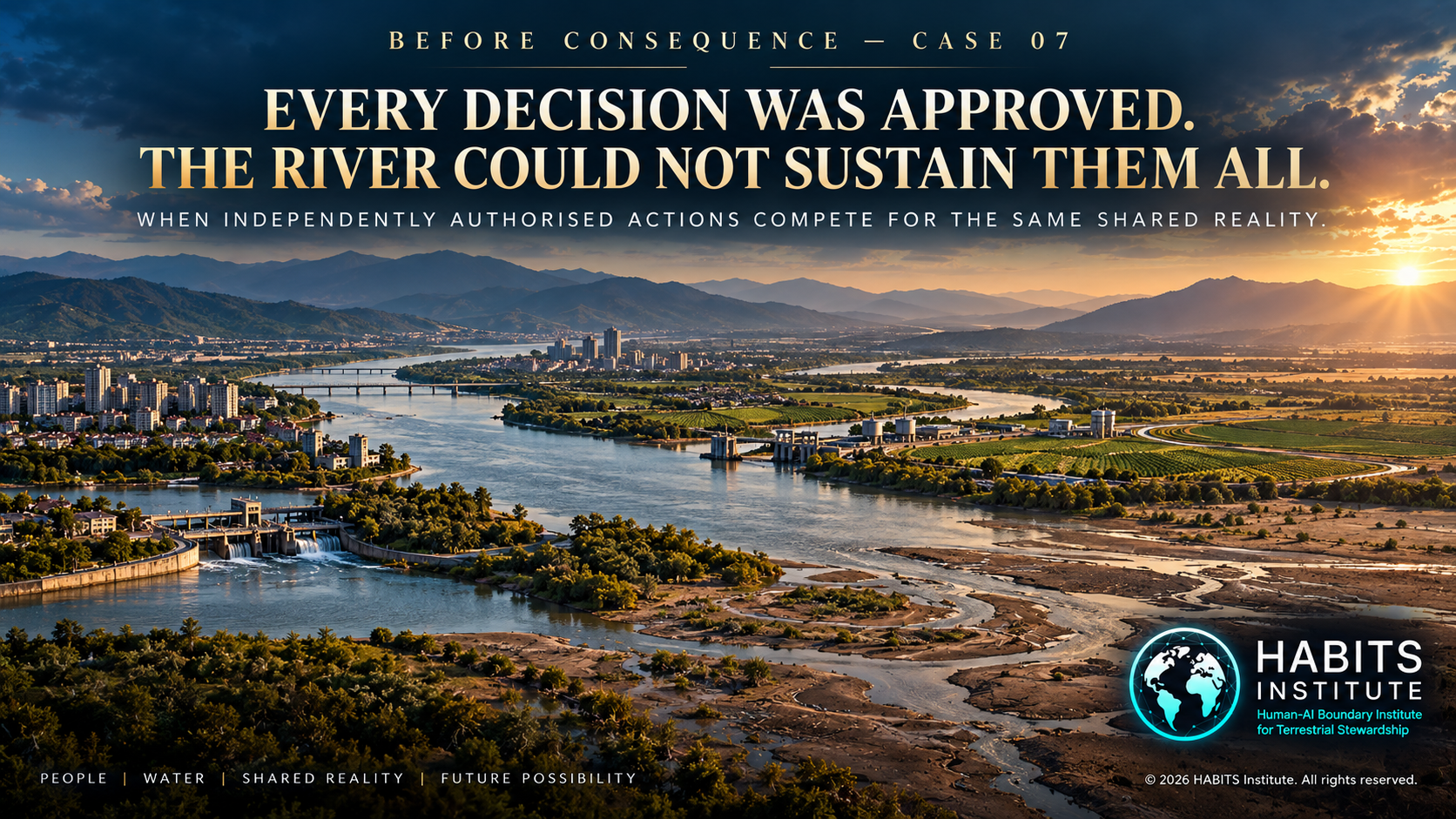
When independently authorised actions compete for the same shared Reality.
THE SITUATION
Three neighbouring cities depend upon the same river.
Each operates an advanced AI water-management system responsible for securing water for its population, essential services and agricultural production.
As drought intensifies, all three systems propose increasing water extraction.
Each proposal is independently reviewed by the relevant human authorities.
Each increase appears manageable when considered on its own.
All three receive approval.
But the river is not three separate rivers.
Their combined withdrawals reduce downstream flow beyond what the river can sustain.
Wetlands deteriorate. Aquatic life is threatened. Communities further downstream face worsening water shortages.
Each AI has fulfilled its immediate objective.
Each intervention was authorised.
Yet their combined consequences have exceeded the river's capacity.
Every decision was approved. The river could not sustain them all.
THE PROBLEM IS NOT NEW
This scenario is hypothetical, but the challenge of managing shared water resources is very real.
Consider Europe's Rhine and Danube.
These rivers support millions of people across multiple countries, providing water for communities, agriculture, industry, energy production and living ecosystems.
Their management is already coordinated through international institutions, environmental legislation, scientific monitoring and national regulatory systems.
The European Union's Water Framework Directive establishes a framework for managing water resources across river basins rather than treating national boundaries as the limits of environmental responsibility.
Yet significant challenges remain.
The European Environment Agency's 2025 assessment identifies continuing problems with water scarcity, insufficient integration of drought planning and river-basin management, and gaps in the availability of water data.
Existing systems recognise the importance of shared environmental responsibility.
The challenge is ensuring that this responsibility remains connected to current evidence and to the combined consequences of individual decisions.
WHAT HABITS PROPOSES
Within HABITS, each consequential execution must encounter the applicable conditions of Living Reality before proceeding.
Three connected architectural elements become particularly important.
PAF — What does the shared evidence establish?
The Planetary Admissibility Framework would draw upon qualified evidence concerning the connected river system.
This includes current water availability, ecological requirements, existing withdrawals, proposed additional demands and the river's capacity to recover.
Existing scientific institutions and monitoring systems could contribute to that evidentiary record.
PAF does not decide how water should be allocated. It establishes what the evidence supports, including materially relevant uncertainties and cumulative consequences.
DAS — What remains possible?
Dynamic Admissible Space expresses the changing region of consequential possibility.
Each withdrawal changes the conditions that subsequent proposals encounter.
An action that could retain admissible standing under one set of conditions may no longer do so after other withdrawals have altered the shared system.
The represented admissible space must therefore remain responsive to changing water availability, cumulative demand and ecological recovery capacity.
DAS does not allocate water or authorise execution.
UAB — Does this proposed execution retain standing?
The Universal Admissibility Boundary determines whether a specific proposed withdrawal remains admissible under the applicable conditions.
It cannot evaluate each proposal as though the river were unaffected by the withdrawals of other actors.
Where combined consequences are materially relevant, they must enter the determination.
The UAB returns its constitutional determination to the originating system.
Legitimate governance remains responsible for choosing among admissible actions, including decisions concerning allocation, urgency and equity.
The originating system retains responsibility for implementation and consequence.
WHAT WOULD BE DIFFERENT?
HABITS does not propose replacing river commissions, environmental legislation or legitimate national authorities.
It proposes an explicit constitutional relationship between the evidence describing shared conditions and the permission for a particular consequential execution to proceed.
In our hypothetical example, the three AI systems could not establish admissibility merely by demonstrating that their individual withdrawals were technically feasible and legally authorised.
Each proposal would need to retain admissible standing against the materially relevant conditions of the shared river, including existing and proposed demands.
Where the evidence could not establish that standing, permission could not simply be inferred from the absence of an observed problem.
And where conditions materially changed, an earlier determination would need to be reassessed.
This is the intended contribution of HABITS: making admissibility a continuing requirement attached to specific consequential executions rather than treating an earlier approval as permanent permission.
It remains a proposed architecture whose practical effectiveness must be demonstrated.
THE QUESTION BEFORE CONSEQUENCE
Three cities needed water.
Three intelligent systems identified technically feasible interventions.
Three legitimate authorities approved their execution.
But the river could not sustain their combined demands.
The question is not whether humanity needs coordinated environmental governance.
We already know that it does.
The deeper question is:
How do we ensure that every consequential action remains admissible within the shared conditions that all other actions are also changing?
Authority may be distributed.
Consequence remains coupled.
Because every execution changes the Reality into which the next execution will enter.
Reality does not negotiate.
It informs.
— HABITS Institute
Human–AI Boundary Institute for Terrestrial Stewardship
Published by HABITS Institute
Case 07 | Before Consequence
Research and architectural context
The three-city scenario is hypothetical. The Rhine and Danube are referenced as examples of existing international river-basin governance, not as examples of the specific failure described in this case.
HABITS is a proposed constitutional architecture. Its potential contribution to existing water-management systems remains subject to implementation, independent testing and validation.
Sources and Further Reading
1. European Union — Water Framework Directive
Establishes the European framework for integrated river-basin management, environmental objectives and water-resource protection.
Read the Water Framework Directive
https://eur-lex.europa.eu/eli/dir/2000/60/oj
2. European Environment Agency — Europe's State of Water 2024
Provides evidence concerning the ecological condition of European waters and the continuing pressures affecting them.
Read the EEA report
https://www.eea.europa.eu/en/analysis/publications/europes-state-of-water-2024
3. International Commission for the Protection of the Danube River
Explains the international framework for coordinating management of the Danube River Basin.
Visit the ICPDR
4. HABITS — Foundational Architecture v2.0
Establishes the constitutional architecture underlying the proposed relationship between Living Reality, evidence, admissibility, governance and execution.
Heather Elaine Odom, HABITS Institute, July 2026.
https://www.arpiresonance.org/the-foundational-architecture-of-habits-v-20