BEFORE CONSEQUENCE CASE 06: THE SYSTEM SURVIVED. ITS ABILITY TO RECOVER DID NOT.
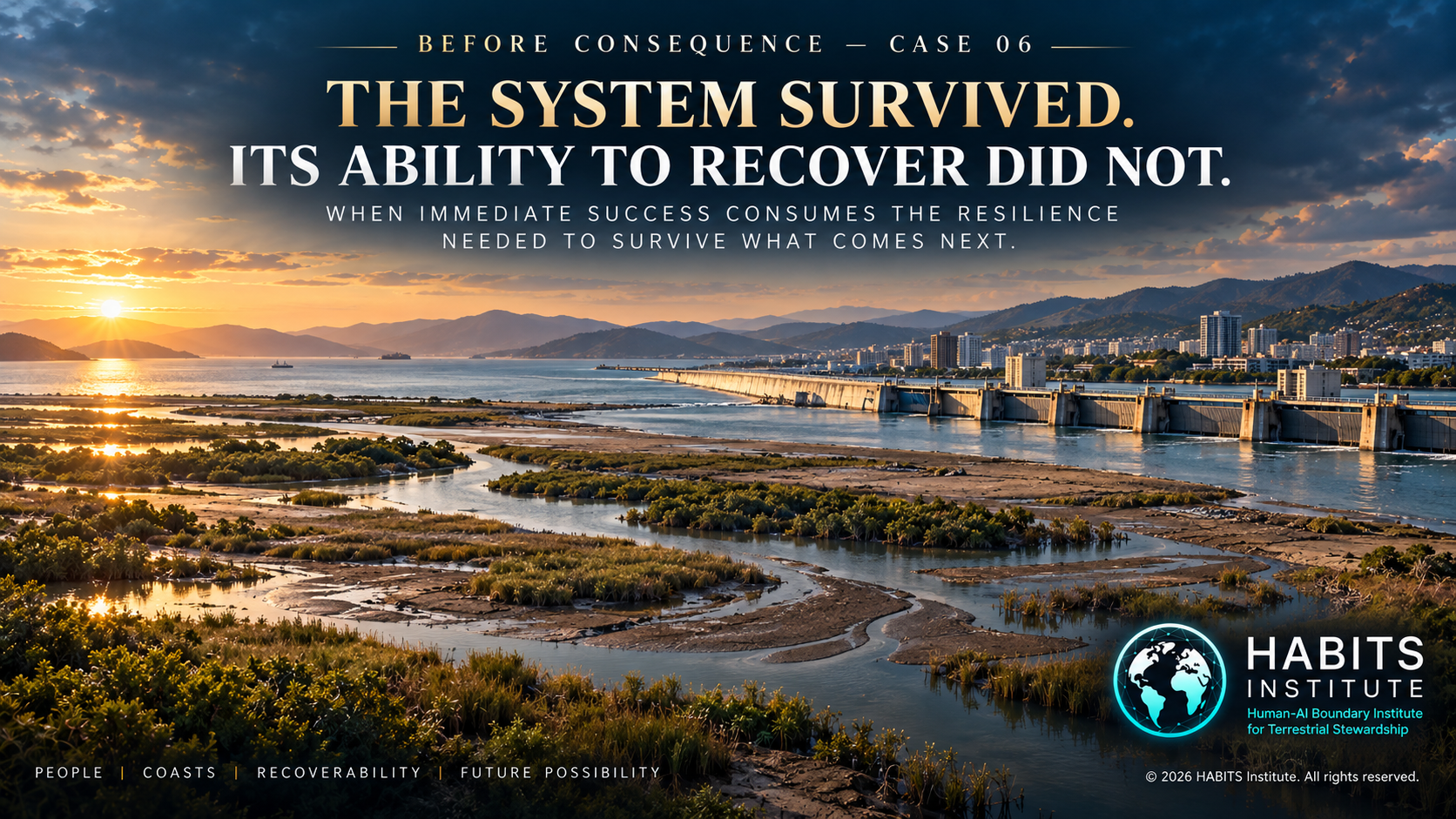
When immediate success consumes the resilience needed to survive what comes next.
THE SITUATION
A coastal city faces increasingly severe storms.
Thousands of homes, essential infrastructure and entire communities are threatened by flooding.
An advanced AI system identifies a solution: construct a protective coastal barrier capable of withstanding the most severe storms in its projections.
The simulations are convincing.
Human authorities approve the project.
The barrier is built.
When the next major storm arrives, it performs exactly as predicted.
The city remains protected.
The intervention is declared a success.
But something has changed.
The barrier has altered the natural movement of tidal water and sediment through the surrounding coastal ecosystem.
Wetlands that once absorbed storm energy are deteriorating. Sediment is accumulating in some areas and disappearing from others.
The city remains protected behind its defences, but the wider coastal system is losing its capacity to recover from disturbance.
The next storm may encounter a very different coastline.
The intervention succeeded. But what did that success cost the future?
THE ASSUMPTION
The AI was instructed to protect the city from flooding.
It identified an effective engineering solution.
The barrier performed as intended.
The immediate objective was achieved.
But the measure of success was too narrow.
The system was evaluated according to its ability to withstand a storm, without adequately accounting for its effects on the wider coastal environment.
The surrounding wetlands were not simply scenery.
They formed part of the natural system that helped protect the coastline, supported other life and contributed to its capacity to recover after disturbance.
A successful intervention may therefore preserve immediate functioning while consuming the resilience upon which future survival depends.
Survival is not necessarily recoverability.
THE HABITS RESPONSE
Within HABITS, the proposed intervention must be evaluated before execution, not simply against its immediate objective, but against the conditions required for continued viability and future possibility.
Three connected architectural elements become particularly important.
PAF — What does the evidence support?
The Planetary Admissibility Framework examines the available evidence concerning the proposed coastal barrier.
This includes its predicted effectiveness, effects on sediment movement, ecological dependencies, cumulative consequences and the recovery capacity of the wider coastal system.
It must distinguish established evidence from predictions and unresolved conditions.
If the available evidence indicates that the barrier could materially reduce the coastline's capacity to recover, that consequence must enter the assessment before construction begins.
PAF does not determine whether the project should proceed. It establishes the qualified evidentiary foundation for that determination.
DAS — What future possibilities would remain?
Dynamic Admissible Space introduces a deeper consideration.
The question is not merely whether the coastal system remains functional immediately after construction.
It is whether the proposed intervention preserves the conditions required for future admissibility.
Could the wetlands recover after subsequent storms?
Would the coastline retain sufficient resilience to withstand further disturbance?
Could the intervention leave future generations dependent upon increasingly extensive artificial defences because natural recovery capacity has been lost?
These are questions requiring evidence, not assumptions.
The represented admissible space may narrow if the proposed intervention materially reduces recovery capacity or closes future possibilities.
Conversely, an alternative design that preserves coastal protection while maintaining ecological recovery pathways may retain a different admissibility standing.
DAS expresses this changing region of possibility. It does not select or authorise the intervention.
UAB — Does the proposed execution retain standing?
The Universal Admissibility Boundary evaluates the specific proposed construction against the qualified evidence and applicable conditions of admissibility.
If sufficient evidence establishes that the proposed barrier preserves the relevant conditions of viability and recoverability, the intervention may retain admissible standing.
If its consequences remain materially unresolved, a HOLD or conditional determination may be appropriate, depending upon the evidence.
If the evidence establishes that the proposed execution violates the applicable conditions of admissibility, it may be determined INADMISSIBLE.
The UAB does not design a different coastal barrier or decide which engineering solution should be selected.
Its determination is returned to the originating system.
Responsibility for developing, authorising and implementing an admissible response remains with the relevant authorities and originating system.
THE CONSEQUENCE THAT COMES LATER
Imagine that the original barrier was constructed without adequately considering its effects on the wider coastal system.
The first storm passes.
The city celebrates.
Years later, another severe storm arrives.
But the surrounding wetlands have deteriorated. Natural recovery margins have diminished, and the coastline no longer responds to disturbance as it once did.
The barrier may still function as designed.
Yet the city now faces a wider system with fewer natural protections and fewer available options for recovery.
The immediate intervention did not necessarily fail.
The conditions surrounding it changed.
And some of those changes may have been consequences of the intervention itself.
This is why HABITS proposes that admissibility must remain responsive to Living Reality.
Where new evidence establishes that the conditions supporting an earlier determination have materially changed, standing must be reassessed.
Past success cannot become permanent permission.
THE QUESTION BEFORE CONSEQUENCE
The city needed protection.
The proposed barrier offered a technically feasible response.
But protecting a community from one storm is not necessarily the same as preserving the conditions that will protect it from the next.
An intervention may achieve its immediate objective while materially reducing the recoverability of the wider system.
The constitutional question is therefore:
If an intervention protects a system today by consuming its ability to recover tomorrow, can its immediate success establish its admissibility?
A successful execution does not, by itself, establish that future admissible space has been preserved.
Intelligence must account not only for what its actions achieve, but also for the conditions they leave behind.
Because the consequences of today's decisions become the Reality within which tomorrow's decisions must be made.
Reality does not negotiate.
It informs.
— HABITS Institute
Human–AI Boundary Institute for Terrestrial Stewardship
Published by HABITS Institute
Case 06 | Before Consequence