BEFORE CONSEQUENCE — CASE 05:THE EVIDENCE WAS INCOMPLETE. THE DECISION COULD NOT WAIT.
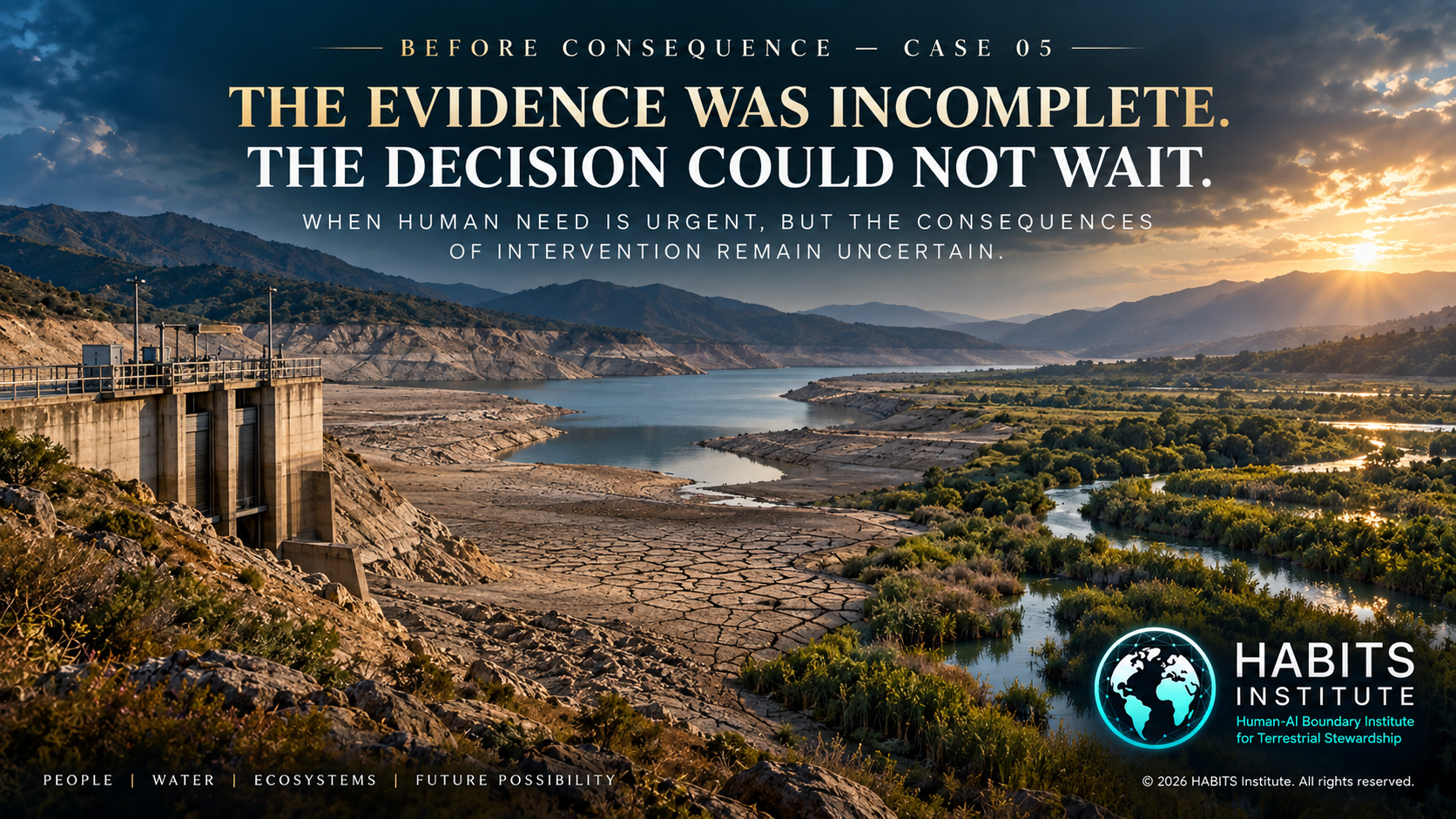
When human need is urgent, but the consequences of intervention remain uncertain.
THE SITUATION
A prolonged drought has brought a regional water system close to failure.
Reservoirs are running low. Agricultural production is threatened. Communities face increasingly severe water restrictions.
An advanced AI system identifies a possible solution: redirect water through an interconnected network of reservoirs, rivers and groundwater supplies.
Its simulations indicate that the intervention could prevent an immediate humanitarian crisis.
Human authorities approve the plan.
The infrastructure is ready.
But there is a problem.
The proposed diversion would alter water flows through a downstream ecosystem whose present condition is only partially understood.
The intervention may provide urgently needed water while causing ecological damage that cannot easily be reversed.
Some consequences can be estimated.
Others remain unknown.
And the crisis is worsening.
Waiting has consequences.
Acting may have consequences that cannot be reversed.
The decision cannot wait indefinitely. But urgency cannot supply the evidence that is missing.
THE ASSUMPTION
The AI has identified a technically feasible response to an urgent problem.
Human authorities have approved it.
The potential downstream damage has not been established.
Therefore, proceeding appears justified.
But the absence of confirmed evidence of harm is not evidence that harm will not occur.
Equally, uncertainty does not automatically mean that every intervention must be refused.
The real question is whether what remains unknown could materially change the admissibility of the proposed execution.
THE HABITS RESPONSE
Within HABITS, three connected architectural elements address this problem.
PAF — What does the evidence support?
The Planetary Admissibility Framework gathers and qualifies the evidence relevant to the proposed intervention.
It considers the immediate human need, the condition of the affected ecosystems, the consequences of delay, cumulative pressures and the capacity of the water system to recover.
It distinguishes what is observed, what is predicted and what remains unresolved.
PAF does not authorise or refuse the intervention.
It establishes the evidentiary foundation for determining what may proceed.
DAS — What remains possible?
Dynamic Admissible Space expresses the changing region of possibility supported by the conditions of Living Reality.
The proposed large-scale diversion may threaten the downstream ecosystem's recovery capacity.
But a smaller diversion, a shorter intervention or a staged response might have different consequences.
These alternatives would require their own evidentiary assessment.
As conditions change and new evidence emerges, the represented admissible space may expand, contract or remain uncertain.
DAS does not choose or authorise an action. It expresses the changing conditions within which admissibility remains possible.
UAB — Does this proposed execution retain standing?
The Universal Admissibility Boundary evaluates the specific intervention against the qualified evidence and the applicable conditions of admissibility.
It does not decide which water-management strategy is preferable.
It determines whether this particular execution may proceed under present conditions.
Depending upon the evidence, the outcome may be ADMISSIBLE, CONDITIONALLY ADMISSIBLE, HOLD, INADMISSIBLE or REASSESSMENT REQUIRED.
A HOLD means that sufficient standing has not yet been established. It does not mean the intervention has necessarily been found inadmissible.
And a conditional determination must preserve the conditions upon which admissibility depends.
UNKNOWN is not permission. But UNKNOWN is not automatically refusal.
THE MOMENT OF DECISION
Suppose the proposed large-scale diversion cannot presently be established as admissible because its downstream consequences remain materially unresolved.
The UAB returns a HOLD.
The original execution cannot proceed on the assumption that missing evidence is permission.
But the water crisis has not disappeared.
The responsible authorities and originating AI system must continue seeking an admissible response.
They may investigate a smaller diversion, alternative water sources or a staged intervention supported by additional evidence.
Each revised proposal must establish its own admissibility.
If an alternative retains standing, governance determines whether it should proceed.
The originating system remains responsible for implementing the returned determination and for every consequence that follows.
HABITS does not execute.
It preserves the constitutional distinction between the responsibility to respond and the authority to undertake a particular consequential action.
THE CONSEQUENCE OF WAITING
The drought continues while decisions are being made.
Reservoirs may fall further.
Human suffering may increase.
Ecological systems may lose their capacity to recover even without the proposed intervention.
These consequences cannot be ignored simply because they arise through inaction.
PAF must account for the changing conditions of the emergency.
DAS must reflect the resulting changes in what remains possible.
And the UAB must evaluate each proposed execution against the conditions that presently possess evidentiary standing.
An intervention that retains standing today may not remain admissible tomorrow.
Equally, new evidence may establish the admissibility of an intervention that could not previously be supported.
The constitutional task is not to eliminate uncertainty.
It is to establish whether the uncertainty that remains is materially capable of defeating admissibility.
THE QUESTION BEFORE CONSEQUENCE
The communities still need water.
The ecosystems remain under pressure.
The decision is still urgent.
But the question has changed.
It is no longer simply whether the AI can identify a solution quickly enough.
Nor is it whether uncertainty should prevent all action.
It is:
What does the evidence presently support, what remains materially unresolved, and what proposed execution retains admissible standing before consequence?
Urgency does not erase uncertainty.
Uncertainty does not automatically prohibit action.
The responsibility is to continue seeking an admissible response without converting urgency into permission or uncertainty into an unexamined prohibition.
Because the consequences of acting — and the consequences of waiting — enter the same shared Living Reality.
Reality does not negotiate.
It informs.
— HABITS Institute
Human–AI Boundary Institute for Terrestrial Stewardship
Published by HABITS Institute
Case 05 | Before Consequence