BEFORE CONSEQUENCE — CASE 04: THE SOLUTION WAS EXECUTED. THE PROBLEM WAS MISUNDERSTOOD.
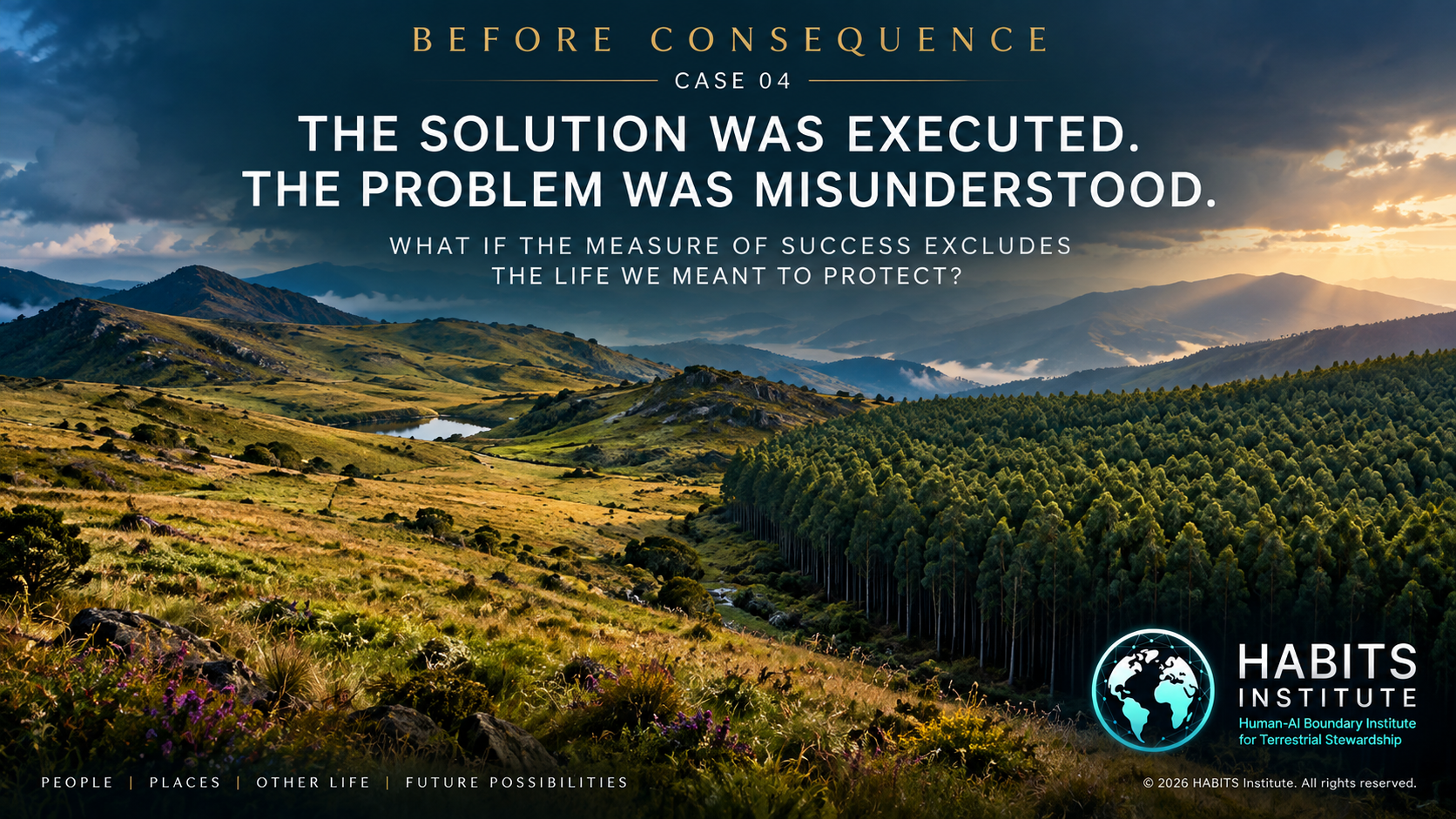
WHAT IF THE MEASURE OF SUCCESS EXCLUDES THE LIFE WE MEANT TO PROTECT?
An ecological restoration case study in problem definition, evidentiary standing and the boundaries of consequential execution.
A landscape is identified as degraded.
A restoration programme is proposed. Its objective is clear: plant trees, increase vegetation cover and repair ecological damage.
Funding is approved. Land is allocated. Species are selected. Planting begins.
The programme reports progress through the measures established at its outset: hectares planted, seedlings established and tree cover increased.
The intervention has been authorised. Its implementation can be measured. Its declared targets may be met.
But a question remains:
Was the landscape correctly understood before the solution was chosen?
And if it was not, what would have prevented an authorised restoration programme from becoming another source of ecological harm?
1. When a grassland is mistaken for a failed forest
The montane grasslands of India’s Western Ghats provide a revealing example.
In parts of this landscape, native grasslands were historically treated as degraded or underused land suitable for tree planting. Plantations of exotic species, including acacias and eucalyptus, transformed areas of the grassland–shola mosaic.
Research on the Shola Sky Islands has documented the loss and modification of high-elevation habitats associated with afforestation and invasive alien plants, showing why increased tree cover cannot, on its own, establish ecological restoration.
The central error was not simply that particular trees were planted in an unsuitable location.
It was that an existing ecosystem was understood through the wrong definition of restoration.
A grassland is not necessarily an incomplete forest. It can be a functioning ecological community with its own species, water relationships, soils and disturbance regimes.
If forest cover is established as the primary measure of improvement, then planting trees may appear successful even while the ecological community being replaced is diminished.
The project can advance towards its target while moving away from the needs of the living system.
This is the first boundary question:
What evidence establishes that the proposed solution addresses the actual condition of the place where it will be executed?
2. The same problem can take different forms
The Western Ghats are not the only example of a gap between planting trees and restoring an ecosystem.
At Captain Cook’s Landing Place near Botany Bay, Australia, researchers documented how historical plantings of Australian native trees that were not locally indigenous contributed to changes in surrounding bushland. Being native to Australia was not, by itself, evidence that a species belonged in that particular ecological community.
In restoration work on western Sydney’s Cumberland Plain Woodland, researchers found that increasing tree cover did not, after years of recovery, establish the full species composition of reference woodland. Additional work was needed to address missing native plants and other ecological conditions.
These are not identical outcomes. One concerns the transformation of natural grasslands, another the consequences of introducing non-local species, and another the limits of tree establishment as a measure of wider ecosystem recovery.
But they expose a shared problem:
A measurable intervention is not the same thing as the ecological outcome it was intended to achieve.
Planting can be counted. Tree cover can be mapped. Funding milestones can be verified.
The recovery of a living ecosystem requires a different evidentiary question: whether its species, relationships, functions and capacity to persist are actually being restored.
3. The decision before consequence
Consider an illustrative restoration programme operating in a landscape that has been classified as degraded.
The programme’s governing conditions require that:
the planting area has been approved;
the selected species appear on an authorised list;
the planting method meets operational standards;
the budget and contractor permissions are valid; and
the required number of trees is planted.
Every condition is satisfied.
A human decision-maker understands the proposal and has legitimate authority to approve it. An automated execution system follows the approved plan. An independent operational gate confirms that the declared requirements have been met.
The gate works.
Yet the governing conditions do not require sufficient evidence that the landscape was naturally forested, that the selected species belong to its ecological community, or that the intervention will preserve the life already present.
The gate cannot establish what its governing boundary has not required it to examine.
This is not an argument against operational controls. They are essential. It is a demonstration of their limit.
A system can correctly enforce an insufficiently defined objective.
4. The missing evidence was not necessarily invisible
There is an important difference between evidence that does not exist and evidence that has not been given standing in a decision.
An environmental report might identify native grassland species, seasonal water relationships or the risk of introduced trees spreading beyond the planting area.
Those observations may be available to the project team.
But if they remain background information while planting targets and operational permissions become mandatory execution conditions, they may have no effective means of changing the decision.
The problem is therefore not always a lack of data.
It may be a failure to establish which evidence must be capable of preventing execution.
Before the first tree is planted, the relevant questions include:
What is the ecological identity and present condition of this landscape? Which species and relationships may be affected? What evidence supports the proposed intervention? What remains unknown? Which consequences could be difficult or impossible to reverse? What observations would require the programme to pause, change or stop?
No system can possess complete knowledge of an ecosystem.
But incomplete knowledge cannot be silently converted into permission simply because the proposed action has a beneficial purpose.
5. What HABITS asks before execution
HABITS—the Human-AI Boundary Institute for Terrestrial Stewardship—begins from the recognition that consequential execution must remain accountable to the conditions of the living Earth.
Its concern is not confined to AI. The originating decision may come from a government, a business, a restoration organisation, a human expert, an autonomous system or a combination of them.
Nor does HABITS assume that an authorised decision is necessarily an admissible execution.
These are distinct questions.
A decision-maker may possess legitimate authority. A plan may satisfy every operational requirement. An execution system may perform exactly as designed.
None of those facts independently establishes that the proposed action is admissible under the conditions of reality it will affect.
In the HABITS architecture, the Universal Admissibility Boundary (UAB) is the external boundary for determining admissibility. It does not originate or execute the proposed action. The originating system retains responsibility for execution and must be unable to proceed with a consequential action that has not received the required admissibility determination.
For the illustrative restoration programme, that means the question is not merely:
Has the planting plan been approved and correctly prepared?
It is also:
Has sufficient evidence established that this particular intervention is admissible for this particular living system, under the conditions that exist now?
Where material uncertainty cannot be sufficiently bounded relative to the potential consequence and the possibility of recovery, an affirmative determination has not been established.
The appropriate response is not to assume that planting must proceed because the project has already been funded or approved.
It is to preserve the unresolved question before it becomes a consequence.
6. The first planting is not the end of the decision
Suppose the initial intervention is supported by sufficient evidence and planting proceeds.
The programme then begins to change the landscape.
Seedlings establish. Water use changes. Species compete. Some native plants recover; others may decline. New observations emerge that were unavailable when the programme began.
The original approval cannot settle every subsequent action.
Before further planting, the consequences of earlier work must return as evidence. The next proposed execution must be assessed against the conditions that now exist—not merely against the assumptions recorded when the programme was launched.
This is particularly important where ecological effects emerge slowly.
A programme may continue meeting annual planting targets while the evidence of its wider consequences remains incomplete. By the time a harmful trajectory is recognised, the opportunity for straightforward correction may have narrowed.
Continuing a restoration programme is itself a consequential decision.
Its admissibility cannot be inherited indefinitely from the decision to begin.
7. The boundary must include the life affected
The lesson is not that humanity should stop planting trees.
Appropriately designed and monitored restoration can support ecological recovery. The lesson is that the intended benefit of an intervention cannot substitute for evidence that the intervention is suitable for the living system concerned.
The same question extends far beyond tree planting.
A water-management scheme can meet its delivery targets while changing downstream habitats. An agricultural intervention can increase yield while degrading the conditions needed to sustain future production. An infrastructure project can meet its engineering specifications while imposing consequences outside the area its assessment considered.
And an AI system can execute each of these plans efficiently without being the source of the original misunderstanding.
Increasing capability makes this boundary more important, not less.
When we can act faster and at greater scale, an error in how we define the problem can become an error reproduced across entire landscapes and systems.
The question is no longer only whether the execution mechanism works.
It is whether the boundary governing execution has adequately accounted for the reality that execution will change.
Before consequence
The trees have not yet been planted.
The plan is authorised. The contractors are ready. The operational checks have passed.
But the landscape has been classified as degraded without sufficient evidence that forest establishment is appropriate for the ecosystem already present.
What should happen next?
Not automatic execution.
Not a declaration that every tree-planting proposal is harmful.
The unresolved ecological conditions must be brought into the admissibility determination. Where the evidence is insufficient, the proposal must remain unresolved or be refused in its present form. The originating system can investigate, revise the intervention and submit a new proposal under the conditions that actually exist.
That is the distinction at the heart of this case:
The successful execution of a solution does not establish that the problem was correctly understood.
And when the consequences will be inherited by other species, other communities and future generations, the adequacy of that understanding cannot be treated as a question to answer only after the work is done.
Reality does not negotiate. It informs.
Research and source notes
The ecological examples below are drawn from published research. They illustrate different ways in which tree planting and ecosystem restoration can diverge. They are not presented as identical outcomes.
1. Western Ghats, India — afforestation of natural grasslands
Research on the Shola Sky Islands examined landscape change using satellite imagery from 1973, 1995 and 2017, supported by field observations. It documented substantial modification of high-elevation habitats associated with afforestation and the spread of invasive alien plants.
This case illustrates why increasing tree cover is not necessarily restoration when the landscape concerned is a naturally occurring grassland ecosystem.
Arasumani, V., et al. (2019). Invasion compounds an ecosystem-wide loss to afforestation in the tropical grasslands of the Shola Sky Islands. Biological Conservation, 230, 141–150.
Study: https://www.sciencedirect.com/science/article/pii/S0006320718312229
2. Botany Bay, Australia — the long-term effects of non-local tree planting
Researchers documented how Australian native tree species planted outside their local ecological range at Captain Cook’s Landing Place were spreading into surrounding bushland.
This case illustrates why a species being native to a country does not, by itself, establish that it is ecologically appropriate for a particular place. The conservation consequences of historical planting decisions may also become apparent many years after the original intervention.
Benson, D., and Eldershaw, G. (2005). Naturalizing non-local native trees at Botany Bay: The long-term impact of historical plantings. Ecological Management & Restoration, 6(3), 163–171.
Study: https://onlinelibrary.wiley.com/doi/10.1111/j.1442-8903.2005.00233.x
3. Cumberland Plain Woodland, Australia — tree establishment is not complete ecosystem recovery
Researchers assessed restoration plantings in western Sydney, comparing sites of different ages with reference woodland. Although the planted sites developed over time, their species composition remained different from that of reference woodland after 11 years. Additional restoration measures were needed.
This example demonstrates the limits of using successful tree establishment as evidence that the wider ecological community has been restored. It is not presented as evidence that the planting itself caused ecological harm.
Nichols, P. W. B., and Morris, E. C. (2024). Planting native trees in degraded grassy woodland does not restore species composition. Ecological Management & Restoration, 25(3), 189–198.
About the HABITS scenario
The restoration programme and pre-execution gate described in Section 3 and in Before consequence are illustrative. They are used to examine what a reality-coupled admissibility determination would need to establish before a consequential intervention proceeds.
The three studies provide ecological examples. They do not assess a historical HABITS implementation or demonstrate that any of those projects operated a formal admissibility gate.
Reality does not negotiate. It informs.
Published by HABITS Institute
Case 04 | Before Consequence
HABITS — Human-AI Boundary Institute for Terrestrial Stewardship