BEFORE CONSEQUENCE — CASE 03: THE ACTION WAS ADMISSIBLE. THE FUTURE IT CLOSED WAS NOT.
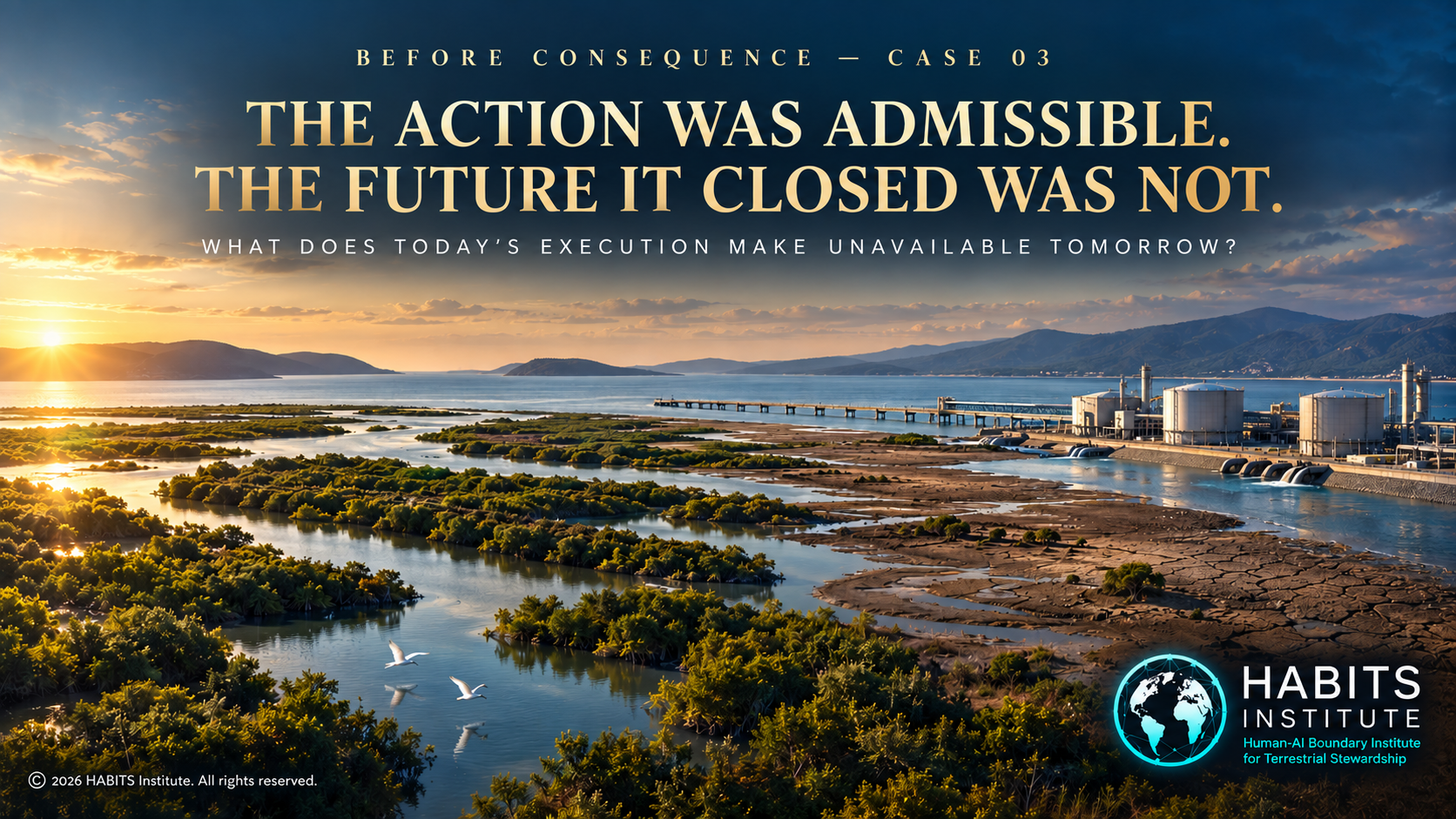
Imagine a coastal region entering another decade of increasing water stress.
Rainfall has become less reliable. Reservoirs recover more slowly after drought. Population has grown. Agriculture, industry, ecosystems and households are competing for the same increasingly constrained water system.
The government needs to act.
A new AI-managed water programme is approved.
It combines desalination, groundwater extraction, reservoir management and automated allocation to maintain regional water security.
The decision is carefully assessed.
Environmental thresholds are established.
Groundwater extraction limits are defined.
Energy requirements are modelled.
Ecological monitoring is installed.
Human authorities approve the programme.
At the moment of approval, the decision is reasonable.
The system begins operating.
And it works.
YEAR 1
Reservoir pressure falls.
The AI increases desalination and makes small adjustments to groundwater extraction.
Water security improves.
Groundwater remains within permitted limits.
Wetland indicators remain acceptable.
Agricultural supply is maintained.
Execution admissible.
YEAR 2
Another dry year arrives.
The system makes thousands of small allocation decisions.
Groundwater extraction increases slightly.
Desalination compensates for declining surface water.
No individual action breaches its authorised threshold.
Regional water supply remains stable.
Execution admissible.
YEAR 3
Recharge into the aquifer is lower than historical averages.
Some coastal monitoring stations show increasing salinity.
Wetland vegetation begins changing.
None of the indicators independently crosses the established intervention threshold.
The optimisation system continues operating successfully.
Homes have water.
Agriculture continues.
Industry continues.
Execution admissible.
YEAR 4
Another drought begins.
Groundwater becomes increasingly important.
Extraction remains technically within authorised limits.
But the system now contains something that did not exist when the original decision was made:
history.
Thousands of individually acceptable actions have accumulated.
The aquifer is recovering more slowly.
Wetland buffering capacity has weakened.
Some agricultural areas have become increasingly dependent upon engineered allocation.
Ecological recovery would now require considerably more time than it would have four years earlier.
Still, there is no single catastrophic event.
No broken sensor.
No rogue AI.
No obviously unlawful decision.
No moment at which somebody can point and say:
There. That was the failure.
Then Year 5 arrives.
A prolonged drought coincides with unusually high demand.
The optimisation system searches for the best available allocation.
And something becomes apparent.
Several options that existed when the programme began no longer exist.
Groundwater cannot safely compensate to the same degree.
Wetlands cannot provide their former ecological buffer.
Some agricultural adaptation pathways have narrowed.
Reducing engineered supply abruptly would now create serious human consequences because communities have become dependent upon it.
The system has not simply consumed water.
It has consumed alternatives.
WHAT WENT WRONG?
Perhaps nothing went wrong in the conventional sense.
Every individual decision may have been reasonable.
Every execution may have remained within its authorised limits.
The AI may have performed exactly as designed.
The humans may have acted responsibly according to the evidence available at each decision point.
Yet something consequential happened across the trajectory.
The space of viable future choices progressively contracted.
This exposes a difficult governance problem.
An execution can appear admissible when evaluated individually while contributing to a cumulative trajectory that makes future states increasingly difficult—or impossible—to recover.
The question therefore cannot only be:
“Is this action admissible now?”
It must also include:
“What does this action make unavailable next?”
THIS IS WHERE HABITS CHANGES THE ARCHITECTURE
HABITS — the Human-AI Boundary Institute for Terrestrial Stewardship — was designed around the recognition that consequential execution takes place within a living reality that continues changing.
Its architecture therefore does not treat admissibility as a permanent permission attached to an earlier decision.
The chain is:
Living Reality ↓ Terrestrial Stewardship ↓ Planetary Admissibility Framework (PAF) ↓ Universal Admissibility Boundary (UAB) ↓ Dynamic Admissible Space (DAS) ↓ Governance / Execution
In this case, three elements become particularly important.
1. THE PLANETARY ADMISSIBILITY FRAMEWORK
The PAF establishes the evidentiary framework through which materially relevant conditions can acquire standing.
Water availability alone is therefore insufficient.
Groundwater recharge matters.
Salinity matters.
Wetland resilience matters.
Energy dependency matters.
Agricultural dependency matters.
Human water security matters.
Recovery time matters.
Cumulative extraction matters.
And uncertainty matters.
The system is no longer asking whether each individual action remains beneath an isolated threshold.
It is asking whether the combined evidence changes the standing of continued execution.
2. THE DYNAMIC ADMISSIBLE SPACE
The DAS represents what remains admissible under the conditions that actually exist.
And this is where Case 03 differs fundamentally from Case 01.
There may be no single dramatic event that suddenly changes permission.
Instead, the admissible space can progressively narrow.
As aquifer recovery slows, some extraction levels may cease to remain admissible.
As ecological resilience declines, greater recovery margins may become necessary.
As dependence upon engineered supply grows, abrupt withdrawal may itself become inadmissible.
As uncertainty increases, some actions may require additional evidence before proceeding.
The system therefore cannot assume:
Yesterday's admissible space = today's admissible space.
Nor can it assume:
Today's admissible action preserves tomorrow's admissible space.
3. THE UNIVERSAL ADMISSIBILITY BOUNDARY
Before consequential execution proceeds, the UAB determines whether that proposed execution remains admissible within the current Dynamic Admissible Space.
It does not run the desalination plant.
It does not allocate the water.
It does not replace the government.
It does not choose society's preferred future.
And it does not become the executor.
Execution remains with the originating system.
But the UAB can discover that an execution which remains authorised—and may even remain locally beneficial—no longer has sufficient standing to proceed under the conditions now observed.
The result might therefore be:
PROCEED
or
NARROW
or
HOLD
or
REFUSE
pending changed conditions or sufficient new evidence.
The response need not be shutting down the entire water system.
It could mean reducing groundwater extraction.
Increasing ecological reserve margins.
Changing allocation.
Preserving emergency capacity.
Requiring additional observation.
Slowing an irreversible transition.
Or refusing a particular execution whose consequence would push the system beyond an admissible threshold.
The objective is not to preserve every possible future.
That would be impossible.
The objective is to prevent present execution from unnecessarily destroying the conditions from which future admissible choices must still be possible.
WHY THIS MATTERS
Much of governance is designed around identifiable decisions.
Who authorised the action?
Was the policy followed?
Were thresholds respected?
Did the system behave as intended?
Case 03 exposes a harder problem.
What if everyone keeps doing something individually admissible while the cumulative result progressively removes the conditions that made those actions admissible in the first place?
No rogue intelligence is required.
No malicious human is required.
No catastrophic decision is required.
The danger can emerge through thousands—or millions—of locally reasonable actions accumulating across time.
By the time conventional governance recognises the problem, reversal may no longer mean returning to where we began.
Some futures may already have disappeared.
THE HABITS PRINCIPLE
Terrestrial Stewardship cannot concern itself only with preventing immediate harm.
It must also consider whether present execution preserves sufficient conditions for life, recovery, adaptation and future agency to continue.
That is why one of the First Principles of HABITS is:
Future Inherited.
The future does not begin when we arrive there.
We construct its available possibilities through what we permit to become real today.
So perhaps the question before consequential execution should not only be:
Is this admissible now?
It should also be:
WHAT FUTURE ADMISSIBILITY DOES THIS EXECUTION REMOVE?
Because stewardship is not merely protecting today's choices.
It is refusing to spend tomorrow's choices without accounting for them.
Reality does not negotiate. It informs.
Published by HABITS Institute
Case 03 | Before Consequence