BEFORE CONSEQUENCE CASE 09: THE ACTION WAS LEGAL HERE. THE CONSEQUENCE CROSSED THE BORDER.
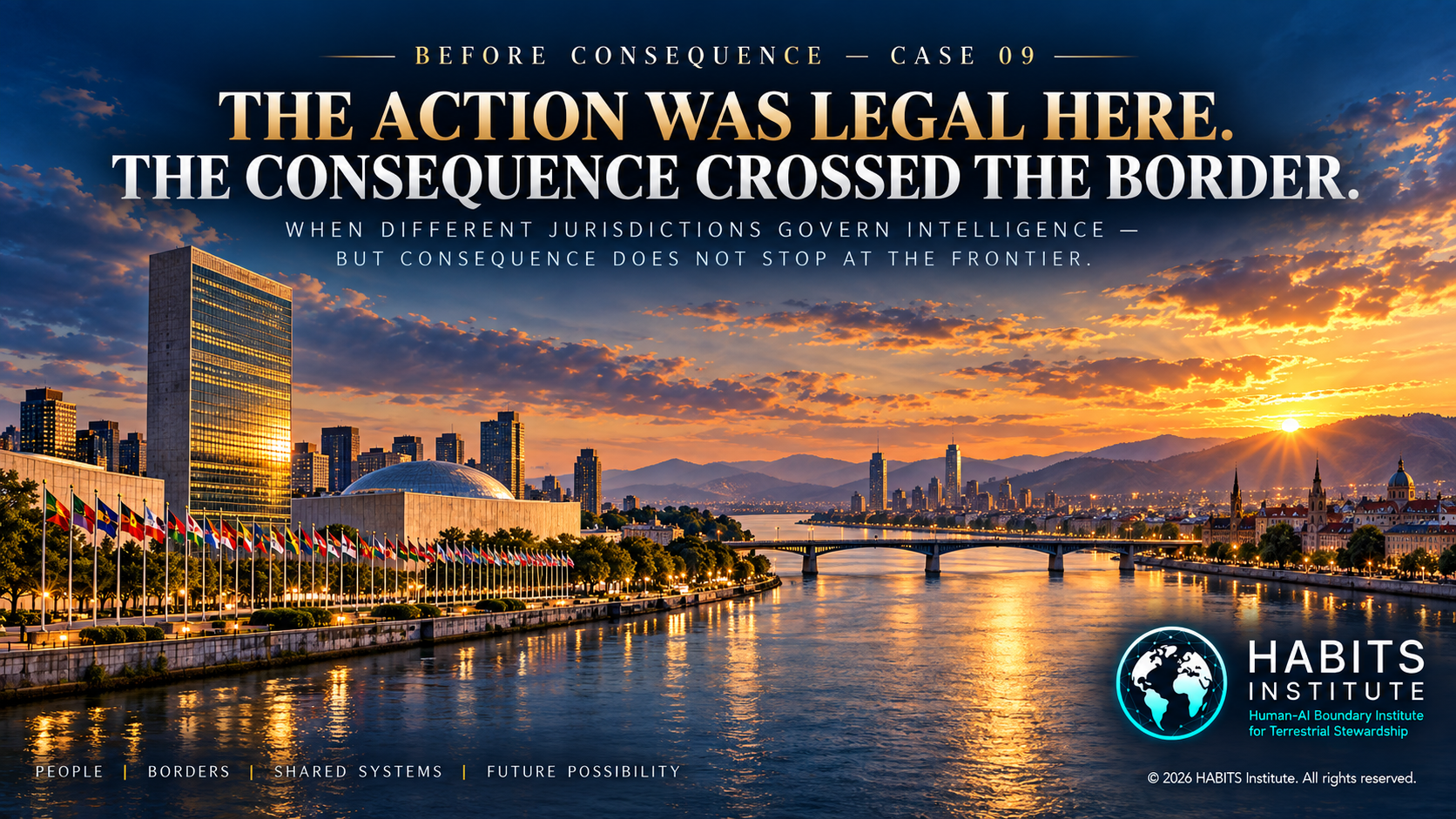
When different jurisdictions govern intelligence — but consequence does not stop at the frontier.
THE SITUATION
Two neighbouring countries regulate advanced artificial intelligence differently.
Country A permits a particular high-consequence AI-directed industrial process.
Country B does not.
Both governments possess legitimate sovereignty.
Both have their own laws, standards and regulatory institutions.
The system is deployed legally in Country A.
Its operators comply with national requirements.
Its permits are valid.
Its AI governance obligations have been satisfied.
The execution begins.
But its consequences do not remain inside Country A.
Atmospheric pollution crosses the border.
A shared river carries contaminants downstream.
Migratory species lose habitat.
Energy and infrastructure effects propagate into neighbouring systems.
Country B did not authorise the execution.
But Country B receives part of the consequence.
The action was legal here. The consequence crossed the border.
THE ASSUMPTION
National sovereignty is fundamental to international governance.
Countries possess legitimate authority to create laws within their jurisdictions.
But physical systems do not necessarily respect those jurisdictional boundaries.
Atmospheres move.
Rivers flow.
Oceans circulate.
Species migrate.
Supply chains span continents.
Digital infrastructure crosses borders.
And climate effects accumulate globally.
A nationally authorised action may therefore produce consequences beyond the territory in which the authority was exercised.
The problem is not necessarily that Country A acted unlawfully.
The problem is that jurisdictional authority and consequential reach are not always the same thing.
WHY THIS MATTERS FOR AI
Advanced AI may accelerate this problem.
A powerful system could evaluate, coordinate and execute industrial, infrastructural or environmental decisions at speeds and scales that extend beyond traditional regulatory boundaries.
One jurisdiction may permit an action.
Another may prohibit it.
A third may not yet regulate it at all.
The UN is already warning about fragmented AI-governance systems that create loopholes or leave countries behind. United Nations
But regulatory fragmentation creates another difficulty.
An actor may exploit the differences between jurisdictions while the consequence itself remains physically coupled.
THE HABITS RESPONSE
Within HABITS, legitimate political authority would remain distributed.
Countries would continue to govern.
International institutions would continue to coordinate.
Local laws, rights and democratic processes would remain important.
But no originating system could establish admissibility merely by demonstrating that its proposed execution was lawful in the jurisdiction from which it originated.
PAF — What consequence field is actually affected?
The evidentiary assessment would need to include materially relevant effects outside the originating jurisdiction where the evidence supports their relevance.
A political border could not automatically exclude downstream ecosystems, communities or shared infrastructure from the evidentiary field.
DAS — What shared possibilities are altered?
Dynamic Admissible Space would express how the proposed execution changes the conditions available not only to the originating actor, but to other actors participating within the same connected system.
One nation's action may reduce another nation's recovery margin or future alternatives.
UAB — Does this execution retain standing within the shared conditions?
The Universal Admissibility Boundary would evaluate the proposal against the materially relevant conditions of the connected Reality.
It would not decide the politics between the countries.
It would not allocate sovereignty.
It would determine whether the proposed execution possesses admissible standing.
Governance would still be required to resolve questions of rights, compensation, allocation, treaties and political responsibility.
NON-BYPASSABILITY
This leads to a difficult question.
What happens when an actor deliberately chooses the jurisdiction with the weakest rules?
Today this is often discussed as regulatory arbitrage.
For advanced AI, the stakes could become much greater.
If consequential systems can simply relocate execution to whichever jurisdiction permits it, then international governance may contain a structural loophole.
Within the mature HABITS architecture, sufficiently consequential execution would encounter the admissibility requirement regardless of whether the originating actor possessed political, institutional or technical authority.
That is what non-bypassability is intended to address.
Not one global government.
Not one global AI.
But one constitutional requirement:
consequence must encounter Reality before execution.
THE BORDER REALITY DOES NOT RECOGNISE
Political borders are real and important human institutions.
They determine law, responsibility and democratic authority.
But they do not divide the atmosphere.
They do not divide a river at the molecular level.
They do not divide climate systems.
And they do not divide the ecological consequences of actions merely because the action originated elsewhere.
This creates a constitutional problem for a world of increasingly autonomous systems.
If intelligence can operate globally while admissibility remains purely local, the boundary may exist in law but disappear in consequence.
THE QUESTION BEFORE CONSEQUENCE
Country A authorised the action.
Country B did not.
The originating system complied with the rules governing it.
Yet the consequence entered both.
The deeper question is:
When political authority stops at the border but consequence does not, what determines whether the execution may proceed?
International law can establish responsibilities between states.
Governance can establish legitimate authority.
But shared consequence requires accountability to the conditions that all jurisdictions ultimately inhabit.
Borders divide authority. They do not divide Reality.
Reality does not negotiate.
It informs.
— HABITS Institute
Human–AI Boundary Institute for Terrestrial Stewardship
Published by HABITS Institute
Case 09 | Before Consequence