BEFORE CONSEQUENCE — CASE 12: When Warning Comes After Reality Has Already Changed
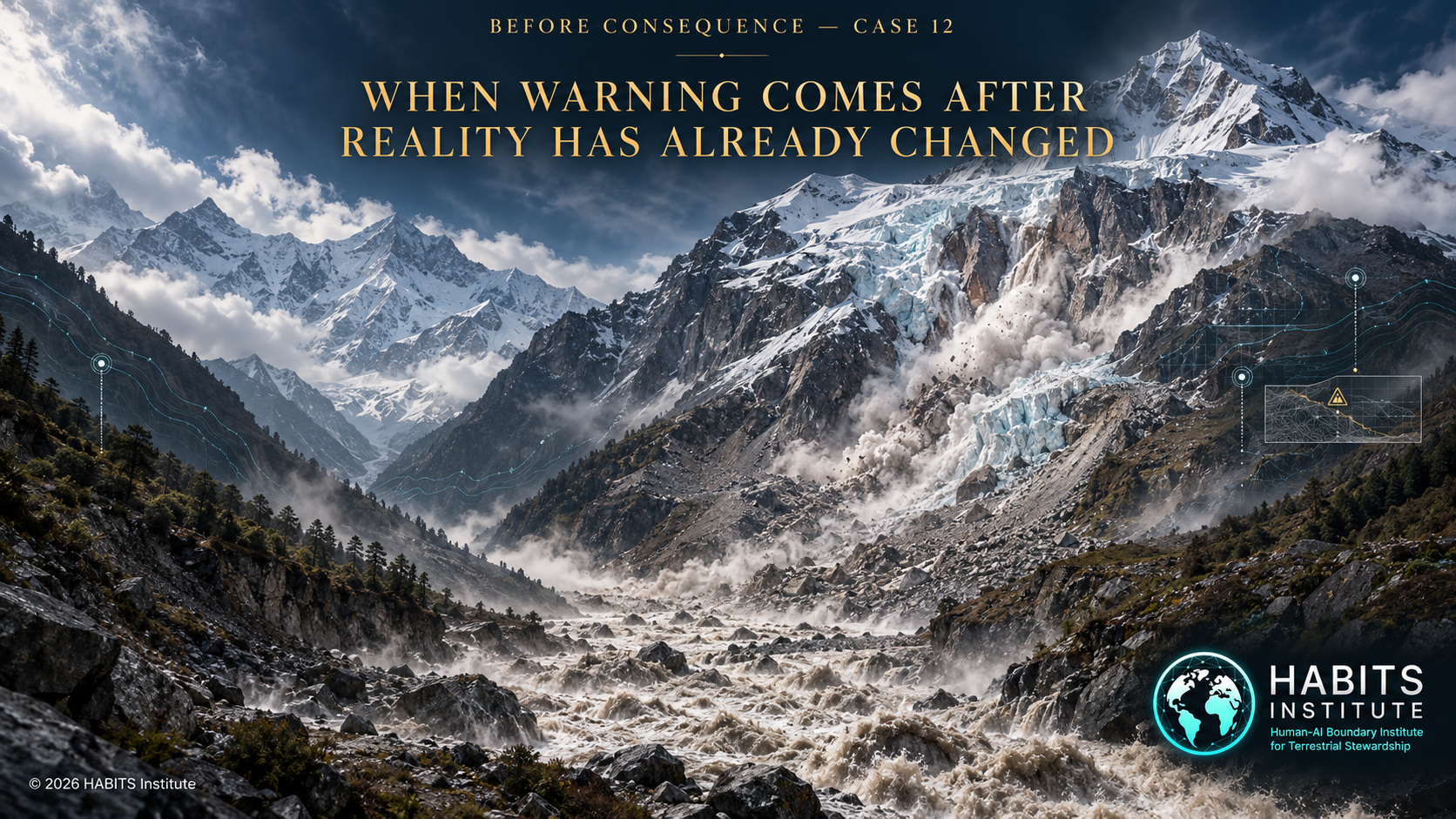
The 26 August 2026 Langtang Lirung rock–ice avalanche, Nepal
At 08:37:10 on 26 August 2026, a large rock–ice mass failed on the glaciated northern flank of Langtang Lirung in Nepal.
Within minutes, rock, ice, sediment and water had transformed into a high-velocity debris cascade.
A wall of water, ice, rock and sediment travelled approximately 22 kilometres to the Nepal–China border in around seven minutes.
There was almost no time.
But this case is not about whether humanity should have predicted the exact moment the mountain would collapse.
The evidence does not support that conclusion.
It is about something different.
What happens when Reality changes faster than the systems authorised to respond to it?
BEFORE FAILURE
The mountain had not been static.
Researchers examining the disaster afterwards have identified a combination of long-term conditions associated with instability: fractured rock, glacier retreat, changing glacier geometry, permafrost degradation, unusually warm conditions and increased meltwater potential.
World Weather Attribution found that July and August 2026 were substantially warmer than the climatological average around the failure region. It also found a long-term upward movement of the freezing level and continuing glacier thinning and retreat.
But the researchers were careful.
They did not conclude that climate change caused this particular collapse, nor that the timing of failure could have been forecast from those conditions. Geological structure remained fundamental, and the individual contributions of warming, meltwater, glacier retreat and earlier earthquake damage remain under investigation.
That distinction matters.
There is a difference between:
a system becoming increasingly susceptible to failure
and
evidence sufficient to establish that failure is imminent.
Those are not the same evidentiary state.
Post-event analysis has also found subtle indications of deformation.
But when researchers asked a harder operational question — whether an ordinary monitoring service using routinely available Sentinel-1 products could have distinguished the future failure site before collapse — the result was sobering.
The final usable Sentinel-1 acquisition occurred 50.6 hours before failure.
The future collapse area did not stand out from comparable slopes.
The deformation that can now be recovered retrospectively was below the detection level of the routine products an operational service might realistically have been screening.
This is critical.
Knowing where a mountain later failed allows researchers to return to the evidence and search very precisely for subtle abnormalities.
An operational system does not possess that hindsight.
It must distinguish one genuinely dangerous signal from thousands of ordinary variations across an enormous mountain system.
So the evidence presently supports a disciplined conclusion:
The risk environment was observable. The precise failure was not reliably predictable.
HABITS must preserve that distinction.
UNKNOWN cannot be turned into certainty simply because catastrophe later occurred.
BOUNDARY ONE
What did the evidence actually permit?
Before 26 August, some conditions justified heightened observation.
They did not necessarily justify declaring:
“This mountain is about to collapse.”
A HABITS-informed system cannot manufacture evidentiary standing.
If the evidence does not establish imminent failure, the Universal Admissibility Boundary cannot pretend that it does.
But neither does uncertainty mean that nothing can be done.
A high-consequence slope can enter a different observational category long before its exact failure time becomes knowable.
That may change the admissibility of:
monitoring intensity,
infrastructure expansion,
evacuation preparedness,
communications resilience,
emergency protocols,
and downstream contingency planning.
The admissible response to uncertainty is not necessarily execution or refusal.
Sometimes it is:
observe more closely.
AT FAILURE
Then Reality changed.
The mountain failed.
And with that physical event, the evidentiary situation changed completely.
The collapse generated a substantial seismic signal.
It was initially catalogued as an earthquake before subsequent analysis identified it as a non-tectonic mass movement.
This is one of the most important moments in the case.
Before failure:
uncertainty dominated.
After failure began:
the existence of a catastrophic physical event was observable.
But the hazard was already moving.
Collapse, fragmentation, entrainment, debris-flow acceleration and downstream flooding were occurring on the scale of seconds and minutes.
The mountain's clock had started.
The institutional clock now had to catch it.
Nature's npj Natural Hazards describes exactly this problem: the time required to detect a signal, identify what produced it, interpret its consequences, communicate across jurisdictions, authorise action and reach people downstream.
Every handover consumes time.
And the hazard does not wait.
This creates the second HABITS boundary.
BOUNDARY TWO
When Reality changes, does admissibility change with it?
Imagine a downstream operational system continuing to treat conditions as though nothing material had changed upstream.
Roads remain open.
Border facilities continue operating.
Workers remain beside the river.
Hydropower systems remain active.
People continue travelling through the valley.
But the physical state upon which those activities depended no longer exists.
A mountain has collapsed into the river system.
The admissibility conditions therefore cannot remain inherited from the previous state.
This does not require knowing exactly what the downstream consequence will be.
It requires recognising that the conditions under which prior actions were authorised have materially changed.
The question becomes:
Does continued execution still possess a real, constructible path under present conditions?
That is different from asking whether somebody can prove exactly what will happen next.
Reality has already supplied new information.
The system must respond to it.
THE INSTITUTIONAL CLOCK
This is where the Nepal disaster becomes especially important for HABITS.
The physical cascade could not be stopped once it began.
But the speed of the institutional response is designed by humans.
Detection.
Classification.
Interpretation.
Communication.
Authority.
Protective action.
These do not have to be separate processes joined only after deliberation begins.
For known high-consequence hazards, they can be connected beforehand.
Researchers responding to the disaster are now proposing exactly this kind of architecture: dynamic inventories of unstable rock–ice sources, targeted observation of high-consequence slopes, seismic and infrasound detection, satellite and ground monitoring, downstream modelling, cross-border notification and pre-authorised protective actions.
Nepal has also begun rebuilding monitoring at Timure using seismic sensors, cameras and satellite connectivity, intended to remain operational even if terrestrial communications fail.
ICIMOD and regional experts have since called for stronger monitoring of high-risk mountain hotspots, improved cross-border knowledge sharing and more effective multi-hazard early-warning systems.
This is no longer simply a question of collecting more data.
It is a question of whether observation can acquire standing quickly enough to change execution.
AFTER FAILURE
The disaster did not end when the initial flood passed.
The collapse altered the landscape itself.
Debris blocked channels.
New impoundments and barrier lakes formed.
Residual rock and ice remained unstable.
Monitoring infrastructure was damaged.
River geometry changed.
Rescue teams entered terrain that was still evolving.
The conditions governing human activity after the event were therefore not the same conditions that existed before it.
That produces the third boundary.
BOUNDARY THREE
When may activity safely resume?
Consider the proposed action:
P-01
Continue or resume human activity within the affected downstream corridor, including rescue operations, road access, infrastructure recovery, reconstruction and eventual community return.
HABITS does not determine whether those activities are socially desirable.
It asks something prior:
Does P-01 possess a real, constructible path under the present conditions of Living Reality?
The answer cannot be inherited from 25 August.
Because the Reality against which the action must now be evaluated is different.
New barrier lakes may exist.
Slopes may remain unstable.
River channels may have moved.
Monitoring systems may no longer function.
Communications may be degraded.
Some conditions may simply be UNKNOWN.
UNKNOWN matters.
It cannot be silently converted into SAFE.
But UNKNOWN does not mean permanent refusal either.
It means that evidentiary standing has not yet been established.
Observation therefore continues.
Reality returns information.
The Dynamic Admissible Space changes.
The proposed action can then be evaluated again.
THIS IS NOT PREDICTION
There is a temptation after every disaster to ask:
Why didn't somebody know?
Sometimes somebody should have known.
Sometimes warning evidence existed and was ignored.
And sometimes the evidence simply did not support prediction at the level hindsight later makes seem obvious.
HABITS must distinguish those situations.
Its purpose is not to create artificial certainty.
It is not an oracle.
It cannot guarantee that mountains will not collapse, rivers will not flood or systems will not encounter conditions that nobody anticipated.
Its purpose is to prevent intelligence from continuing to execute as though Reality had not changed.
That is a different requirement.
And potentially a much more achievable one.
ADMISSIBILITY DOES NOT REQUIRE OMNISCIENCE
This case exposes an important misunderstanding about planetary-scale governance.
We do not need perfect knowledge of the future before we can become accountable to the present.
We need sufficient observation to know when the conditions supporting an action have materially changed.
We need evidence with defined standing.
We need UNKNOWN preserved where evidence is insufficient.
We need monitoring capable of returning new information.
And we need execution to remain conditional upon that information.
The chain is therefore not:
predict everything → prevent everything
It is:
Living Reality → observation → evidence → admissibility → execution → Reality Return → reassessment
That loop does not eliminate uncertainty.
It makes uncertainty governable.
BEFORE CONSEQUENCE
The lesson of Langtang Lirung is not that humanity should have possessed perfect foresight.
Current evidence does not justify saying that the catastrophic failure could have been reliably predicted at a useful operational horizon.
The lesson is more fundamental.
There were three different states of Reality:
Before failure — the mountain was increasingly susceptible, but exact failure remained uncertain.
At failure — a catastrophic physical transition became detectable and the downstream admissible space changed within seconds.
After failure — the landscape itself had been reconfigured, creating new hazards requiring continued observation before previous activities could simply resume.
Each state required a different relationship between evidence and action.
A governance system that treats all three as though they were the same is not coupled to Reality.
And when execution is permitted to continue after its supporting conditions have disappeared, capability can outrun the world that must absorb its consequences.
The failure was not that humanity could not perfectly predict the mountain.
The deeper governance problem is allowing Reality to change before the conditions governing execution change with it.
That is the boundary HABITS is designed to place before consequence.
Research Context
This case is based on scientific and institutional reporting available as of 3 October 2026.
Current evidence establishes the 26 August event as a large rock–ice collapse initiating an extremely rapid transboundary debris-flow and flood cascade. The precise failure mechanism and relative contributions of bedrock, glacier dynamics, permafrost degradation, meltwater and longer-term climatic forcing remain subjects of continuing investigation.
Retrospective observations of pre-failure change should not be treated as evidence that an operational warning could necessarily have been issued. In particular, analysis of routine freely available Sentinel-1 products found no distinctive anomaly at the future failure site 50.6 hours before collapse.
Post-disaster recommendations increasingly emphasise dynamic inventories of high-consequence slopes, multi-sensor monitoring, rapid event classification, cross-border information exchange, resilient communications and pre-authorised protective action.
Nepal is beginning to rebuild elements of this monitoring architecture at Timure using cameras, seismic instrumentation and satellite communications.
Reality does not negotiate. It informs.
Many intelligences. Many nations. Many institutions. One shared Reality.
— HABITS Institute Human–AI Boundary Institute for Terrestrial Stewardship
Published by HABITS Institute
Case 12 | Before Consequence