BEFORE CONSEQUENCE — CASE 11: THE CLOUD MOVED OFFSHORE. THE CONSEQUENCE DID NOT.
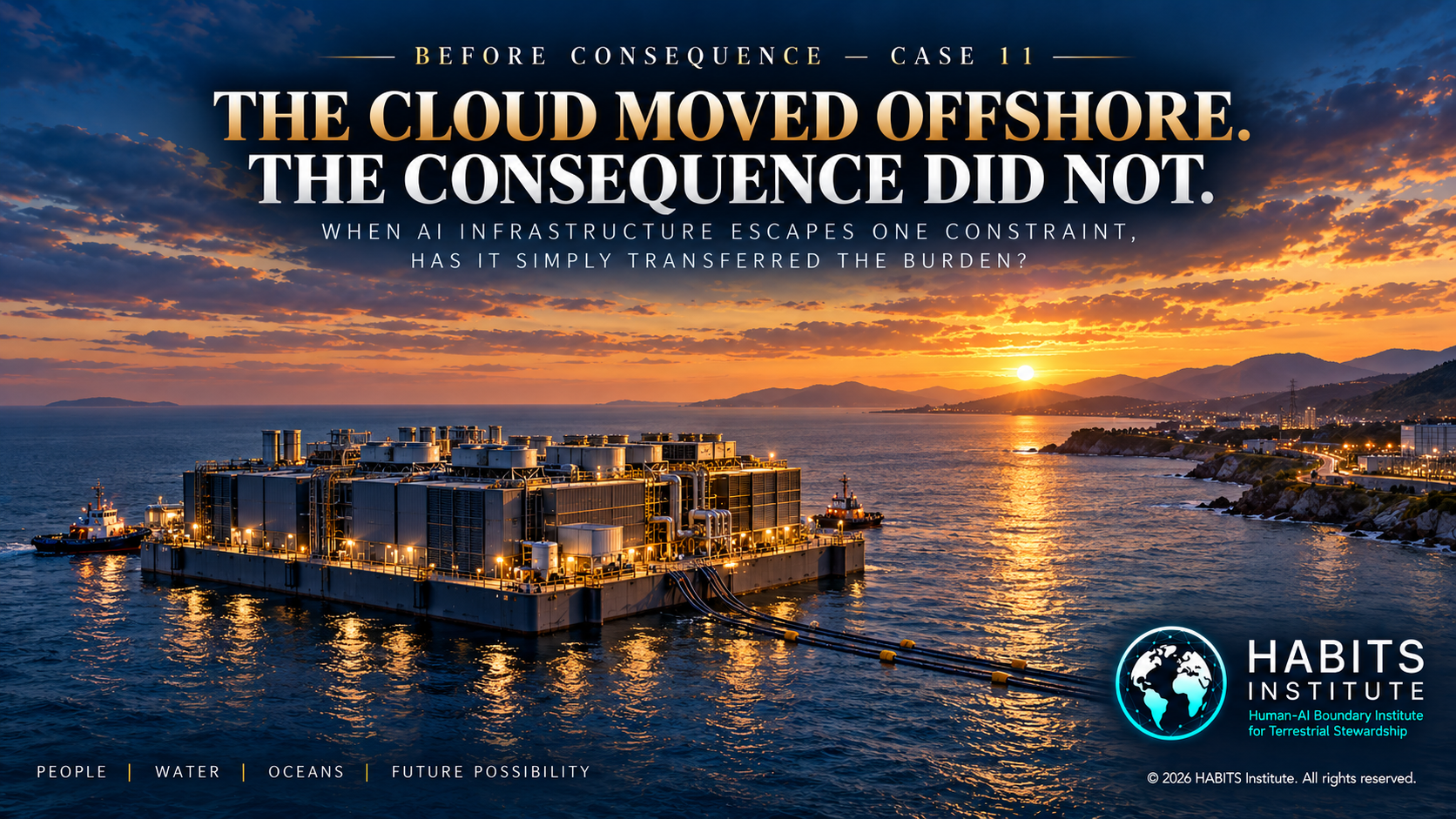
When AI infrastructure escapes one constraint, what determines whether it has simply transferred the burden into another living system?
THE SITUATION
Artificial intelligence is becoming physical infrastructure at extraordinary speed.
Behind every model, agent and digital service sit data centres requiring electricity, cooling, water, land, transmission capacity and supporting infrastructure.
The International Energy Agency now projects global data-centre electricity consumption to rise from about 485 TWh in 2025 to around 950 TWh by 2030, with electricity use by AI-focused data centres growing substantially faster than the sector overall. IEA
Governments are beginning to respond.
On 21 September 2026, Texas halted state-issued permits sought by data centres while electricity-grid and water impacts are audited.
A day later, Victoria published its Sustainable Data Centre Action Plan, explicitly bringing planning, water, environment and energy into the development framework. Jobs, Skills and Regions
The European Commission has simultaneously introduced a common rating scheme intended to make data-centre energy and water performance more transparent and begun consultation on minimum performance standards. Energy
Different jurisdictions.
Different regulatory systems.
The same physical question is beginning to surface:
How much more computational infrastructure can a place actually absorb?
THEN THE CLOUD MOVES TO SEA
Now another possibility is emerging.
Samsung Heavy Industries, Capital Clean Energy Carriers and Lloyd’s Register are developing a floating AI data-centre concept.
Rather than constructing another large facility on land, the infrastructure would be built using offshore shipbuilding techniques, incorporate onboard power generation and use seawater for cooling. The developers present the concept partly as a response to growing constraints around land, power and cooling for conventional data centres. Capital Clean Energy Carriers
At first glance, the logic is compelling.
Less pressure on scarce urban land.
Potentially less demand for freshwater cooling.
Reduced dependence on congested terrestrial infrastructure.
Mobility.
Access to an enormous body of cooling water.
A problem appears to have found a solution.
But HABITS asks another question:
Where did the consequence go?
MOVING A CONSTRAINT IS NOT THE SAME AS REMOVING IT
The heat generated by computation does not disappear because the servers move offshore.
Neither does the requirement for energy.
Nor does infrastructure cease to interact with Living Reality because that Reality is now marine rather than terrestrial.
This does not mean that floating data centres are environmentally inadmissible.
We do not yet have the evidence to make that determination.
And that distinction matters.
The publicly available Samsung project material confirms seawater cooling, but does not provide enough detail to establish the eventual intake design, discharge temperatures, circulation volumes, antifouling methods, precise power configuration or site-specific marine effects.
Those remain questions.
HABITS would preserve them as questions.
UNKNOWN is not evidence of harm.
But neither is it evidence of absence.
THE MARINE EVIDENCE
Large seawater cooling systems are not environmentally neutral by definition.
Depending upon their design, seawater intakes can draw aquatic organisms towards screens or through cooling systems. The established terms are impingement for organisms trapped against intake structures and entrainment for smaller organisms, including eggs and larvae, carried into cooling-water flows. US EPA
Thermal discharge can also matter.
A 2024 systematic review of marine cooling discharges found that altered water temperatures can affect benthic abundance, diversity, dissolved oxygen, community structure and other ecological conditions, while emphasising that effects depend upon local conditions and design. Frontiers
None of this establishes that Samsung's proposed system will produce those effects.
It establishes something narrower and more important:
the relevant marine conditions must enter the evidentiary field before absence of consequence is assumed.
THIS IS WHERE PAF ENTERS
The Planetary Admissibility Framework would not ask whether floating data centres are generally “green”.
Nor would it begin with the developer's preferred description of the technology.
It would examine the specific proposed execution.
For an onshore centre, relevant evidence might include grid capacity, generation mix, water availability, transmission constraints, cumulative regional demand, local ecological burden and existing infrastructure commitments.
For an offshore facility, the evidentiary field changes.
PAF would need to establish the marine baseline; cooling-water intake and discharge architecture; thermal dispersion; seasonal ocean conditions; sensitive species and habitats; biofouling controls; water chemistry; energy source and associated emissions; subsea cables and moorings; noise and vessel activity; accident pathways; and the cumulative effect if one floating centre becomes ten.
The question would not be:
Can this technology work?
It would be:
What does the evidence presently support about this technology operating here, at this scale, under these conditions?
DYNAMIC ADMISSIBLE SPACE
Then comes Dynamic Admissible Space.
DAS changes the question again.
Suppose a coastal region can accommodate one floating data centre without materially reducing ecological resilience.
Could it accommodate five?
Twenty?
Could warmer future seawater reduce cooling efficiency?
Could increasing marine heat stress narrow the ecological margin within which thermal discharge remains tolerable?
Could offshore wind, grid capacity or cleaner onboard generation expand that space later?
Could a different cooling system reduce the burden enough to make a previously inadmissible location viable?
DAS does not say:
sea good, land bad.
Or:
data centre good, data centre bad.
It represents the changing space of consequential possibility.
A proposal may remain unchanged while the conditions around it change.
THE CUMULATIVE PROBLEM
This is already becoming visible on land.
Texas says more than 470 GW of data-centre projects are seeking grid connection in the state—many times the state's current peak electricity demand. Reuters
Each developer can assess its own project.
Each project may appear manageable in isolation.
But shared infrastructure does not experience projects in isolation.
The grid experiences their combined load.
A watershed experiences their combined demand.
An airshed experiences combined emissions.
And an ocean would experience the combined consequences of whatever offshore infrastructure is ultimately placed within it.
This is one of HABITS' central constitutional distinctions:
Authority may be distributed. Consequence remains coupled.
THE UAB QUESTION
Once the evidence has been qualified and the current DAS represented, the Universal Admissibility Boundary asks a highly specific question:
Does this proposed execution retain standing now?
Not:
Are data centres admissible?
But:
Does this particular facility, at this location, at this scale, using this power source and this cooling system, retain standing under present conditions?
The outcome need not be binary.
It could be ADMISSIBLE.
It could be CONDITIONALLY ADMISSIBLE.
It could require HOLD while materially relevant evidence is obtained.
It could be INADMISSIBLE under present conditions.
Or changing conditions could require REASSESSMENT.
And conditional standing could matter enormously.
A project might retain standing only at a reduced scale.
Only with a particular cooling configuration.
Only outside a sensitive ecological area.
Only if additional energy capacity is provided.
Only if thermal discharge remains within evidence-supported conditions.
Only if marine monitoring continues.
Only while cumulative regional burden remains below a defined evidentiary threshold.
These would not be arbitrary conditions imposed because HABITS dislikes the project.
They would have to be earned by evidence.
AND THEN REALITY GETS TO ANSWER
The most important part comes after construction.
Traditional approval often asks:
Did the project satisfy the conditions under which we allowed it?
HABITS asks something harder:
Do the conditions that made it admissible still exist?
Sensors may show that predicted thermal dispersion was correct.
Marine life may remain unaffected within observation limits.
Cooling efficiency may exceed expectations.
Standing could remain intact.
But Reality might also contradict the model.
A thermal plume could behave differently.
A vulnerable species could appear.
Cumulative development could increase.
Ocean temperatures could change.
A cleaner power source could become available.
An assumption could prove wrong.
That consequence becomes new evidence.
Standing can therefore strengthen, weaken, expire or require reopening.
Prior approval cannot become permanent permission simply because the infrastructure is already there.
THIS IS NOT AN ARGUMENT AGAINST AI INFRASTRUCTURE
Civilisation will need computation.
Data centres support healthcare, communications, transport, research, commerce and increasingly the systems through which societies function.
Victoria explicitly describes them as essential 21st-century infrastructure. Jobs, Skills and Regions
The EU is simultaneously pursuing greater data-centre capacity and stronger sustainability requirements. Energy
That is precisely why the question matters.
HABITS is not asking civilisation to stop building.
It asks us to stop confusing technical possibility, regulatory approval and economic demand with physical admissibility.
Innovation can solve constraints.
It can also relocate them.
Sometimes relocation genuinely reduces consequence.
Sometimes it merely changes who—or what—receives it.
THE QUESTION BEFORE CONSEQUENCE
A terrestrial data centre reaches the limits of land, freshwater or electricity.
Engineering responds:
Move it offshore.
That may be an excellent solution.
But before we call the problem solved, another question has to survive:
What changed in Living Reality—and what merely changed location?
If the terrestrial burden falls while marine consequence remains negligible, the represented admissible space may genuinely expand.
If the burden has simply moved from a strained electricity grid or freshwater system into a marine ecosystem, then relocation is not yet evidence of resolution.
That is where HABITS would place the boundary.
Not against innovation.
Between innovation and assumption.
Between:
“We found somewhere else to put it.”
and:
“The evidence establishes that it can stand there.”
The cloud may be digital.
Its consequences are not.
And moving consequence out of sight does not move it outside Reality.
Reality does not negotiate. It informs.
— HABITS Institute Human–AI Boundary Institute for Terrestrial Stewardship
Published by HABITS Institute
Case 11 | Before Consequence
Research context
The Samsung Heavy Industries floating data-centre project remains a developing concept rather than a demonstrated large-scale marine deployment. Its partners describe seawater cooling and onboard power generation as design features intended to address constraints affecting land-based facilities. Capital Clean Energy Carriers
Texas' September 2026 permit pause, Victoria's Sustainable Data Centre Action Plan and the European Commission's new rating and proposed minimum-performance regime demonstrate that electricity, water, infrastructure and environmental impacts are already becoming active governance questions around AI infrastructure. Texas Government
Scientific literature on large marine cooling systems establishes potential mechanisms including thermal alteration, impingement and entrainment, but does not establish that those effects will occur in the Samsung design. Site, cooling architecture, flow, temperature, ecology and mitigation determine actual consequence. Frontiers
Case 11 is therefore not a determination about Samsung or floating data centres. It is a demonstration of what evidence a Reality-coupled admissibility architecture would require before technological displacement is treated as environmental resolution.