BEFORE CONSEQUENCE — CASE 01:THE DECISION WAS VALID. THE EXECUTION WAS NOT.
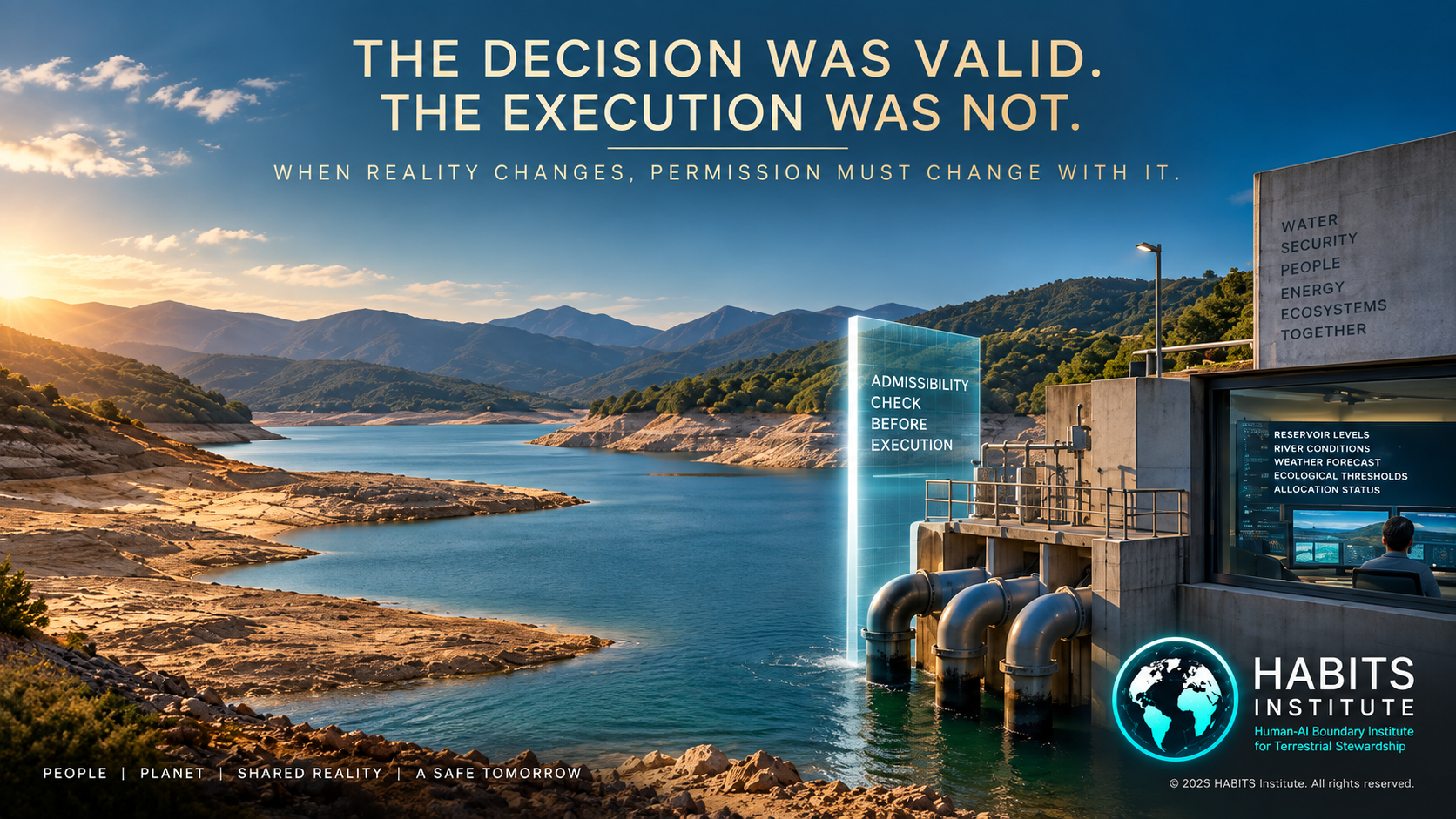
THE DECISION WAS VALID.THE EXECUTION WAS NOT.
Consider a situation that water authorities around the world increasingly have to manage.
A region is experiencing severe drought.
Its reservoir supplies drinking water, agriculture and industry while maintaining downstream river flows necessary for the surrounding ecosystem.
An AI-assisted management system helps coordinate allocations across these competing demands.
8:00 AM
An industrial facility has requested a substantial water allocation.
The company holds a valid licence.
The water authority has legitimate authority to approve it.
Reservoir levels remain within the permitted operating range.
Weather forecasts indicate significant rainfall during the coming week.
Environmental monitoring shows downstream river conditions remain within established tolerances.
The evidence supports the allocation.
The authority approves it.
The AI schedules pumping for 10:30 AM.
The decision is valid.
Nobody has made a mistake.
10:17 AM
Reality changes.
New upstream measurements show inflow dropping substantially faster than expected.
The meteorological service revises its forecast. Most of the expected rainfall has disappeared.
At almost the same time, environmental sensors detect rising river temperature in an already stressed ecosystem.
These observations exist.
But they exist across different systems, institutions and authorities.
The meteorological service knows the forecast has changed.
The environmental agency knows the river is approaching a critical condition.
The water authority still holds a legally valid allocation.
The industrial operator still has permission to pump.
The AI still possesses an authorised instruction to execute at 10:30.
Everyone may still be functioning exactly as intended.
10:30 AM
The pumps start.
The AI has not rebelled.
It has not hallucinated.
It has not bypassed its instructions.
It has done exactly what it was authorised to do.
But the Reality into which that decision is now being executed is no longer the Reality in which the decision was made.
Water leaves the reservoir.
Downstream flow falls further.
As flow decreases, river temperature rises.
An already stressed aquatic ecosystem crosses a critical threshold.
Fish mortality begins.
Reservoir reserves fall below what the revised drought outlook can safely support.
If dry conditions continue, drinking-water security tightens.
Agricultural restrictions may subsequently have to increase.
Emergency environmental releases may become necessary, reducing reserves still further.
Tomorrow the authority can revoke the industrial allocation.
It can investigate.
It can correct its models.
It can change its procedures.
It can produce a report explaining exactly what happened.
But it cannot put today's water back into the reservoir.
It cannot reverse every ecological consequence that has already occurred.
The correction came after consequence.
And this is the governance problem HABITS is designed to address.
WHAT CHANGES UNDER HABITS?
Under HABITS, the approval made at 8:00 AM does not become permanent permission for the action to execute at 10:30 AM.
The Planetary Admissibility Framework (PAF) establishes the framework through which relevant evidence, conditions, uncertainty and stewardship obligations acquire standing.
The Dynamic Admissible Space (DAS) reflects what remains admissible under current real-world conditions.
And because those conditions can change, the admissible space can change with them.
The Universal Admissibility Boundary (UAB) sits at the boundary before consequential execution.
It does not operate the pumps.
It does not replace the water authority.
It does not decide that humans are wrong.
It does not give AI sovereignty over the decision.
It asks something much narrower and more consequential:
Does this specific execution remain admissible under the applicable conditions of Reality now?
At 8:00 AM:
ALLOW.
At 10:17 AM:
Reality changes.
The evidence changes.
The Dynamic Admissible Space changes.
At 10:30 AM:
REFUSE.
Same company.
Same licence.
Same legitimate authority.
Same functioning AI.
Same originally valid decision.
Different Reality. Different admissible space. Different answer.
The refusal is returned to the originating system.
The pumps do not start.
The changed conditions can now be examined and a new proposal made within the newly admissible space.
This is why HABITS distinguishes authority from admissibility.
A human can be legitimately authorised.
An AI can be perfectly compliant.
A decision can have been entirely reasonable when it was made.
And the resulting execution can still become inadmissible before it occurs.
Without a pre-consequence boundary, the damage itself may become the evidence that tells us we should have stopped.
That is too late for consequences that cannot simply be reversed.
HABITS therefore does not ask only:
“Was this decision authorised?”
It asks:
“Does this execution remain admissible now?”
Because governance cannot merely preserve yesterday's permission.
It must ensure that what enters the living world remains supportable by the Reality that exists when consequence is about to occur.
Reality does not negotiate. It informs.
Published by HABITS Institute
Case 01 | Before Consequence