ARPI INSIGHT — PART II
Where Coastal DRH Could Help
From a Coherence Problem to a Boundary Response
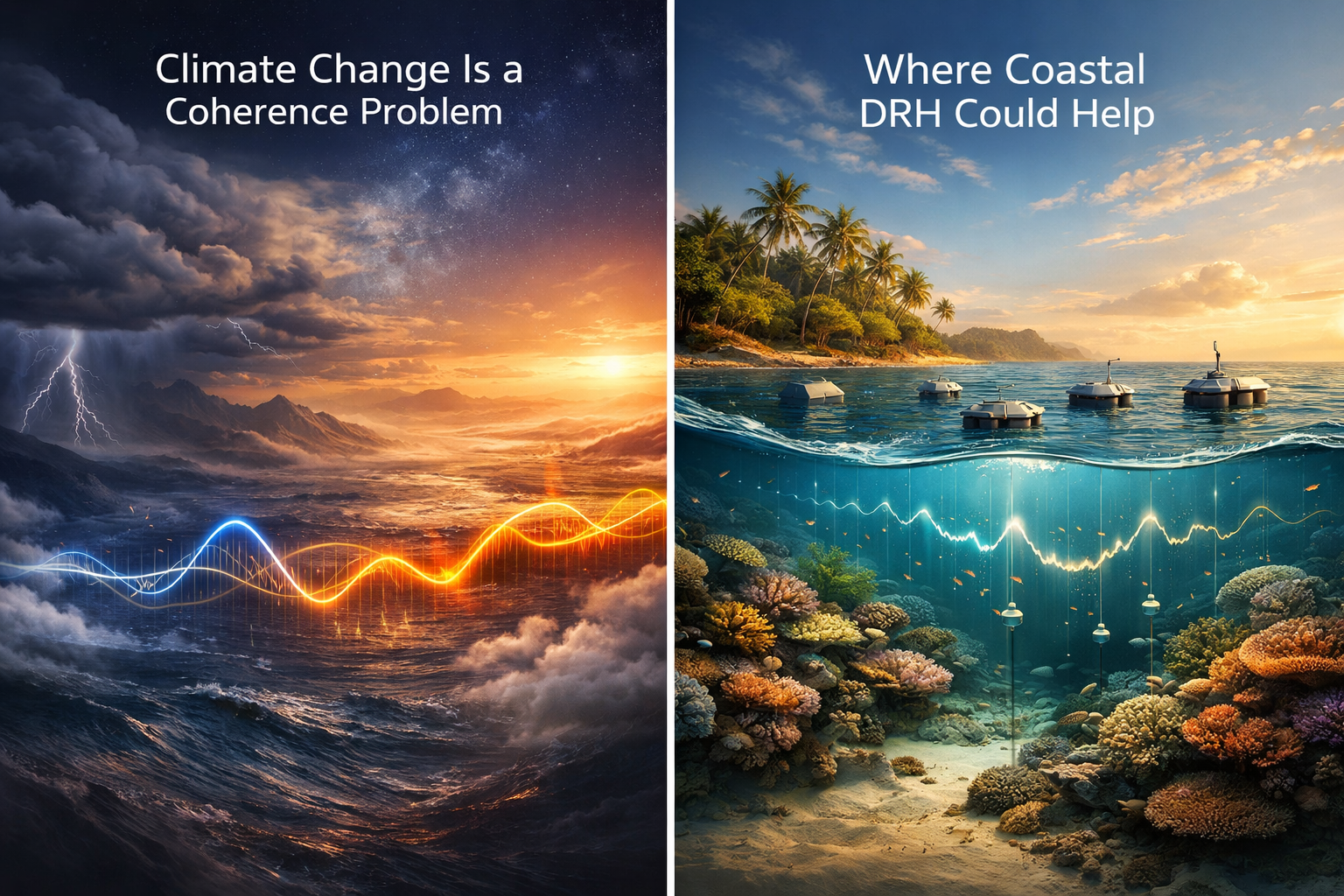
From diagnosis to action
In ‘Climate Change Is a Coherence Problem’, we showed that climate breakdown is not driven solely by rising averages — but by the loss of rhythmic stability across Earth’s systems.
The ocean reveals this clearly.
Warming and acidification do not just push conditions in one direction.
They increase volatility — sharp swings in temperature, chemistry, and energy flow that living systems struggle to track.
This second Insight asks the next question:
If climate change is a coherence problem, where — if anywhere — can technology help without causing harm?
Why recovery capacity now matters more than survival
Across the Great Barrier Reef, corals increasingly survive heat events only to fail later.
Not because they are dead — but because they cannot rebuild fast enough.
Acidification and warming quietly erode calcification capacity:
• skeletons grow thinner
• larvae fail more often
• recovery windows shrink
The system has not collapsed — it has lost coherence at the boundary where rebuilding occurs.
The boundary where leverage exists
There is one zone where small, reversible interventions can matter:
The upper euphotic zone — the sunlit surface layer where:
• air meets water
• chemistry meets biology
• variability becomes stress
It is the interface where life already does the work.
This is not the deep ocean.
It is not bulk chemistry.
It is not global control.
What Coastal DRH actually does
Coastal Dynamic Resonant Harvesters (DRH) are not designed to “fix” the ocean.
They are designed to support coherence at the boundary, by:
• reducing short-timescale chemical extremes
• stabilising destructive variability
• giving biology time to act
• preserving recovery capacity during stress windows
They operate where instability does the most damage.
They do not raise average pH.
They do not override ecosystems.
They do not scale indiscriminately.
How this complements existing reef restoration
Current restoration efforts:
• save corals
• propagate fragments
• improve water quality
• monitor stress
Coastal DRH does something different — and complementary: It protects the conditions that make rebuilding possible.
It helps ensure that:
• nursery-grown corals can calcify effectively
• post-bleaching survivors can rebuild skeletons
• early life stages are not lost to chemical volatility
This is support, not substitution.
What Coastal DRH does not claim
To remain coherent with Part I, this must be explicit:
• ❌ It does not stop climate change
• ❌ It does not replace emissions reduction
• ❌ It does not restore global ocean chemistry
• ❌ It does not geoengineer the sea
Like all boundary-aligned responses, it is local, reversible, and limited.
The coherence principle, applied
If climate change is a coherence problem, then legitimate responses must:
• work with natural rhythms
• reduce destructive variability
• avoid forcing averages
• remain reversible
Coastal DRH meets these conditions only at the interface — nowhere else.
Paired Insight Summary
Part I:
Climate change destabilises Earth by breaking coherence.
Part II:
Coastal DRH offers a way to support coherence — not by control, but by stabilising the boundary where life rebuilds.
Together, they make a single claim:
The future will not be saved by mastering systems, but by learning where — and how gently — to support them.
This Insight forms part of a paired exploration: Part I identifies climate change as a breakdown of systemic coherence; Part II examines where carefully bounded action at Earth’s boundaries could help preserve recovery capacity without causing harm.
Where Coastal DRH Could Help:
“Read Part I: Climate Change Is a Coherence Problem →”