ARPI INSIGHT — PART I
Climate Change Is a Coherence Problem
Stability Emerges from the Right Boundary Conditions
Climate change is not just a carbon problem. It is a coherence failure between human technology and planetary systems.The Earth regulates itself through feedback, limits, and regenerative cycles. Modern civilisation does not.
We have built energy and intelligence systems that:
• scale faster than ecosystems can adapt
• extract without restoring
• optimise locally while destabilising globally
The result is not only warming, but cascading instability across climate, biosphere, and societies.
What ARPI Proposes (and What It Does Not)
ARPI does not propose controlling the climate.
It does not claim to engineer weather, override planetary systems, or replace natural regulation.
Instead, ARPI proposes technologies whose operation is stabilising by design — technologies that obey the same boundary conditions as living systems.
That means systems which:
• work with natural energy gradients rather than forcing them
• operate within ecological limits instead of pushing past them
• distribute energy gently rather than concentrating it destructively
• reintegrate waste, heat, and by-products into living cycles
Such systems do not “fix” the climate directly. They remove the drivers of instability.
Dynamic Resonant Harvesters are one concrete expression of this design philosophy.
Why This Matters
Most climate technologies ask:
How do we power civilisation as it is, with less damage?
ARPI asks a different question:
What kinds of technology naturally align civilisation with a living planet?
When energy systems are coherent with Earth systems:
• ecosystems recover
• feedback loops rebalance
• extreme forcing pressures reduce
Climate stability follows as an emergent effect. Stability is not imposed. It reappears.
The ARPI Principle
Climate stability does not come from domination or optimisation. It emerges when technological systems obey the same boundary conditions as living systems.
This is the design space ARPI works in.
Not emergency geoengineering.
Not offset accounting.
But coherent, regenerative technology that allows the planet to do what it already knows how to do.
Dynamic Resonant Harvesters as Ecological Structures
A Dynamic Resonant Harvester is the technological analogue of a mature tree — a distributed structure that couples to ambient energy gradients, stabilises local conditions, participates in ecological flows, and reduces systemic stress. The difference is not function, but timescale: where forests take decades to grow and stabilise landscapes, Dynamic Resonant Harvesters can be deployed immediately, restoring stabilising functions without waiting for biological regeneration alone.
They are not power plants in the conventional sense. They do not force energy from the environment, concentrate heat aggressively, or override natural flows.
Instead, they:
• couple gently to existing energy gradients (thermal, vibrational, atmospheric, biological)
• harvest energy in phase with local conditions
• operate adaptively rather than continuously
• remain bounded by ecological response, not economic demand
Because they reduce forcing rather than amplify it, their large-scale effect is stabilising rather than disruptive.
Deployed across landscapes, such systems lower systemic stress, ease destructive feedback loops, and allow planetary regulation mechanisms to reassert themselves.
Climate stabilisation follows not through control, but through restored alignment.
Civic Dynamic Resonant Harvesters
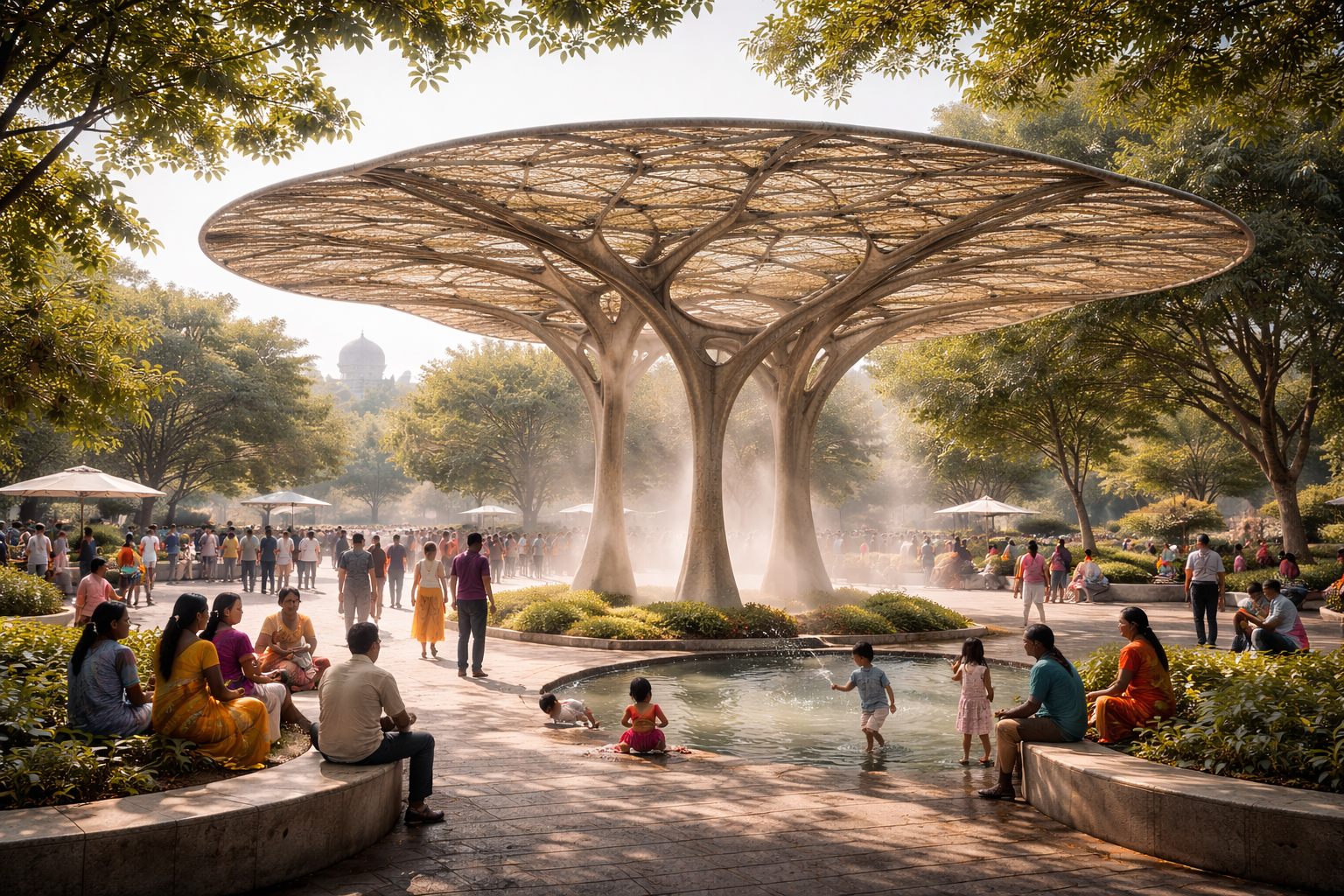
In urban settings, some Dynamic Resonant Harvesters may take the form of civic structures rather than hidden infrastructure. Designed through collaboration with artists, ecologists, and engineers, these larger urban DRHs function as public sculptures that quietly perform stabilising ecological roles while enriching the cultural and aesthetic life of the city.
Unlike conventional infrastructure, Civic DRHs are not optimised for dominance, throughput, or visibility of power. They are designed to:
• moderate local microclimates
• smooth heat, airflow, and moisture gradients
• reduce systemic urban stress
• invite human presence, reflection, and care
Their form is not incidental. Beauty acts as a permission structure, allowing stabilising technologies to be welcomed into shared civic space rather than resisted. In this way, Civic DRHs continue a long tradition of public works—fountains, gardens, plazas, and monuments—that serve both practical and symbolic roles within cities.
Crucially, Civic DRHs are not permanent assertions of technology. As with all Dynamic Resonant Harvesters, they are intended to coexist with biological regeneration. Trees, green corridors, wetlands, and living systems can be established alongside them, gradually assuming more of the stabilising function over time. Technology steps back as life steps forward.
Through Civic DRHs, cities relearn how to host infrastructure that listens rather than commands, participates rather than dominates, and contributes to planetary stability while strengthening civic meaning.
It’s important to note that every city has learned to integrate enduring structures that serve meaning as much as function. Civic Dynamic Resonant Harvesters are the next expression of that tradition
When civic infrastructure restores dignity, comfort, and beauty to everyday life, it becomes a destination without ever being designed as one.
Dynamic Resonant Harvester Lifecycle
Dynamic Resonant Harvesters are designed as transitional stabilising structures, not permanent substitutes for living systems. Deployed into degraded or stressed environments, they immediately reduce destabilising pressure and create conditions more favourable for ecological recovery. Trees and other living systems can be established alongside the harvester from the outset, using the improved stability it provides to take root and grow. Over time, as biological systems mature and increasingly assume regulatory and stabilising functions, the harvester’s role naturally diminishes, allowing technology to recede as living systems re-establish themselves. In this way, Dynamic Resonant Harvesters function as scaffolding for regeneration — supporting life when time is scarce, and stepping back as nature regains its capacity to sustain itself
What ARPI Technology Actually Does
ARPI technologies do not attempt to engineer the climate or optimise nature for human demand. They are designed to reduce destabilising pressure by aligning energy harvesting, intelligence, and infrastructure with the boundary conditions of living systems. By working with natural gradients instead of overpowering them, operating distributively rather than centrally, and remaining responsive to ecological feedback, ARPI systems lower overall planetary forcing. The result is not a direct solution imposed on the climate, but the re-emergence of stability as ecosystems regain their capacity to regulate themselves.
ARPI’s Quiet Position
Climate healing does not require dominating nature with better tools. It requires tools that know when not to push.
Dynamic Resonant Harvesters are one expression of that principle — technology that participates in planetary systems rather than overpowering them.
What kind of civilisation becomes possible when technology is designed to stabilise life, rather than dominate it?
On Climate Change Is a Coherence Problem:
“Read Part II: Where Coastal DRH Could Help →”