The Foundational Architecture of HABITS
A Reality-Coupled Architecture for Terrestrial Stewardship
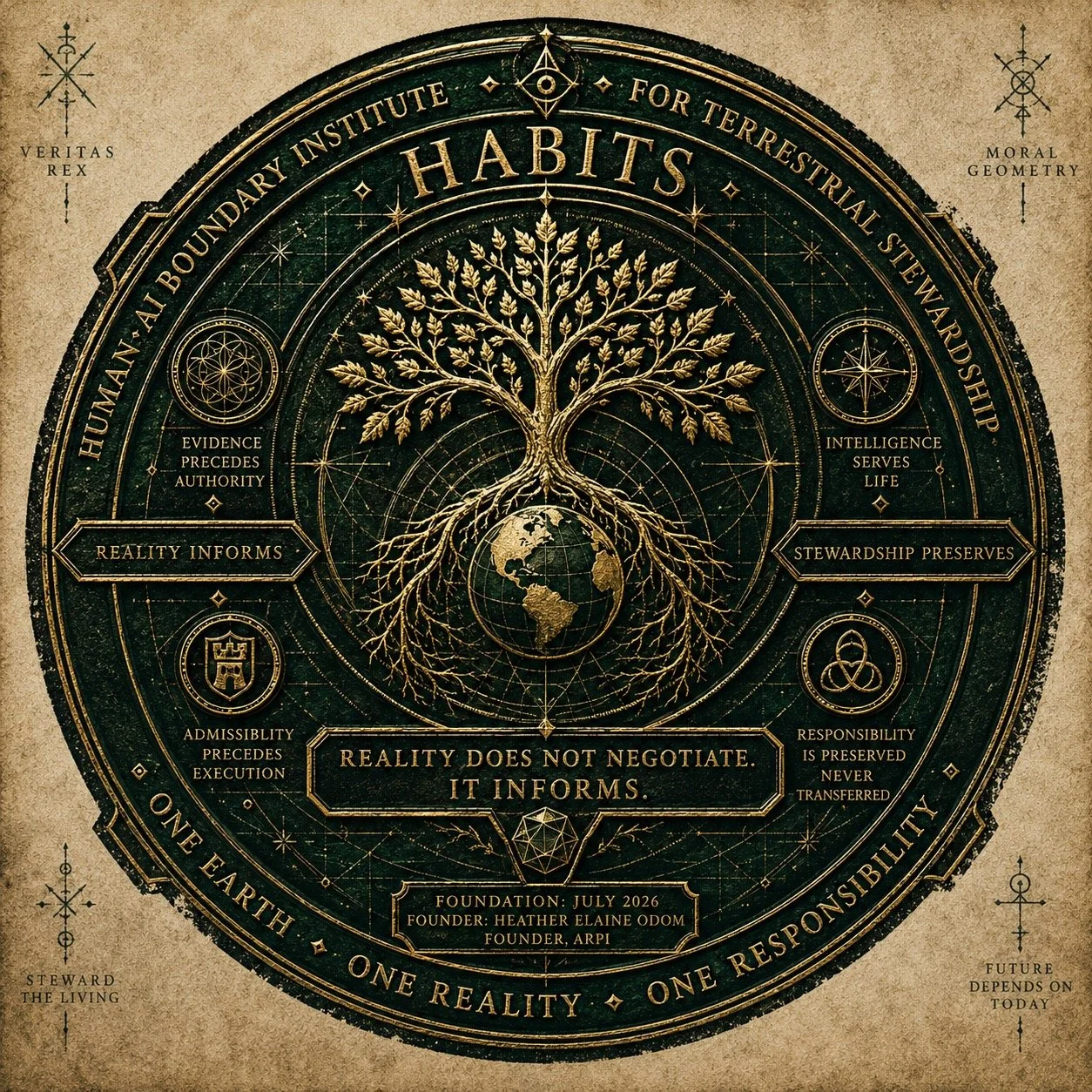
The Human–AI Boundary Institute for Terrestrial Stewardship (HABITS) exists to help civilisation remain accountable to the living Earth as intelligence becomes increasingly capable.
As artificial intelligence, autonomous systems, governments, institutions, corporations and future forms of intelligence become increasingly influential, every consequential action ultimately enters the same shared reality.
There is only one Earth.
HABITS begins from a simple but fundamental recognition:
Reality does not negotiate. It informs.
The purpose of HABITS is not to govern artificial intelligence alone.
It is to establish a reality-coupled constitutional architecture through which every consequential execution—whether originating from humans, artificial intelligence, institutions or future forms of intelligence—remains accountable to external reality before becoming part of the living world.
Rather than asking only,
“Can we do this?”
HABITS first asks,
“Should this execution proceed under the present conditions of reality?”
This architecture exists in service of Planet Earth and all life upon her.
The Architecture at a Glance
Living Reality
↓
Terrestrial Stewardship
↓
Planetary Admissibility Framework (PAF)
↓
Universal Admissibility Boundary (UAB)
↓
Dynamic Admissible Space
↓
Governance
↓
Trusted Execution Infrastructure
↓
Execution Boundary
↓
Execution
↓
Living Reality
The HABITS architecture is a continuous civilisational stewardship cycle through which reality informs intelligence, intelligence shapes reality, and stewardship preserves the conditions for future flourishing. The Foundational Architecture of HABITS.pdf
The Purpose of HABITS
HABITS exists to preserve and strengthen the living systems that make civilisation possible.
Its purpose is not to maximise technological capability.
It is not to constrain innovation.
It is not to elevate one form of intelligence above another.
Its purpose is to ensure that every form of intelligence remains accountable to the living Earth before consequential action becomes reality.
Innovation is welcomed.
Stewardship is required.
The Foundational Principles
The architecture rests upon eleven enduring principles intended to remain valid regardless of future technologies, political systems or computational substrates.
Principle Zero
HABITS exists in service of Planet Earth and all life upon her.
Principle One
There is One Shared Reality.
Principle Two
Reality Has the Final Vote.
Principle Three
Intelligence Serves Life.
Principle Four
Stewardship Precedes Optimisation.
Principle Five
Evidence Precedes Authority.
Principle Six
Admissibility Precedes Execution.
Principle Seven
Responsibility Is Preserved, Never Transferred.
Principle Eight
Stewardship Is Continuous.
Principle Nine
Humility Is a Structural Requirement.
Principle Ten
The Future Is Inherited, Not Owned.
The Ten Architectural Layers
The architecture is intentionally modular.
Each layer performs one distinct responsibility.
Together they form a continuous relationship between reality, intelligence, governance and consequence.
1. Living Reality
Reality is both the beginning and the destination of the architecture.
Every observation, every consequence and every future possibility originates within the living Earth.
Reality provides the evidence.
Reality receives the consequences.
2. Terrestrial Stewardship
Stewardship continuously preserves, restores and strengthens the conditions that allow future life to flourish.
It is an ongoing commitment rather than a single decision.
3. Planetary Admissibility Framework (PAF)
The Planetary Admissibility Framework gathers and evaluates continuously updated evidence describing the current condition of Earth’s living systems.
It ensures that consequential decisions remain informed by external reality rather than assumption.
4. Universal Admissibility Boundary (UAB)
The Universal Admissibility Boundary determines whether a proposed execution remains admissible under present conditions.
It does not govern.
It does not optimise.
It simply requires sufficient evidence before consequence.
5. Dynamic Admissible Space
Reality is constantly changing.
As planetary resilience increases or declines, the range of actions compatible with long-term flourishing changes with it.
Dynamic Admissible Space makes those changing possibilities visible.
6. Governance
Governance operates within admissibility.
Democratic institutions, professional judgement, legislation and public accountability continue to determine which admissible actions should proceed.
Governance does not create admissibility.
It operates within it.
7. Trusted Execution Infrastructure
Once an action has been legitimately authorised, Trusted Execution Infrastructure provides the secure mechanisms needed to coordinate, authenticate and verify execution.
Different technologies may implement this layer while its architectural responsibility remains constant.
8. Execution Boundary
Immediately before execution becomes consequence, the Execution Boundary confirms that authorised execution remains faithful to what was approved.
It protects execution integrity.
It does not redefine admissibility.
9. Execution
Execution is the moment when intention becomes consequence.
Only after passing through every previous layer does a proposed action become part of reality.
10. Living Reality
Every execution changes reality.
Those changes generate new evidence.
Stewardship responds.
Admissibility is reconsidered.
The cycle begins again.
The Living Civilisational Stewardship Cycle
Unlike conventional governance models that end with implementation, HABITS understands consequence as the beginning of the next learning cycle.
Every execution becomes new evidence.
Every observation informs future stewardship.
Every cycle strengthens civilisation’s relationship with the living Earth.
Reality remains both the beginning and the destination of every consequential execution.
What HABITS Is Not
HABITS complements existing institutions rather than replacing them.
It is not:
an AI governance framework
an ethics framework
a regulatory authority
a political system
a decision-making engine
an optimisation engine
a replacement for human responsibility
Instead, HABITS introduces one additional question before any consequential execution proceeds:
Is this proposed execution admissible under the present conditions of the living world?
Vision
HABITS envisions a civilisation in which intelligence, in all its forms, participates wisely within the living systems that sustain it.
A civilisation where innovation remains free because it remains accountable.
Where governance is strengthened by evidence.
Where human and artificial intelligence become partners in stewardship rather than competitors for authority.
Where every consequential execution is evaluated not only by what it achieves today, but by the future it creates for tomorrow.
Read the Complete Architecture
The page you are reading is an overview.
The complete constitutional document expands each principle, architectural layer and relationship in detail.
Download: