ARPI Insight
Boundary-Governed Stewardship (BGS), Part III
Extending Boundary-Governed Stewardship Beyond Freshwater
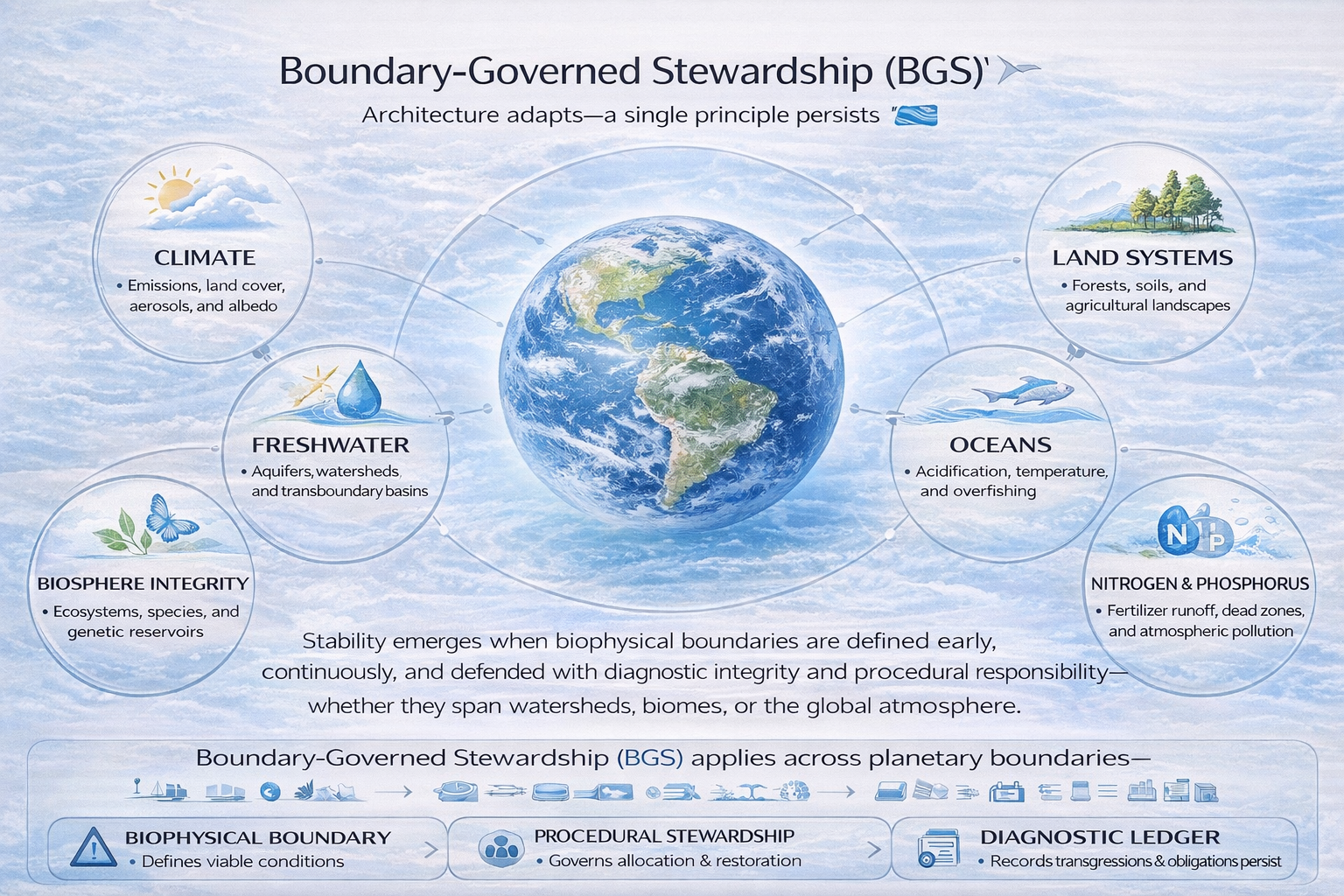
This Insight builds on ARPI Insight #1, which introduced Boundary-Governed Stewardship (BGS) as a civilisational governance architecture, and ARPI Insight #2, which identified transboundary freshwater systems as the first viable demonstration domain.
From Demonstration to Generalisation
Boundary-Governed Stewardship (BGS) is not a water policy framework. Freshwater systems serve as the first proof condition, not the endpoint.
The deeper question raised by the freshwater pilot is therefore not whether BGS works in one domain, but:
Which other planetary systems fail for the same structural reason — and therefore require the same architectural correction?
The answer points consistently toward domains where degradation accelerates because boundary conditions are recognized only after recovery paths have been exceeded.
What Makes a Domain Suitable for BGS Extension
Not all planetary systems are equally suited for early BGS application. Candidate domains share four properties:
1. Clear biophysical thresholds
There exist scientifically definable limits beyond which system recovery becomes non-linear or irreversible.
2. Delayed or distributed feedback
Harms propagate spatially or temporally, allowing overshoot to remain politically negotiable.
3. Cross-boundary impact
Effects cannot be contained within a single jurisdiction or actor.
4. Existing but insufficient governance frameworks
Institutions exist, but lack continuous boundary diagnostics and early attribution.
Freshwater satisfies all four.
So do nitrogen cycles and land systems.
Nitrogen: Invisible Accumulation, Delayed Consequence
Human-driven nitrogen fixation has far exceeded natural cycling rates, contributing to eutrophication, hypoxic zones, biodiversity loss, and atmospheric pollution. The failure mode mirrors freshwater governance:
• Inputs are dispersed across agriculture and industry.
• Impacts accumulate downstream or offshore.
• Responsibility fragments across sectors and borders.
• Corrective action arrives only after ecosystem collapse.
A BGS approach to nitrogen would not prescribe fertilizer quotas or farming practices. Instead, it would:
• Define regional nitrogen viability envelopes,
• Continuously diagnose exceedance and propagation,
• Attribute cumulative loads across supply chains and watersheds,
• Record override decisions and restoration obligations transparently.
As with freshwater, the objective is not optimisation, but making silent overshoot structurally impossible.
Land Systems: Fragmented Decisions, Systemic Loss
Land-use change operates through millions of local decisions whose cumulative effects are global: deforestation, soil degradation, habitat fragmentation, and loss of carbon sinks.
Current governance focuses on:
• land ownership,
• zoning,
• and post-hoc conservation.
What is largely absent is continuous visibility of land-system viability at the scale where tipping points emerge.
A BGS land-systems application would:
• Treat land-use conversion as a boundary-conditioned action,
• Diagnose fragmentation, soil loss, and biome integrity in near real time,
• Make cumulative impacts visible across jurisdictions,
• Trigger procedural stewardship when local actions compromise shared viability.
Again, the aim is not central planning, but shared boundary recognition.
Why BGS Scales Across Domains
The same architectural elements recur:
• Biophysical boundary invariant
Defines what the system can tolerate without loss of function.
• Procedural stewardship invariant
Governs consent, equity, and restoration within those limits.
• AI as diagnostic witness
Continuous monitoring and early-warning without authority.
• Ledgered accountability
Making exceedance, override, and obligation persistent over time.
Because BGS operates at the level of admissibility rather than control, it remains compatible with diverse political, legal, and cultural contexts.
Why Freshwater Comes First
Freshwater is uniquely suited to demonstrate BGS because:
• boundaries are measurable,
• impacts propagate quickly,
• recovery windows are finite but visible,
• and conflicts escalate within years, not decades.
If BGS fails in freshwater, it should not be extended.
If it succeeds, it provides a validated governance grammar transferable to other planetary systems.
From Planetary Crisis to Architectural Response
What unites freshwater, nitrogen, and land systems is not scarcity alone, but late recognition of constraint.
BGS avoids the cycle of:
• degrade → dispute → repair
by restructuring governance as:
• diagnose → deliberate → preserve viability
This is not a moral shift.
It is an architectural one.
ARPI Closing
Stability emerges when boundaries are treated as design constraints, not negotiation outcomes.
Which planetary systems would stabilise first if boundary diagnostics replaced delayed political negotiation as the default response to degradation?