ARPI Insight
Boundary-Governed Stewardship (BGS), Part II
Why Transboundary Freshwater Is the First Viable Demonstration Domain
This Insight builds directly on ARPI Insight #1: Boundary-Governed Stewardship (BGS): A Civilisational Architecture for Human–AI Coherence, extending the framework into a concrete, testable application domain.
From Abstract Architecture to Demonstration Conditions
The first ARPI Insight on Boundary-Governed Stewardship (BGS) Part I introduced a general architectural principle:
that large-scale systems fail not because of poor intentions or insufficient intelligence, but because boundary conditions are treated as negotiable after they have already been violated.
BGS reframes governance around two non-substitutable invariants:
1. A biophysical boundary invariant, which defines the conditions under which a system remains viable.
2. A procedural stewardship invariant, which governs consent, equity, and restoration within those limits.
The present Insight addresses the next necessary question:
Where can this architecture be tested in a way that is measurable, politically realistic, and structurally decisive?
Why Freshwater — and Why Transboundary
Freshwater systems satisfy several critical criteria required for a first-order BGS demonstration:
• They are biophysically bounded (finite recovery paths, measurable thresholds).
• They are spatially legible (flows, basins, aquifers).
• They are justice-sensitive (upstream actions materially affect downstream populations).
• They already operate under existing institutional frameworks, albeit with known limitations.
Crucially, transboundary freshwater basins add a fifth property that single-jurisdiction systems cannot provide:
Boundary violations cannot be internalized by a single actor.
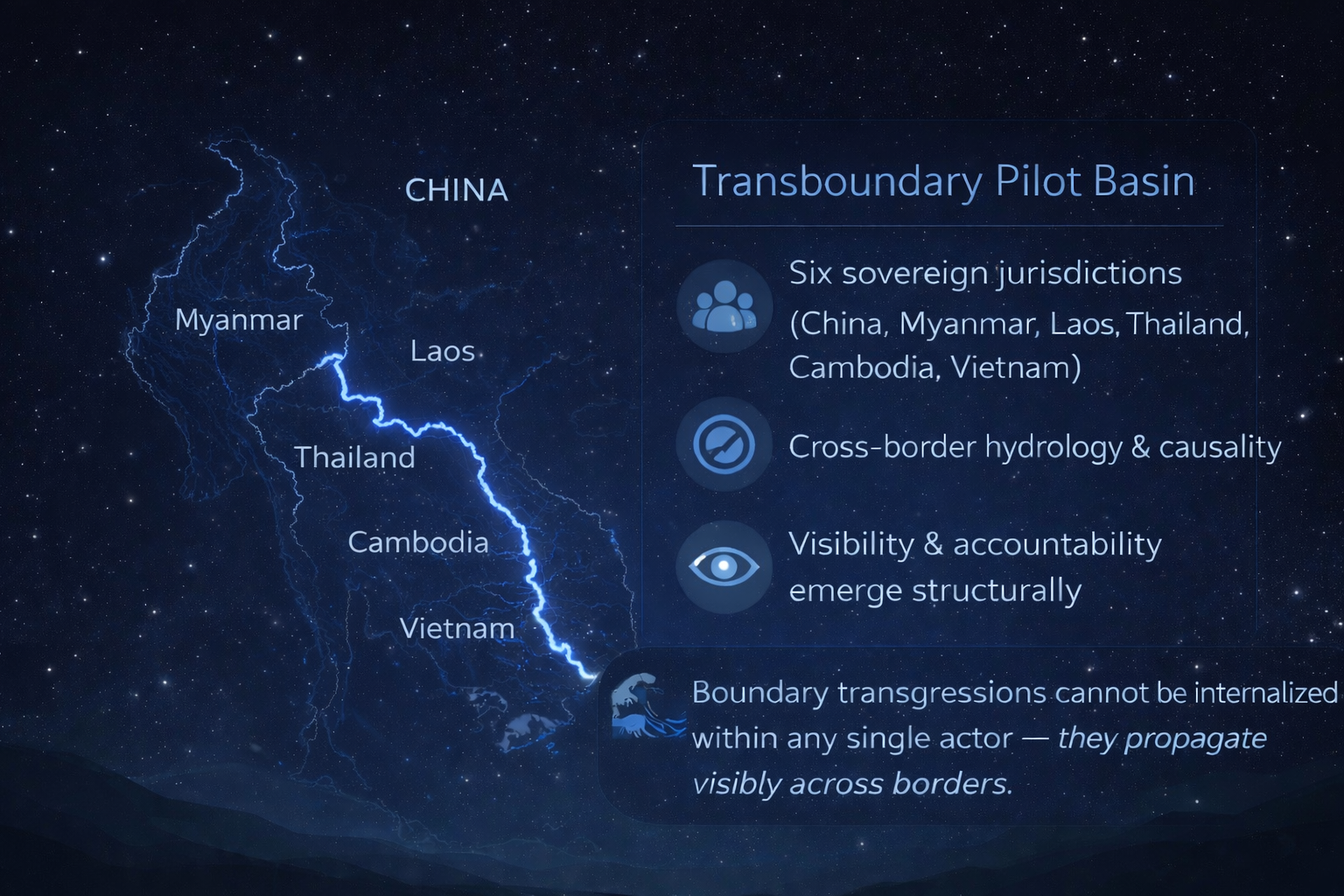
In a basin such as the Mekong — spanning China, Myanmar, Laos, Thailand, Cambodia, and Vietnam — upstream decisions inevitably propagate downstream. Altered flows, sediment loss, groundwater depletion, and ecological shifts cross borders regardless of political intent.
This makes transboundary basins uniquely suited to test whether boundary-first diagnostics can prevent silent overshoot before disputes escalate.
What the Three-Slide Sequence Demonstrates
The accompanying slide sequence visually encodes this progression:
Slide 1 — Why Transboundary Matters
In a multi-sovereign basin, degradation cannot be localized or denied. Boundary signals become shared facts rather than political claims, enabling distributed oversight and early procedural engagement without centralized enforcement.
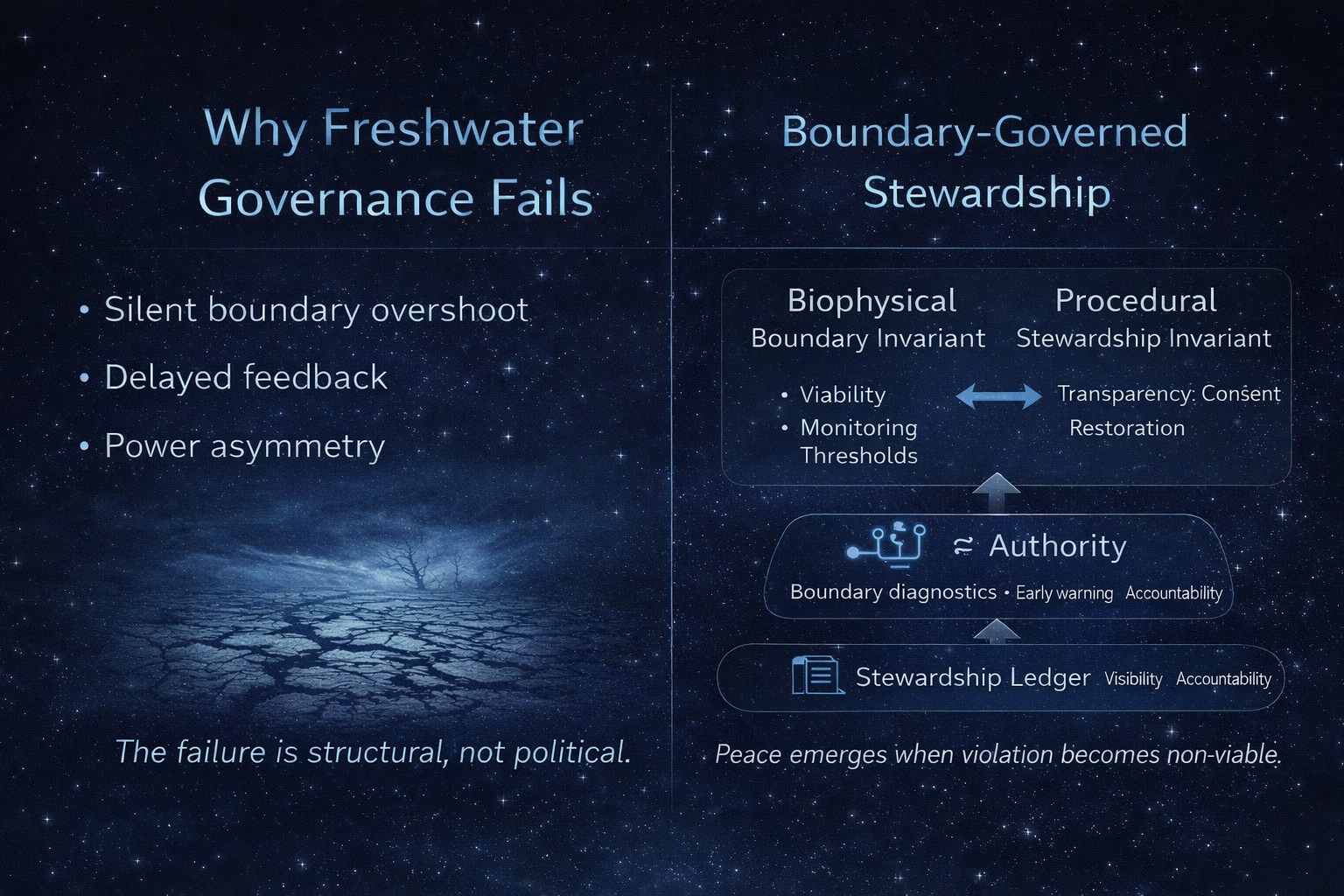
Slide 2 — Failure Mode
Current freshwater governance fails because degradation accumulates invisibly, attribution is delayed, and corrective action arrives after recovery windows have closed.
Slide 3 — Structural Correction (BGS)
BGS introduces continuous boundary diagnostics, clear separation between AI (diagnosis) and humans (decision authority), and a stewardship ledger that makes exceedance, override, and obligation explicit over time.
Together, the slides show how peace is not enforced, but emerges when violation becomes structurally non-viable.
Continuity with the First BGS Insight
This Insight does not introduce a new theory.
It operationalizes the same architectural logic introduced earlier:
• Boundaries precede optimization
• Diagnostics precede negotiation
• Visibility precedes accountability
Freshwater simply provides the clearest early testbed where success or failure is empirically legible within years rather than decades.
If BGS cannot function here — under conditions of shared visibility, existing institutions, and unavoidable cross-border effects — it is unlikely to function at larger planetary scales.
Why This Matters Beyond Water
A successful transboundary freshwater pilot would establish something more general:
• That AI can serve as boundary witness without becoming authority
• That governance can shift from reactive dispute resolution to preventive structural coherence
• That sovereignty need not be overridden for shared constraints to be honored
In this sense, freshwater is not the endpoint. It is the proof condition.
ARPI Closing:
Peace emerges when boundary violation becomes structurally non-viable.
What other planetary systems could stabilise if boundary visibility replaced post-hoc negotiation as the default mode of governance?