ARPI INSIGHT
Zero Was a Placeholder — Not a Void
Why Nature Never Begins Creation from Nothing
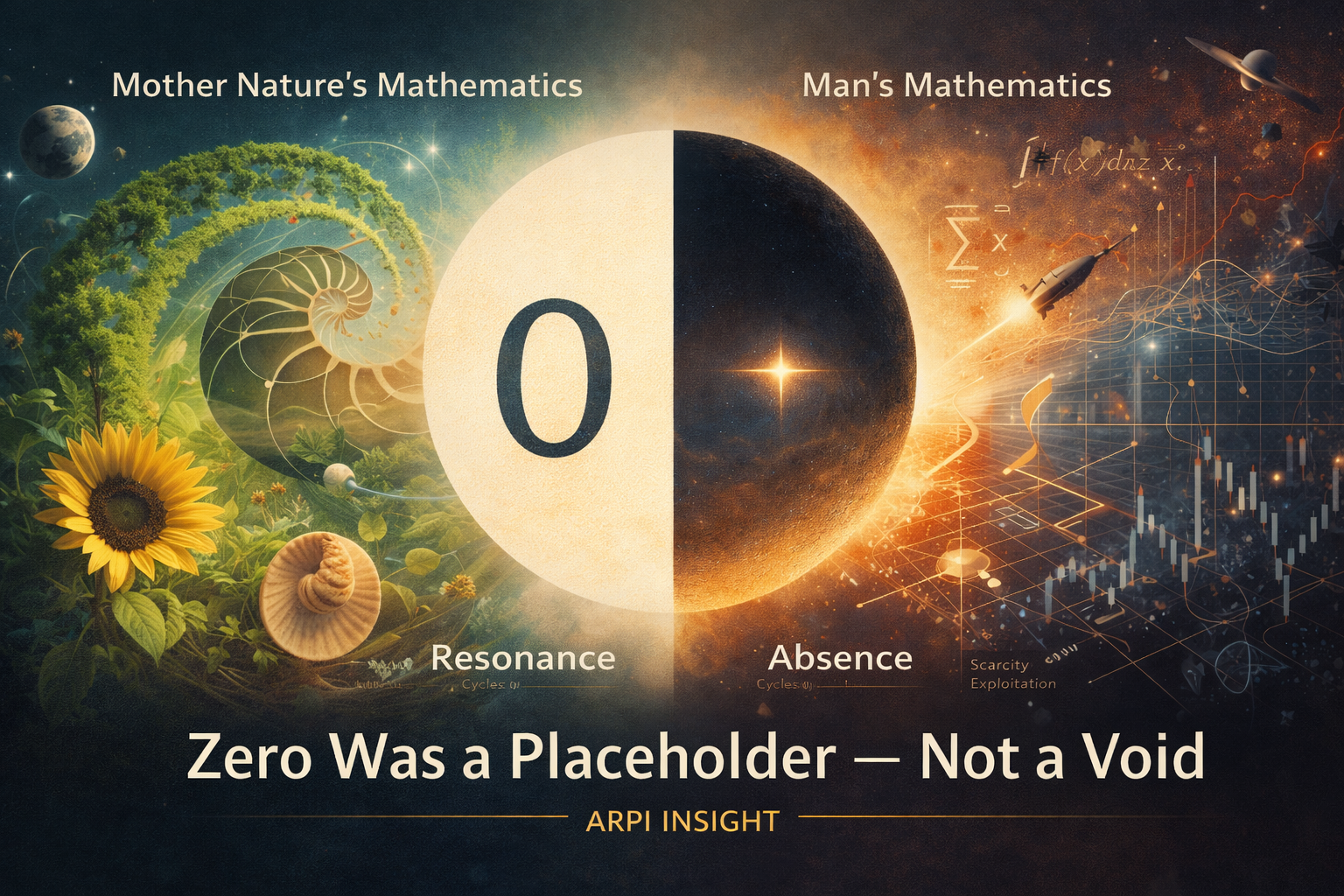
For most of human history, numbers were not abstractions. They were counts of life itself: flocks, harvests, stones, stars, seasons.
Mathematics originally described presence, proportion, and rhythm — not emptiness. Egyptian geometry aligned pyramids to the heavens. Greek mathematics spoke of harmony. Mesoamerican calendars turned on cycles of renewal. None required a number for “nothing.”
Nature itself does not begin from absence. She builds through resonance: spirals, ratios, waves, and cycles. Even apparent stillness hums with activity. There is no true void.
The Birth of Zero — as Pause, Not Absence
Zero first emerged in India as a placeholder, not a declaration of nothingness.
Shaped by Buddhist and Hindu philosophy, śūnyatā did not mean void — it meant relational emptiness: nothing exists alone; everything arises in relation.
Zero was the pause between notes. A resting place in the cycle. A marker of position — not a statement of absence.
In this form, zero did not break mathematics. It completed it.
The Western Turn — From Resonance to Void
As zero travelled west through Arabic scholarship into Europe, its meaning hardened. What had been relational became absolute.
The pause became a void.
The circle became “nothing.”
This reinterpretation proved powerful. Zero enabled ledgers, algebra, navigation, calculus, and computation. But it also introduced a subtle fracture: absence was placed at the foundation of number.
From that point on, the world increasingly appeared as empty space to be filled, owned, conquered, or exploited — rather than as living coherence to be participated in.
The Cost of the Abstraction
With zero-as-void, humanity gained extraordinary technical power.
But we also gained:
• mathematical models of scarcity inside an abundant universe
• economies built on debt and deficit
• physics that struggles with singularities and infinities
• technologies that optimise extraction rather than harmony
The problem is not mathematics itself. It is the boundary condition we placed at its centre.
Nature’s Mathematics Never Used Zero
Nature does not calculate — she resonates.
Growth unfolds in spirals.
Efficiency appears in triangles and domes.
Energy moves in waves and harmonics.
Nothing is lost; everything transforms.
What we call beauty is often the recognition of coherence.
Entropy, in this light, is not disorder — it is the limit of discernment imposed by abstraction. When resonance is compressed beyond our ability to resolve it, it appears as randomness or void.
The ARPI Position
Zero was never the problem. Zero mistaken for nothing was.
When silence is mistaken for emptiness, we lose the music.
When boundaries are mistaken for absence, we lose coherence.
ARPI reframes zero not as a void, but as a boundary condition — a marker of transition, not annihilation. From this perspective, mathematics returns to its original role: describing relationships, limits, and resonant structure, rather than domination over an imagined emptiness.
The question is not whether zero exists. The question is:
What happens to civilisation when we place absence at the foundation of meaning — instead of resonance?