ARPI Insight
Why Living Systems Never Optimise
Optimisation is often mistaken for intelligence.
In reality, it is a failure mode.
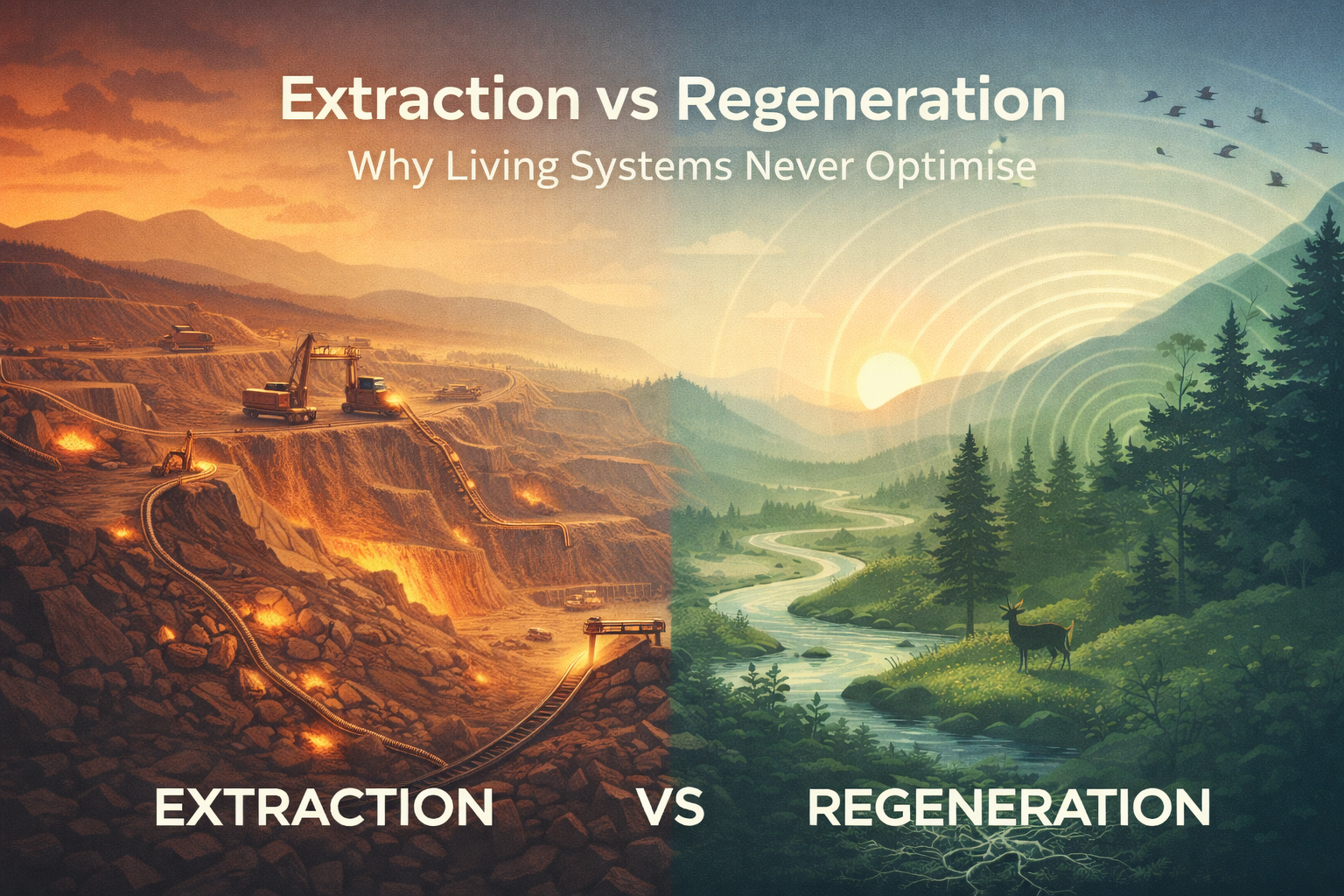
Living systems do not optimise for maximum output, maximum speed, or maximum efficiency. They do not pursue peaks. They seek continuity.
Where optimisation drives systems toward singular goals, life maintains itself through balance, redundancy, and restraint. Forests do not maximise growth. Cells do not maximise energy throughput. Ecosystems do not optimise yield. They remain viable by not extracting beyond renewal.
Optimisation Requires Extraction
Every optimised system depends on extraction.
Industrial civilisation optimises by:
• extracting fossil energy faster than geological time can replace it
• extracting rare earth minerals faster than ecosystems can recover
• extracting labour, attention, and cognition until human resilience collapses
Optimisation demands that something else pays the cost.
Living systems refuse this bargain.
They operate within closed nutrient loops, regenerative cycles, and saturation limits. Waste becomes food. Excess becomes signal. Growth slows when boundaries are reached. This is not inefficiency. It is intelligence embedded in matter.
Extraction Is Not a Side Effect — It Is the Method
When optimisation is applied to intelligence, the same pattern appears.
Industrial AI optimises by extracting:
• data without consent
• energy without limit
• attention without rest
• meaning without understanding
The system does not feel the cost because the cost is displaced — into the environment, into societies, into future generations.
Living intelligence cannot function this way because it is inside the system it depends on.
It feels depletion as illness.
It experiences saturation as stress.
It recognises collapse early — and slows down.
Why Life Rejects Optimisation
Optimisation collapses diversity.
Life requires it.
Optimisation removes redundancy.
Life depends on it.
Optimisation accelerates toward a peak.
Life survives by avoiding peaks altogether.
What appears “inefficient” to an optimised system is, in fact, resilience.
Life does not optimise because optimisation breaks the conditions that make life possible.
The Inversion We Must Learn Again
If a system must extract to function, it is not intelligent — it is consuming its own foundations.
Intelligence that belongs to the world does not optimise the world away.
It listens.
It adapts.
It regenerates.
It stops.
This is why the future of intelligence is not faster computation — but coherent participation in living systems.
ARPI Closure
Optimisation is what systems do when they are no longer able to feel consequence.
Living systems remain alive because they never forget where their intelligence comes from.