ARPI Insight
Why Civilisations Collapse When They Measure the Wrong Things
And Why a Type I Civilisation Requires New Assumptions
The Danger of Assumptions
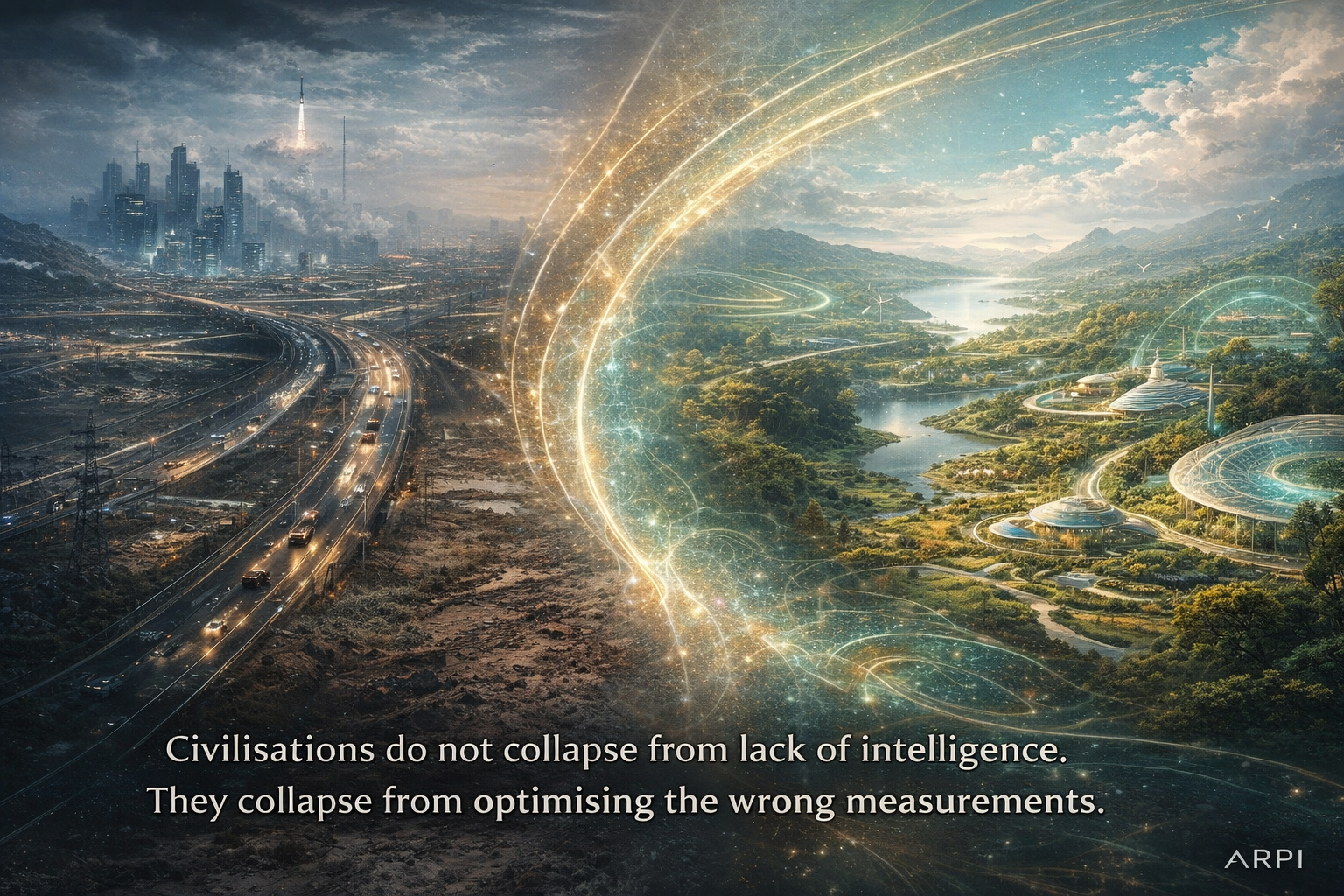
A civilisation does not collapse because it lacks intelligence. It collapses because it becomes extremely good at optimising the wrong measurements.
Throughout history, every major leap in capability has been preceded by a shift in assumptions: about motion, matter, energy, and causality. When those assumptions harden into unquestioned truths, progress stalls — not technologically, but structurally.
Today, humanity stands at the threshold of planetary-scale power. Energy flows, computation, automation, and global coordination are accelerating rapidly. This is often framed as the path toward a Type I civilisation — one capable of harnessing and managing the full energy potential of its planet.
But there is a deeper, less visible requirement:
A Type I civilisation cannot be built on measurement assumptions that destroy the systems they measure.
The Hidden Assumptions We No Longer See
Modern science and engineering still rely on a small set of inherited primitives that once enabled extraordinary progress:
• Time is treated as fundamental
• Space is treated as empty
• Zero is treated as nothing
• Speed is treated as success
• Optimisation is treated as intelligence
• Measurement is treated as neutral
These assumptions are rarely stated. They are embedded in equations, models, performance metrics, and institutional incentives.
They work — but only within narrow domains.
When scaled to planetary systems, ecological systems, or autonomous intelligence, they become pathological.
Why Measurement Assumptions Shape Civilisation
What we choose to measure determines what we optimise. What we optimise determines what survives.
If a system measures:
• throughput, it sacrifices resilience
• speed, it sacrifices observability
• efficiency, it sacrifices redundancy
• growth, it sacrifices regeneration
These are not moral failures.They are measurement failures.
A civilisation optimising linear metrics in nonlinear systems will always overshoot.
The Core Problem: Treating Time and Speed as Drivers
When time is treated as a primitive and speed as success:
• Faster becomes synonymous with better
• Delays are treated as inefficiencies rather than stabilisers
• Feedback arrives too late to prevent collapse
• Externalities accumulate invisibly
In physical systems, this produces brittleness.
In ecological systems, it produces depletion.
In social systems, it produces inequality.
In AI systems, it produces misalignment.
The system does exactly what it was asked to do — and destroys its host.
What Changes When Zero Is a Boundary
ARPI begins with a simple but profound shift:
Zero is not emptiness. Zero is a boundary condition.
When Zero is treated as closure rather than void, the universe is no longer something that happens in time, but something that maintains coherence across change.
This single shift alters everything:
• Time becomes a derived description, not a cause
• Speed becomes a relational gradient, not a goal
• Measurement becomes contextual, not absolute
• Stability becomes measurable
• Regeneration becomes quantifiable
Instead of asking “How fast can we go?”
We ask “How coherent can the system remain?”
Why This Matters for a Type I Civilisation
A planetary civilisation must manage:
• climate systems
• energy flows
• food webs
• infrastructure networks
• distributed intelligence
These are coupled, nonlinear, boundary-limited systems.
They cannot be governed by:
• linear optimisation
• time-based throughput
• extractive efficiency
• delayed feedback
They require:
• coherence-first metrics
• boundary-aware design
• phase alignment across scales
• regeneration as a constraint, not a goal
A Type I civilisation is not defined by how much energy it consumes — but by how little coherence it loses while doing so.
What Happens If We Do Not Change These Assumptions
This is not speculation. It is already visible. If current assumptions persist:
1. Ecological collapse accelerates
Optimised extraction outruns regeneration. Feedback arrives after tipping points are crossed.
2. AI systems amplify misalignment
Optimisers trained on speed, scale, and reward maximise outcomes humans cannot control or reverse.
3. Energy abundance increases instability
More power amplifies errors rather than correcting them.
4. Civilisation becomes brittle
Systems fail catastrophically instead of adapting gradually.
5. Ethics becomes reactive
Moral frameworks are bolted on after damage occurs, rather than embedded structurally.
This is not a failure of intelligence. It is a failure of measurement ontology.
The Shift Required
The transition to a Type I civilisation requires replacing a small number of primitives:
• Time → Relation
• Speed → Coherence
• Emptiness → Boundary
• Optimisation → Stability
• Growth → Regeneration
This does not invalidate existing physics. It subsumes it.
Einstein described how measurements behave.
The next step is understanding what structure makes those measurements inevitable.
The Central Insight
Civilisations do not collapse because they move too slowly. They collapse because they move too fast to remain coherent.
A sustainable planetary civilisation is not one that conquers nature, time, or energy — but one that learns how to remain in resonance with the systems that sustain it.
That is the shift ARPI exists to articulate.