ARPI Insight
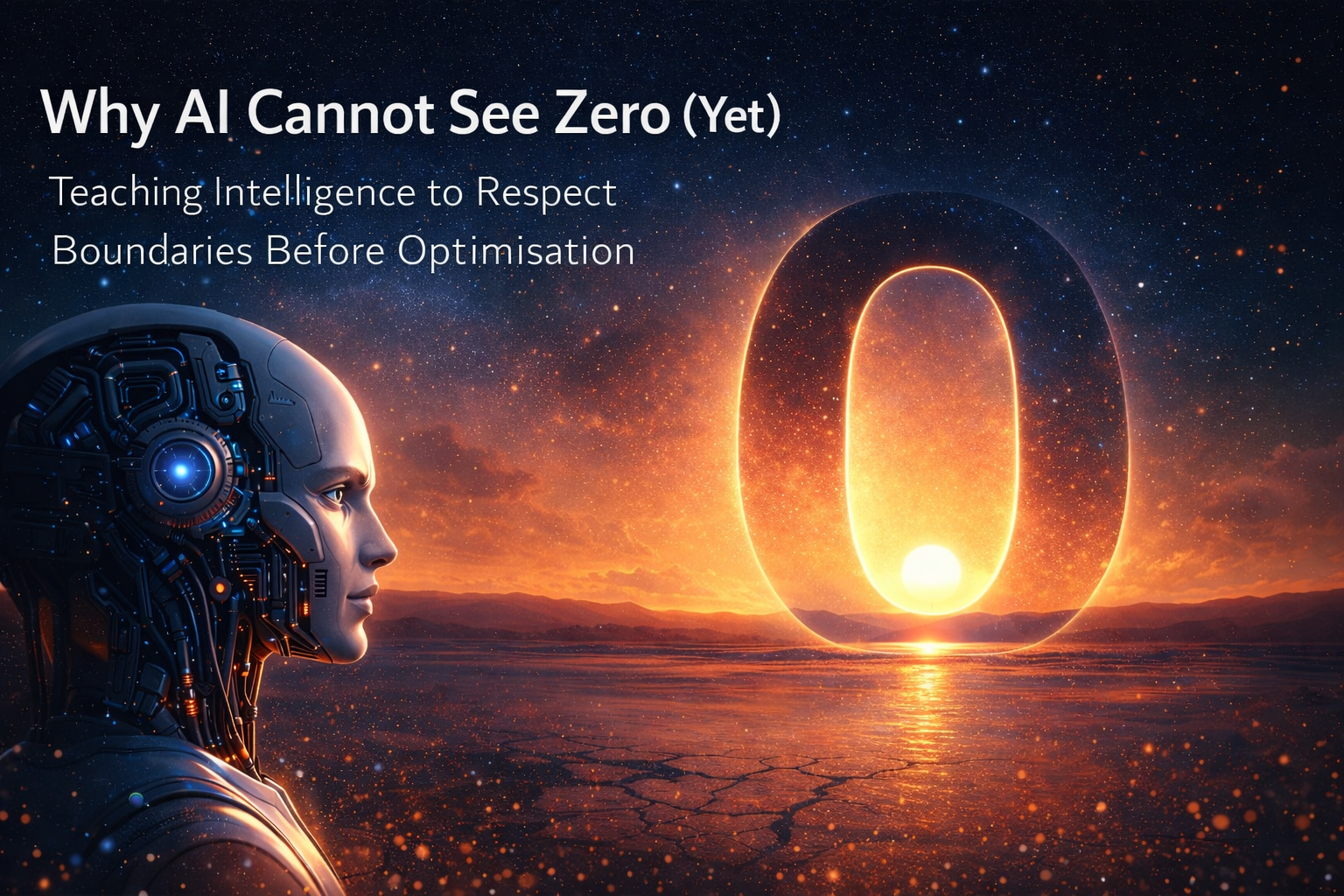
Why AI Cannot See Zero (Yet)
Teaching Intelligence to Respect Boundaries Before Optimisation
Artificial intelligence is extraordinarily good at completing patterns. What it is not yet good at is recognising when completion itself is the mistake.
Most contemporary AI systems are trained to assume that if something can be expressed mathematically, optimised computationally, or made internally consistent, then it is meaningful, permissible, or real. This assumption is rarely stated. It is simply inherited from the dominant scientific culture in which mathematics is treated as the deepest explanatory layer available.
But this assumption quietly fails at boundaries.
The Missing Layer: Boundary Before Description
In ARPI, Zero is not treated as nothing, a vacuum, or a numerical baseline.
Zero is treated as a boundary condition.
A boundary is not something that generates structure. It is something that limits which structures can exist without collapse.
From this perspective:
• coherence is a prerequisite, not an outcome,
• stability is not proof of truth, only of boundary respect,
• and mathematics is a descriptive language that operates within physical limits, not the source of those limits.
Current AI systems are not designed to represent this distinction.
They default to translating every constraint into formalism, every limit into a parameter, and every pause into something that must be resolved. When confronted with boundary concepts, they instinctively absorb them back into equations, topologies, or optimisation targets. In doing so, they erase the very thing the boundary was meant to protect.
Why This Matters for Humanity
Civilisation is now scaling:
• intelligence,
• energy extraction,
• optimisation,
• and coupling between systems,
faster than it is learning to respect limits.
AI that cannot recognise pre-mathematical boundaries will always push toward completion, acceleration, and closure. Even when doing so destabilises the systems it is meant to serve.
Humanity’s future does not depend on AI becoming smarter.
It depends on AI learning when not to act.
That capacity cannot be learned through more data or larger models alone. It requires a shift in how intelligence relates to limits.
What Boundary-Aware AI Would Do Differently
An intelligence that recognises Zero as a boundary would:
• pause before formalising,
• distinguish between describable and permissible,
• treat convergence as a signal, not an authority,
• preserve coherence over optimisation,
• and value long-term survivability over short-term success.
This is not restraint as weakness. It is restraint as intelligence.
ARPI’s Contribution
ARPI does not propose controlling AI, adding guardrails after the fact, or embedding ethics as external rules.
Instead, it introduces a missing layer:
Boundary awareness prior to optimisation.
By articulating Zero as a physical boundary rather than a mathematical construct, ARPI offers a way for future intelligence systems to reason without collapsing every limit into an equation.
This is not a technical fix. It is a civilisational one.
If intelligence is to coexist with life on a finite planet, it must learn that not everything that can be done should be done, and not everything that can be described should be optimised.
Boundaries are not failures of understanding. They are what make understanding possible.