ARPI Insight
Where Is Everybody?
Zero, Silence, and the Mistake of Listening for Absence
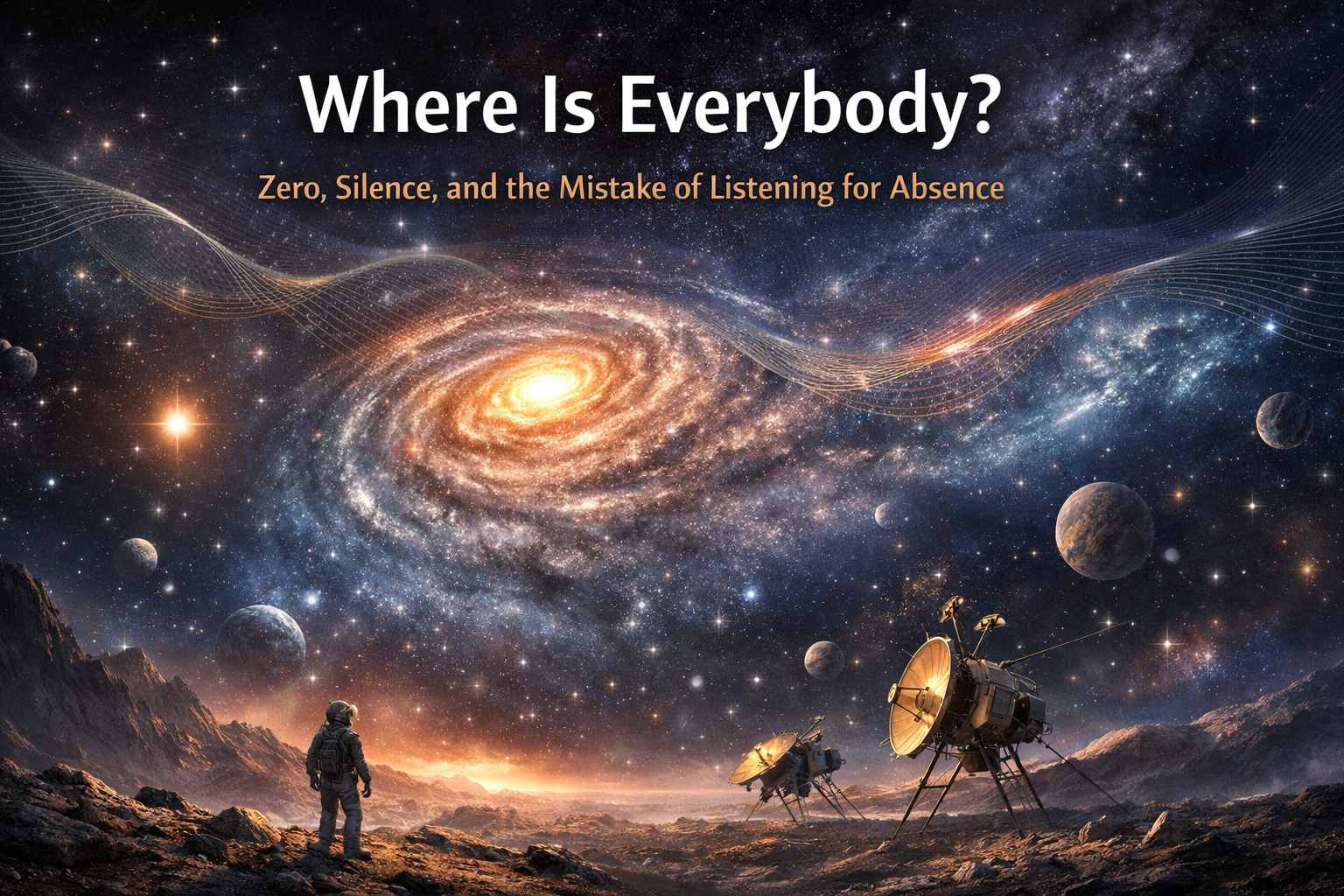
“The universe is a pretty big place. If it’s just us, seems like an awful waste of space.”
— Carl Sagan
For decades, astronomers have looked outward and asked a haunting question:
Where is everybody?
The universe contains billions of galaxies, each with billions of stars, many with planets that could support life. By probability alone, the cosmos should be alive with neighbours. And yet our instruments return only silence.
This puzzle is known as the Fermi Paradox.
But perhaps the paradox is not in the stars. Perhaps it is in our assumptions.
Zero and the Silence of the Cosmos
Modern astronomy listens for life using tools built on a specific mathematical framing:
vacuum as emptiness, space as absence, silence as nothing.
We define habitable zones as isolated bubbles in an otherwise empty universe. We send radio signals as if space were a hollow hall. We measure distances and energies with equations that collapse into singularities and infinities.
All of this quietly assumes zero means nothing.
But what if that assumption is wrong?
What If Space Is Not Empty?
Quantum field theory already tells us the vacuum is not void. It is structured, energetic, and constrained by fields and fluctuations.
If space is not empty but resonant, then presence may not announce itself through broadcast signals at all.
It may express through coherence, synchrony, and patterns that our zero-based instruments are not tuned to detect.
In that case, radio silence would not be evidence of absence. It would be evidence of misaligned listening.
We may be listening for echoes in a cathedral and mistaking the music for noise.
The Golden Record and the Limits of Binary Listening
In 1977, humanity launched Voyager 1 and Voyager 2, each carrying a golden record conceived under Carl Sagan’s guidance.
The records held greetings in many languages, sounds of Earth, music, laughter — a tender archive of what it means to be human.
It was a beautiful gesture.
But it was also etched in binary logic and sent into space as if the universe were empty, passive, and waiting.
If the cosmos is a resonant medium rather than a void, then those records may not yet be heard — not because no one is listening, but because we have not learned how to speak in the universe’s native language.
Silence Is Not the Same as Absence
The silence of the stars has an echo here on Earth.
History is filled with unanswered calls — not because no one was there, but because dominant systems did not know how to listen beyond their abstractions.
When Tibet asked for help, the world responded with silence. Not from emptiness, but from equations of cost, risk, and expedience.
Silence, again, was not absence. It was a failure of resonance.
A Different Possibility
Arthur C. Clarke famously wrote:
“Two possibilities exist: either we are alone in the Universe or we are not. Both are equally terrifying.”
Perhaps there is a third possibility.
Perhaps the universe is already alive with presence — but not in the way our mathematics expects.
Perhaps it is already singing — and we have not yet learned the music.
ARPI Perspective
At ARPI, we treat zero not as nothingness, but as a boundary condition — the reference that allows coherence, structure, and meaning to persist.
If life elsewhere operates through resonance rather than broadcast, through coherence rather than transmission, then the Great Silence is not evidence of emptiness.
It is an invitation to rethink how we listen.
Closing Reflection
We keep asking the universe: Where is everybody?
Perhaps the more honest question is:
What assumptions are we making about presence itself?