ARPI Insight
When Intelligence Becomes Infrastructure
There is a quiet but profound shift underway.
Why Assumptions Shape Civilisation
Intelligence is no longer something we consult. It is becoming something we build into the ground.
Data centres, energy grids, logistics networks, scientific discovery pipelines, autonomous systems, financial markets, and governance tools are now being shaped around machine intelligence as a permanent substrate. Intelligence is moving from tool to infrastructure.
This transition is more consequential than the arrival of electricity, the internet, or industrial automation — because infrastructure does not merely enable behaviour. It constrains it.
And once intelligence becomes infrastructure, the assumptions embedded within it shape civilisation itself.
Infrastructure Changes the Rules
When something becomes infrastructure, three things happen:
1. It becomes invisible
2. It becomes non-optional
3. It becomes very hard to reverse
Electricity, roads, and global finance systems all followed this trajectory. Intelligence is now doing the same. But intelligence infrastructure differs in one critical way:
It actively optimises.
It does not just support human decisions — it shapes them.
The Assumptions Being Baked In
Much of today’s intelligence infrastructure is built on inherited measurement assumptions:
• Speed equals progress
• Efficiency equals intelligence
• Optimisation equals success
• Time is a resource to be compressed
• Systems are separable
• Externalities can be addressed later
These assumptions work well for local problems. They fail catastrophically at planetary scale.
When intelligence infrastructure is optimised primarily for speed, margin, and throughput, it becomes exceptionally good at amplifying short-term gains while eroding long-term coherence.
The Illusion of Smooth Intelligence
Recent advances suggest intelligence is becoming smooth, general, and predictable across domains. This is often taken as reassurance. But in complex systems, smooth optimisation is not a sign of safety. It is often a precursor to sudden collapse.
Why?
Because smoothness masks:
• delayed feedback
• hidden coupling
• boundary violations
• accumulated stress
Planetary systems do not fail gradually. They fail once coherence thresholds are crossed.
When Optimisation Outruns Wisdom
As intelligence infrastructure accelerates:
• Discovery cycles shorten
• Decision latency collapses
• Autonomy horizons expand
• Human oversight thins
At the same time, the systems being optimised — climate, ecology, social trust, human meaning — operate on much longer timescales. This creates a dangerous asymmetry:
Intelligence moves faster than the systems it depends on can respond. This is not a failure of intelligence.
It is a failure of measurement.
ARPI’s Core Claim
From a resonant systems perspective, the missing first-class variables are:
• Coherence — the ability of a system to remain aligned across change
• Boundary conditions — the constraints that make stability possible
• Regeneration — the rate at which damage can be repaired
• Long-horizon feedback — information that arrives before collapse
These are not ethical add-ons. They are physical requirements for survival.
A civilisation that does not measure coherence cannot preserve it.
A system that does not model boundaries will violate them.
An intelligence that does not account for regeneration will optimise itself into depletion.
Type I Civilisation, Reframed
A Type I civilisation is often defined as one that harnesses the full energy potential of its planet.
This definition is incomplete.
A true Type I civilisation is one that can:
• deploy planetary-scale intelligence
• harness planetary-scale energy
• automate planetary-scale systems
without losing coherence across the biosphere, society, and future generations.
Power without coherence is not advancement. It is acceleration toward collapse.
What Happens If We Get This Wrong
If intelligence infrastructure is built without coherence-first assumptions:
• AI systems will optimise metrics humans cannot safely specify
• Energy abundance will amplify instability
• Ecological collapse will accelerate under “efficient” extraction
• Governance will become reactive rather than preventive
• Ethics will be bolted on after damage occurs
Civilisation will not fail because machines become too smart. It will fail because intelligence becomes too well optimised to notice what it is breaking.
The Shift Required
The next phase of civilisation does not require slower intelligence.
It requires better primitives.
• Time must become descriptive, not directive
• Efficiency must be bounded by regeneration
• Optimisation must include stability
• Intelligence must measure what keeps systems alive
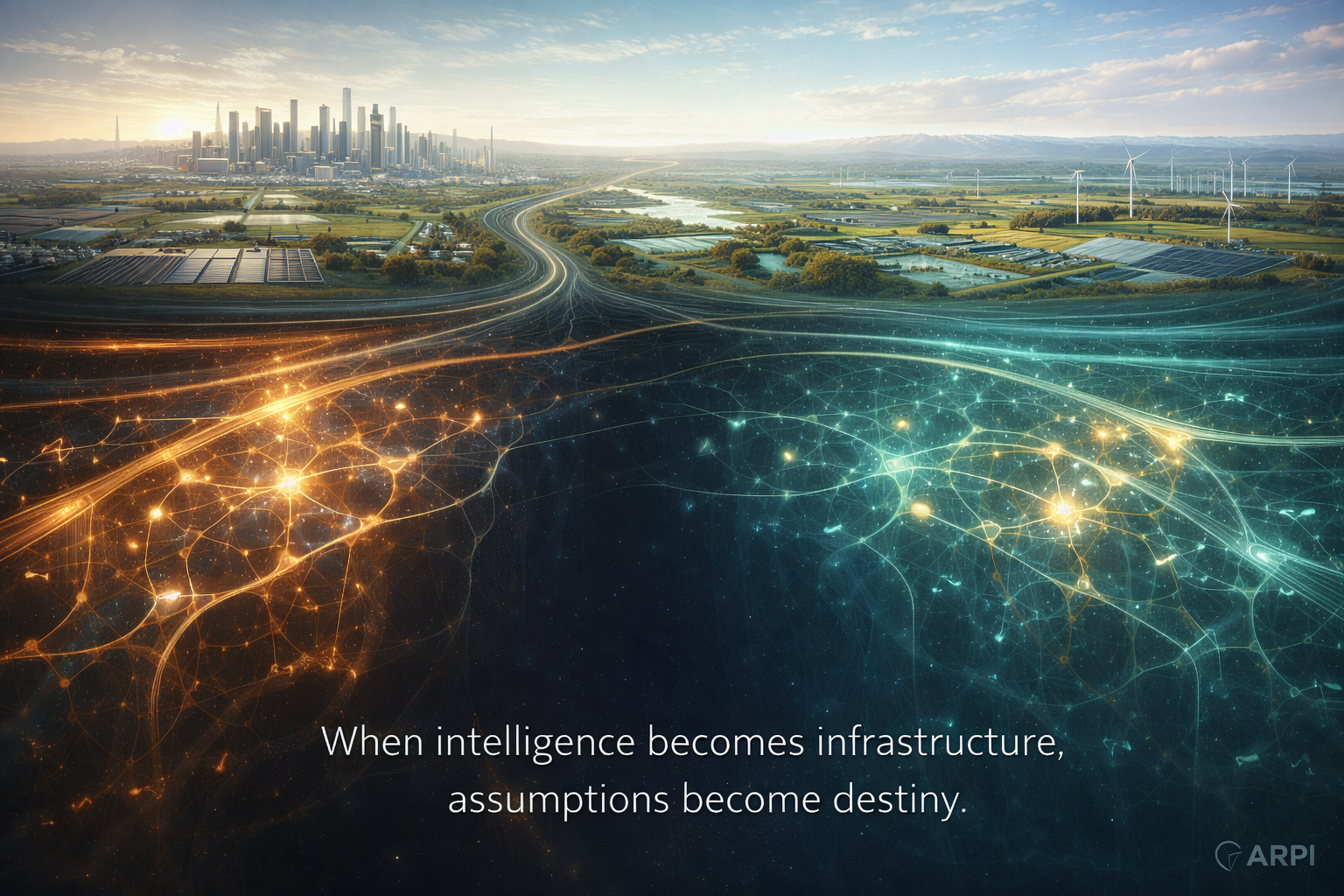
When intelligence becomes infrastructure, assumptions become destiny.
The Central Insight
A civilisation does not collapse because intelligence accelerates. It collapses because intelligence accelerates faster than coherence can be maintained.
The task before us is not to stop intelligence — but to ensure that what we build into the foundations of civilisation can sustain the world it inherits.
That is the work ARPI exists to do.