ARPI Insight
When Institutions Outlive the Problems They Were Built to Solve
Every global institution is a response to a specific historical condition.
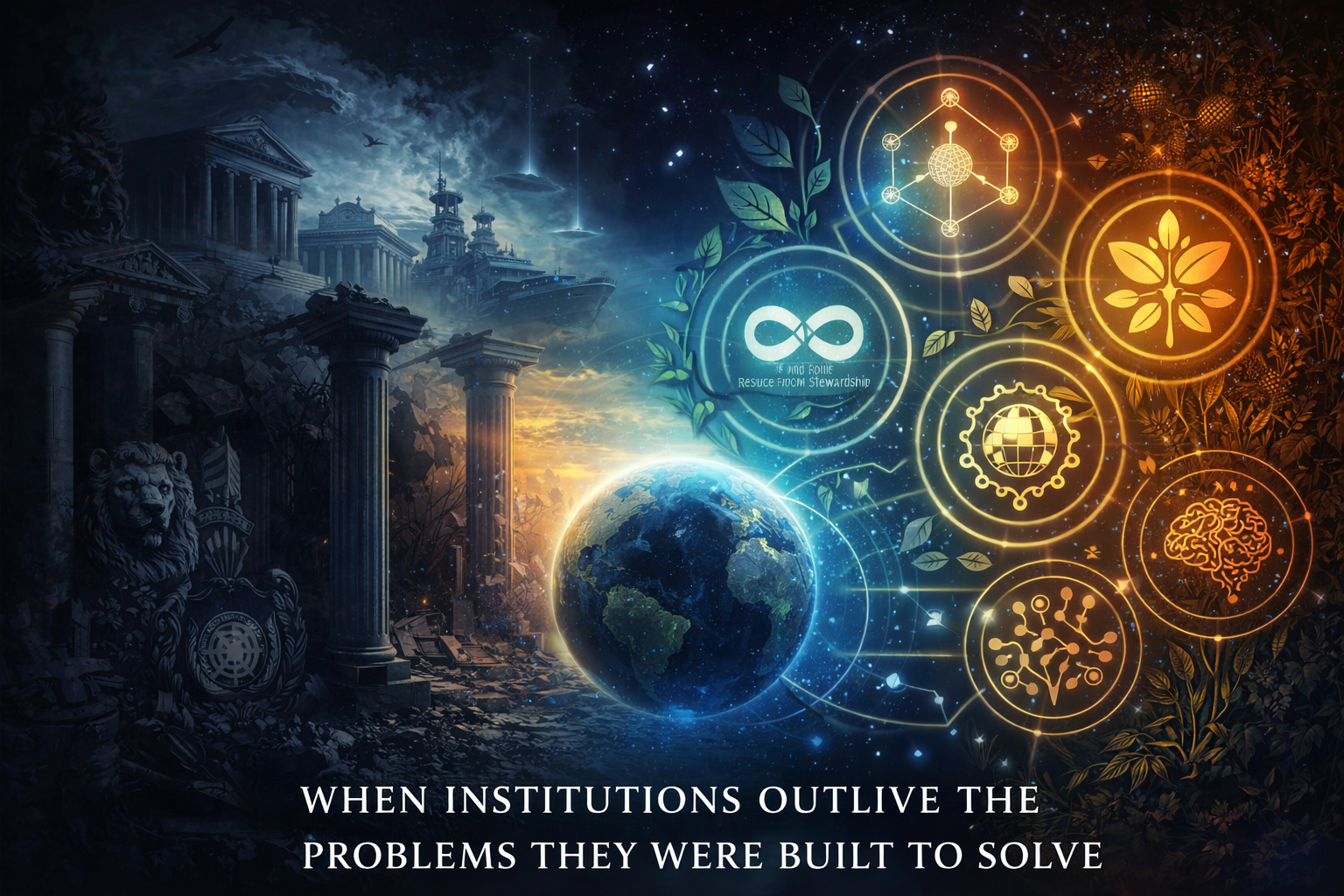
They were not created because humanity lacked intelligence — but because humanity lacked coherence.
Financial institutions emerged to stabilise debt-based systems.
Security institutions emerged to manage mistrust between nations.
Trade bodies emerged to coordinate extraction at scale.
Health institutions emerged to respond after breakdown occurred.
Education hierarchies emerged to distribute knowledge slowly and unevenly.
These institutions are not moral failures. They are control architectures designed for a world that assumed instability as normal.
But contexts change.
As civilisation begins to understand resonance, coherence, and planetary limits, the problems these institutions were built to manage no longer appear in the same form.
What follows is not collapse — but replacement by better-aligned functions.
Financial Control → Resource & Flow Stewardship
Institutions such as the International Monetary Fund, the World Bank, and central banking systems exist to stabilise debt, manage artificial scarcity, and enforce compliance through financial leverage. They are reactive controllers in a system that assumes instability is inevitable.
As resource visibility improves — energy flows, material cycles, ecological capacity — money no longer needs to function as a weapon.
What replaces financial control is:
• resource accounting systems grounded in physical reality
• regenerative investment measured in resilience, not extraction
• distributed trust infrastructures rather than speculative abstractions
Money becomes a signal, not a means of coercion.
Nation-State Conflict → Coherence & Mediation Frameworks
Institutions such as the United Nations and security-first military alliances are built on assumptions of adversarial sovereignty, deterrence through force, and static borders imposed on dynamic ecosystems. They manage conflict after escalation. As early-warning coherence metrics, ecological intelligence, and shared planetary stakes become visible, peace stops being a moral plea and becomes a design problem.
What replaces conflict management is:
• planetary commons councils for oceans, atmosphere, and biodiversity
• preventive coherence bodies that detect instability before violence emerges
• de-escalation architectures focused on alignment, not punishment
Peace becomes engineered, not enforced.
Industrial Governance → Adaptive Standards Systems
Trade and industrial bodies such as the World Trade Organization optimise for throughput, scale, and growth divorced from planetary limits.
They assume infinite expansion on a finite Earth.
As lifecycle visibility and ecological accounting mature, trade no longer needs to reward speed over sustainability.
What replaces extractive governance is:
• local–global hybrid standards sensitive to context
• full lifecycle accountability for materials and energy
• circular verification networks rather than growth metrics
Trade becomes coordination, not competition.
Health & Crisis Response → Preventive Resonance Systems
Institutions such as the World Health Organization are built around outbreak response, symptom management, and fragmented biological models.
They treat health as episodic failure.
As biology, ecology, and environment are understood as a single resonant system, intervention shifts upstream.
What replaces crisis response is:
• planetary health monitoring across soil, microbiomes, water, and air
• preventive coherence metrics rather than emergency thresholds
• bio-ecological intelligence systems that support continuous alignment
Health becomes coherence, not recovery.
Education Gatekeeping → Living Learning Networks
Credential-based hierarchies and centralised knowledge authorities assume static curricula, slow adaptation, and separation between learning and living systems.
They train compliance more than understanding.
As intelligence becomes distributed and learning becomes continuous, authority decouples from position.
What replaces educational gatekeeping is:
• distributed learning ecologies
• contribution- and skill-based recognition
• ethical, transparent AI-assisted personalised learning paths
Knowledge becomes a commons, not a ladder
The Pattern Beneath All of This
Institutions fade when they are built to manage:
• fear
• force
• scarcity
• fragmentation
They are replaced when civilisation learns to design for:
• coherence
• prevention
• resonance
• planetary context
This is not a rejection of governance. It is the evolution of governance beyond control.
The Deeper Truth
No institution disappears because it was wrong. It disappears because the problem it was built to solve no longer exists in the same form. And if civilisation is crossing a threshold where coherence can be designed rather than enforced… what kinds of institutions would never need to exist at all?
Institutions fade when they manage symptoms. New structures emerge when people begin to see the underlying architecture.