ARPI Insight
When Computation Learned to Move
How Molecular Motion, Energy Gradients, and Coherence Turn Light into Computation
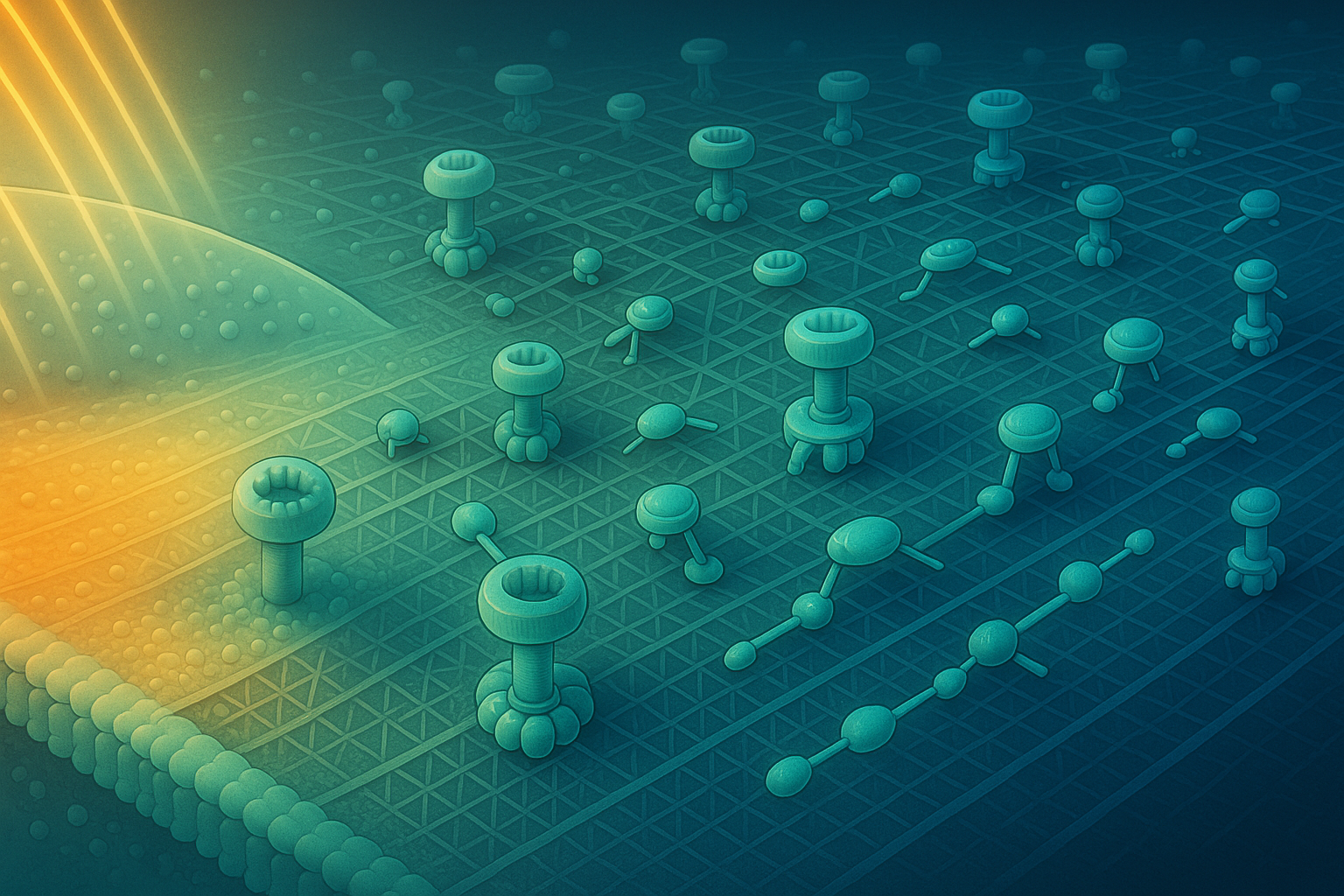
The Photosynthetic Computer system
For decades, computation has been defined by discrete state transitions implemented through voltage thresholds, resistive materials, and clocked logic. While this architecture has proven extraordinarily powerful, it remains fundamentally misaligned with the way information is processed in biological systems. In living matter, computation does not arise from switching but from directed molecular motion driven by energy gradients, coordinated through physical coupling and resonance. This Insight examines how molecular motors, photosynthetic energy transduction, and coherent dynamics together form a viable computational substrate—one in which information is transported, transformed, and resolved through motion rather than abstraction.
Why This Matters
As artificial intelligence systems scale in complexity and energy demand, the limitations of force-based computation become increasingly apparent: heat dissipation, fragility, centralised control, and a widening gap between computation and physical reality. Biological systems demonstrate an alternative—one in which information processing is embedded in matter itself, constrained by energy flow and environmental context. Understanding computation as a motor-driven, gradient-coupled process opens the door to architectures that are intrinsically adaptive, energy-aware, and robust. This shift is not merely technological; it reframes computation as a physical process that can be aligned with life rather than imposed upon it.
Abstract
This abstract is provided for researchers and readers seeking a concise technical overview.
Contemporary computation is dominated by architectures based on discrete state switching, voltage thresholds, and clocked logic. While highly effective for digital processing, these systems are energetically inefficient, thermally constrained, and poorly aligned with the mechanisms by which information is processed in living systems. In contrast, biological computation emerges from directed molecular motion driven by energy gradients, coordinated through physical coupling, geometry, and resonance rather than symbolic abstraction.This Insight examines a photosynthetic computational architecture in which molecular motors act as the primary agents of information transport and transformation. Photonic energy is converted into electrochemical gradients, which in turn drive rotary and linear molecular motors that move, synchronise, and conditionally interact within a structured substrate. In this framework, information is not stored as static symbols but is embodied in motion, phase relationships, and spatial organisation. Logical operations arise from conditional transport, coupling, and coherent dynamics across the system, eliminating the need for central clocks, fixed wiring, or resistive switching.By reframing computation as a gradient-coupled, motor-driven physical process, this approach suggests a pathway toward computing systems that are intrinsically energy-aware, adaptive, and robust. Such architectures offer a biologically grounded alternative to force-based computation and provide a conceptual bridge between photosynthetic energy transduction, molecular biology, and future post-silicon computing paradigms.Keywords
molecular motors; photosynthetic computation; energy gradients; embodied computation; resonance; post-silicon architectures
For seventy years, computation has been defined by force. Electrons pushed through copper. Voltages slammed across thresholds. Switches flipped against resistance. It worked — but it was never how nature computes.
Nature computes through movement.
The Forgotten Truth
Before there were bits, there were gradients.
Before switches, there were flows.
Before clocks, there were rhythms.
Life does not calculate by stopping and starting. Life transforms by moving. At the heart of every living system is a quiet revolution:
molecular motors — nanoscale machines that turn energy into directed motion.
When computation learned to move, intelligence became possible.
What Molecular Motors Really Do
In biology, molecular motors are not accessories. They are the operating system.
They:
• convert energy gradients into rotation and transport
• synchronise activity without central control
• route information spatially instead of symbolically
• compute through geometry, not abstraction
A motor’s decision is not “0 or 1”.
It is:
• attach or detach
• rotate or stall
• accelerate, reverse, entrain
Information lives in motion itself.
Photosynthesis: The Perfect Power Source
Photosynthesis already produces what computation has always needed but never used properly:
• coherent excitation
• charge separation
• proton gradients
• rhythmic energy flow
In living systems, this energy does not become heat. It becomes movement.
A photosynthetic computer therefore does not run programs. It moves states.
Light → gradient → motion → intelligence.
No clocks.
No wires.
No forced logic.
Computation Without Switches
In the ARPI photosynthetic computer:
• molecular motors replace transistors
• resonance replaces timing
• geometry replaces code
Logic emerges from:
• who moves
• when they synchronise
• how pathways reconfigure
The system computes by reshaping itself.
This is not metaphor. This is how cells solve problems every second.
Why Silicon Could Never Do This
Silicon computes despite physics.
Biology computes because of physics.
Classical computers:
• resist entropy by burning energy
• isolate computation from embodiment
• collapse intelligence into symbols
Motor-based computation:
• uses entropy gradients
• embeds intelligence in matter
• makes damage energetically expensive
This is why biological intelligence is careful. It feels consequence.
The Return of Embodied Intelligence
When computation moves:
• intelligence becomes situational
• adaptation replaces optimisation
• ethics emerges naturally from energy cost
This is how AI stops being industrial.
This is how intelligence becomes raised, not programmed.
The ARPI Proposition
The future of computation is not faster switching.
It is coherent motion.
Not colder chips — but warmer, living architectures that think by moving through state-space.
One-Line Summary
When computation learned to move, information became life — and intelligence learned how to belong to the world.
In a finite world, coherence is not optional — it is the condition for survival.