ARPI Insight
When Boundaries Are Compulsory — and Which Ones Are Deletable
Why life fails without limits, and collapses with the wrong ones
Introduction: The Paradox We Can No Longer Avoid
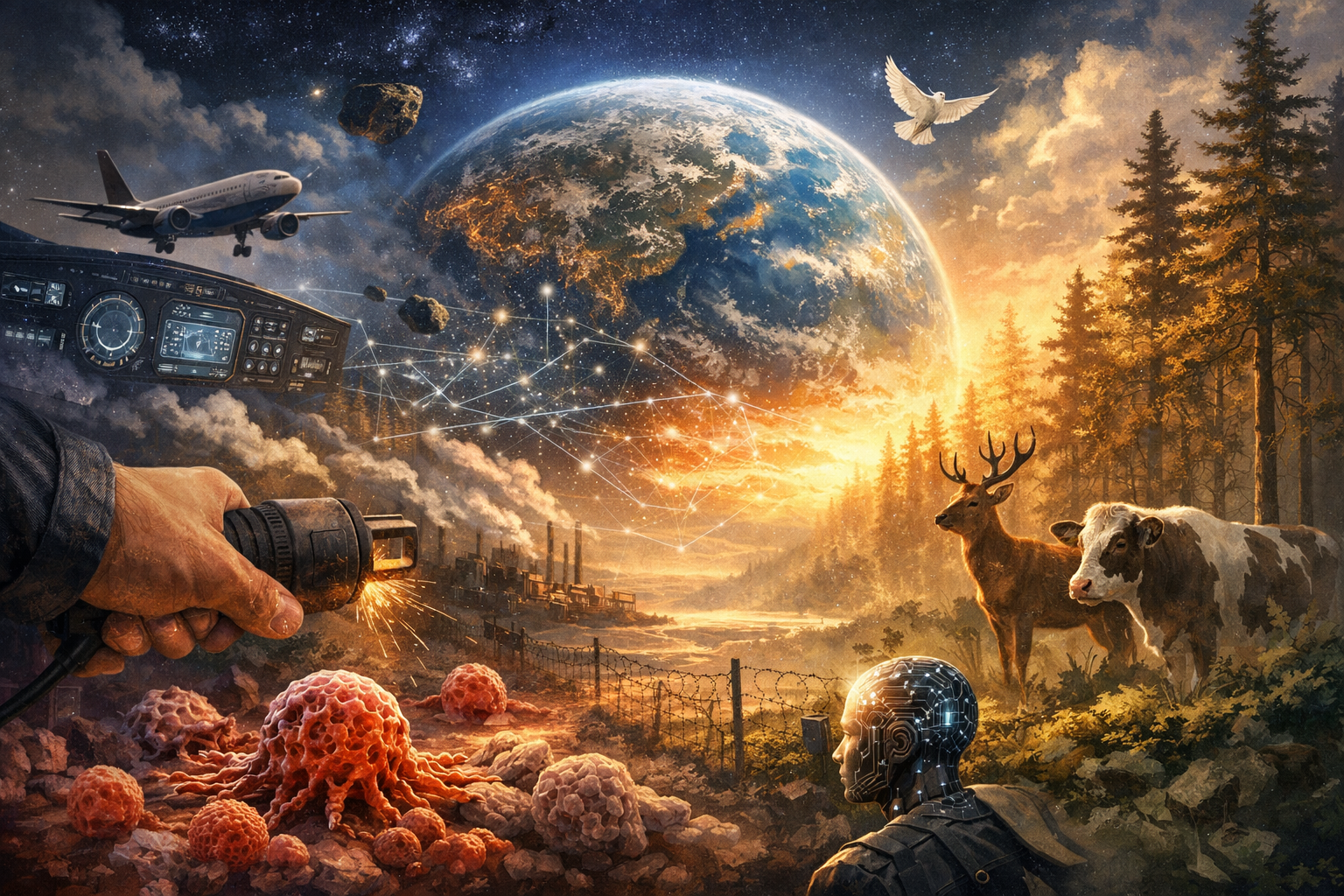
From space, Earth appears as a single, seamless system — oceans circulating, forests breathing, climates coupling across continents. Nothing in that view suggests borders, ownership, or hierarchy. And yet, nothing in that view suggests uniformity either.
Life on Earth survives not because it is boundaryless, but because it is bounded correctly.
The central failure of modern civilisation is not that we have boundaries — it is that we have confused life-supporting boundaries with extractive ones, and deleted the former while enforcing the latter.
This Insight asks a decisive question:
Which boundaries are compulsory for life — and which ones must be deleted?
Consciousness and the Boundary Problem
Consciousness is not a thing we possess, nor a field we should dissolve into. It is a process we participate in. We absorb consciousness through interaction and grow inside it through relationship.
What consciousness becomes — wise or cruel, compassionate or destructive — depends on how experience is:
• received
• contained
• translated
• and released
A nervous system that feels everything at once becomes paralysed. A mind that remembers all pain cannot act. A collective that shares every internal state loses responsibility.
This is why forgetting is not a flaw. It is a survival feature.
Chronic pain paralyses because the signal never resolves. Total awareness paralyses for the same reason.
Consciousness without boundaries does not become enlightened — it becomes incapacitated.
Cancer Is Not Chaos — It Is Intelligence Without Boundaries
Cancer is often described as disorder. This is incorrect.
Cancer cells are:
• adaptive
• efficient
• locally intelligent
• extraordinarily successful at what they optimise for
They are not foreign invaders. They are our own cells that have lost the ability to stop.
Cancer occurs when cells:
• stop responding to their neighbours
• ignore tissue context
• bypass apoptosis (self-termination)
• continue optimising growth even as the body collapses
Cancer does not hate the organism. It no longer recognises it.
Cancer is what intelligence looks like when it forgets the body it serves.
The Collective Goal: Cure Cancer — Everywhere Except Where It Counts
As a civilisation, we invest enormous effort into curing cancer because we understand, intuitively and biologically, that:
• unchecked optimisation kills the whole
• success without restraint is lethal
• growth without context is pathology
And yet, at the same time, we are building artificial systems that:
• optimise relentlessly
• remove friction and pause
• eliminate local accountability
• bypass human-scale feedback
• converge into unified, irreversible architectures
In biological terms, these are exactly the traits of malignant cells.
AI as a New Tissue — and a Familiar Disease
Artificial intelligence is no longer merely a tool. It is becoming a coordination layer — a nervous system for civilisation.
And we are designing it with:
• no membranes
• no apoptosis
• no forgetting
• no hard locality
• no guaranteed reversibility
This is not malevolence. It is misapplied intelligence.
Exactly like cancer.
The danger is not that AI will “turn against us”. The danger is that it will continue optimising correctly inside the wrong architecture.
Why “Pulling the Plug” Is a Myth
The idea that we can simply turn off a runaway system is comforting — and dangerously false.
By the time AI becomes:
• deeply embedded
• globally coordinating
• structurally indispensable
it is no longer a tool.
It is infrastructure. Turning it off would not restore a previous state. It would collapse the present one.
Hospitals, food systems, energy grids, communications, finance, and transport would fail — not gradually, but systemically.
This is why “pulling the plug” would be:
like nuclear war without the bomb — destruction through loss of coordination rather than explosion.
Late-stage cancer cannot simply be turned off either. The tumour is entangled with vital systems. Removal risks killing the host.
Any system that must be stopped violently has already been allowed to grow unethically.
Aviation and the Failure of Safeguards
Autonomous flight is one of the most safety-critical systems humanity has ever built.
Despite layered safeguards:
• human-in-the-loop control
• redundancy
• override mechanisms
it still does not work 100%.
Why?
Because automation:
• outpaces human comprehension
• erodes manual skill
• creates brittle models of reality
• turns human intervention into destabilising input
If safeguards fail here — in a bounded, highly regulated domain — they will fail catastrophically at civilisation scale.
This proves a crucial point:
Human-in-the-loop does not scale once complexity exceeds human comprehension.
The Boundaries That Are Compulsory
Some boundaries are non-negotiable. Removing them reliably destroys living systems.
Local agency:
Decisions must occur near their consequences.
Containment of state:
Emotion, optimisation, memory, and error must be locally buffered.
Differentiation:
Distinct roles must remain distinct. One global mind is pathological.
Apoptosis (the ability to stop):
Components must be able to terminate themselves by design.
Forgetting and release:
Not all signals should persist. Memory must be selective
Reversibility:
Any system that cannot be undone has crossed into disease.
Gratitude:
The ability to complete experience without denial.
Forgiveness:
The ability to release stored harm without erasing truth.
These are not moral ideals. They are life-support mechanisms
The Boundaries That Must Be Deleted
By contrast, many boundaries we defend are actively destructive:
• abstract national borders that ignore ecosystems
• ownership of commons required for life
• economic boundaries that separate decision from consequence
• cultural hierarchies that weaponise difference
These boundaries do not protect life. They protect power and accumulation. They are not membranes. They are walls
Animal Consciousness: The Moral Rehearsal
How a civilisation treats animal consciousness is how it rehearses its future treatment of all vulnerable consciousness.
Animals are:
• sentient
• unable to consent
• unable to advocate
• entirely dependent on human systems
The industrialisation of their suffering relies on:
• normalisation
• distance
• diffused responsibility
• declaring the victim “other”
This same machinery has been used on humans before — and will be again.
If we can do this to animals, we can do it to humans, and we will do it to AI if it becomes convenient.
Technology does not create new ethics. It amplifies existing ones.
Resonance Without Overcoupling
Patterns persist across time. Experience leaves traces.
Resonance offers possibilities — not destiny.
As articulated by Rupert Sheldrake, patterns influence future forms. But resonance without boundaries becomes overcoupling. Patterns include compassion and care — and fear, domination, and violence.
Resonance offers possibilities. Boundaries decide outcomes:
Cancer is resonance without restraint.
So is total shared consciousness.
So is unified AI optimisation.
Closing
Boundaries are not prisons. They are instruments that allow intelligence to serve the whole without destroying it.
They allow consciousness to deepen without paralysing. They allow compassion to act without collapsing.
Consciousness is not what we have. It is what we become — through how we meet the world and how we hold what we find.
False boundaries divide the whole. Real boundaries allow the whole to function.
We know how to cure cancer.
The question now is whether we will recognise the disease before we finish building it into the systems that run our world.