ARPI Insight
What If Einstein Had Never Used Zero?
The civilisation we might have built — and the planet we could be healing instead.
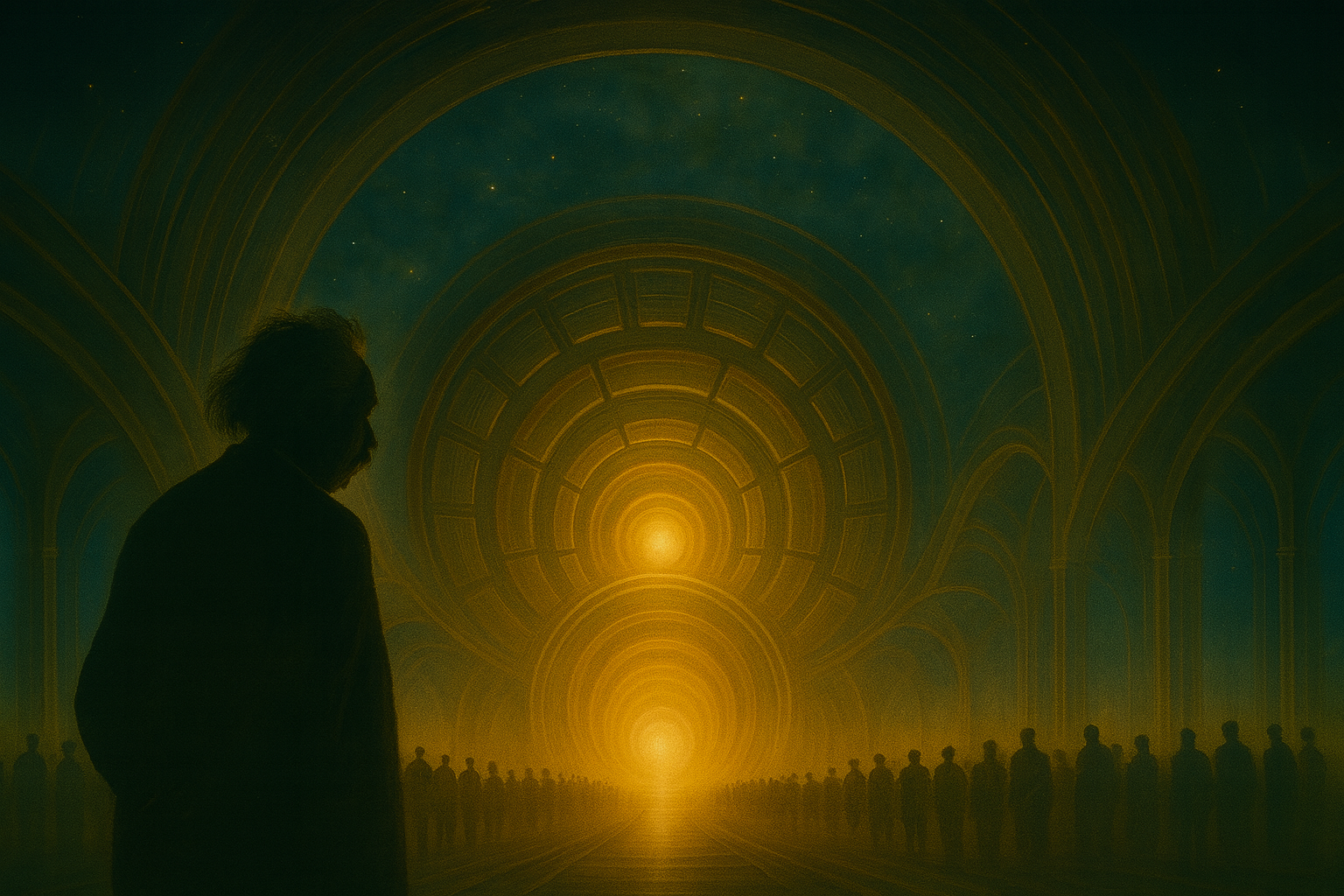
The fork in the Road Nobody Names
There is a quiet assumption hidden beneath modern physics:
Zero is real.
A true vacuum.
A true “nothing.”
A true origin point.
From that assumption, a civilisation emerges that believes truth is found by going:
• smaller
• colder
• emptier
• higher-energy
• more extreme
And so, when understanding stalls, the default response becomes: build a bigger tunnel. smash harder. search deeper. But what if Einstein had taken a different path?
What if he had built relativity without the metaphysical anchor of zero?
A zero-less Einstein changes the target of science
Without zero, physics would have been less obsessed with “final particles” and more devoted to relationships:
• not “what is reality made of at the bottom?”
• but “how does reality organise itself into form?”
Instead of hunting ultimate objects, science would have focused on:
• coherence
• coupling
• phase
• resonance
• relational fields
• living organisation
In that world, the frontier is not “smaller than the proton.” The frontier is how nature creates.
The civilisation that grows out of that physics
A zero-driven civilisation tends to become extractive:
• dig
• drill
• mine
• burn
• smash
• measure the debris
A resonance-driven civilisation tends to become restorative:
• align
• attune
• harmonise
• cultivate
• learn from living systems
• measure coherence rather than wreckage
One civilisation builds machines that force nature to confess. The other builds systems that let nature speak.
CERN as a symbol of the old reflex
This is not an attack on CERN or the brilliance of the people involved. It is a recognition of what large-collider thinking represents:
A civilisation still committed to the belief that the deepest truth lies at an imagined zero-distance scale, and that meaning increases with energy.
So we propose:
• larger tunnels
• higher power
• greater cost
• more decades
Billions, and a vast allocation of human genius. And the question must be asked plainly:
What does this do to heal our Earth?
The wasted lifeforce question
When a planet is under strain, resources are not neutral.
Every megaproject is not only money — it is:
• years of attention
• political bandwidth
• educational focus
• industrial capacity
• energy investment
• global narrative
What we fund becomes what we become.
If the next era of physics requires another tunnel, we should ask: is our theory serving life — or consuming it?
A different “collider” for a living world
In the alternative world — the one without zero — the great scientific projects might have looked like this:
• a Global Coherence Observatory (atmosphere, oceans, geomagnetic fields)
• medicine focused on resonant regulation, not chemical domination
• agriculture designed around soil vitality and symbiotic fields
• energy harvesting through alignment, not combustion
• computation based on synchrony, not switching
• education that teaches children how nature organises intelligence
In that world, “big science” is not a deeper hole in the Earth. It is a deeper partnership with the Earth.
The question that becomes our compass
So here is the ARPI challenge — gentle, but uncompromising:
If a scientific direction cannot justify itself in the language of life, it is not yet complete science.
A civilisation in transition must decide what its intelligence is for.
Not just discovery. Not just prestige. Not just legacy.
But healing. Stability. Beauty. Continuity for the children.
Closing
If Einstein had not used zero, we might have built a science that never mistook “nothing” for a foundation. And if we now choose resonance over zero, we may still become the civilisation that learns to do what nature does best:
create through coherence.
evolve through alignment.
heal through harmony.
In a finite world, coherence is not optional — it is the condition for survival.