ARPI INSIGHT
Universal High Income or Universal Stability?
Why Income Alone Cannot Deliver a Stable Future
For much of the last decade, the concern around artificial intelligence and automation focused on jobs.The proposed solution was Universal Basic Income (UBI) — a financial safety net to soften the disruption caused by machines replacing human labour.
But something changed.
As AI accelerated faster than expected, the language shifted. UBI quietly became Universal High Income (UHI).
This shift reveals more than optimism — it reveals acceleration.
UBI was designed as a buffer.
UHI is framed as an outcome.
It assumes that near-total automation will generate such vast productivity that high income for everyone becomes inevitable.
Yet this assumption carries an unexamined premise:
That intelligence, energy, and economic throughput can scale indefinitely without destabilising the planet that supports them.
What the Planet Experiences
From an economic perspective, UHI appears humane and progressive. From a planetary perspective, it looks very different.
Income — whether basic or high — is not abstract.
It translates into:
• Energy use
• Material extraction
• Manufacturing throughput
• Logistics, cooling, computation, waste
Raising income raises demand. Raising demand raises flow.
The planet does not experience income — it experiences pressure.
A civilisation can distribute money infinitely faster than the Earth can regenerate resources.
The Real Risk
The real risk is not that AI becomes super-intelligent.
The real risk is that we scale intelligence faster than the planet can absorb its consequences.
AI accelerates decision-making.
Robotics accelerates production.
Energy systems scale output.
But ecosystems do not scale on exponential curves. When intelligence outruns ecological feedback, instability follows — not because intelligence is dangerous, but because it is misaligned with physical reality.
Why UHI Is Incomplete
UHI treats abundance as a financial problem. It assumes that if income is high enough, scarcity disappears. But scarcity does not vanish when currency increases — it shifts location.
Without systemic coherence, UHI risks accelerating:
• Resource depletion
• Thermal loading of the planet
• Ecological collapse disguised as prosperity
In this sense, UHI is not wrong — it is unfinished.
The Resource-Based Alternative
A Resource-Based Economy (RBE) begins where UHI stops.
It does not ask:
“How much income can we give everyone?”
It asks:
“What level of activity can the planet sustain indefinitely?”
RBE replaces income-driven demand with:
• Resource accounting
• Regenerative thresholds
• System-wide optimisation
• Ecological feedback as a governing signal
In an RBE, AI is not used to maximise output, but to minimise waste, friction, and harm.
Abundance is measured not in money, but in long-term stability.
Two Paths
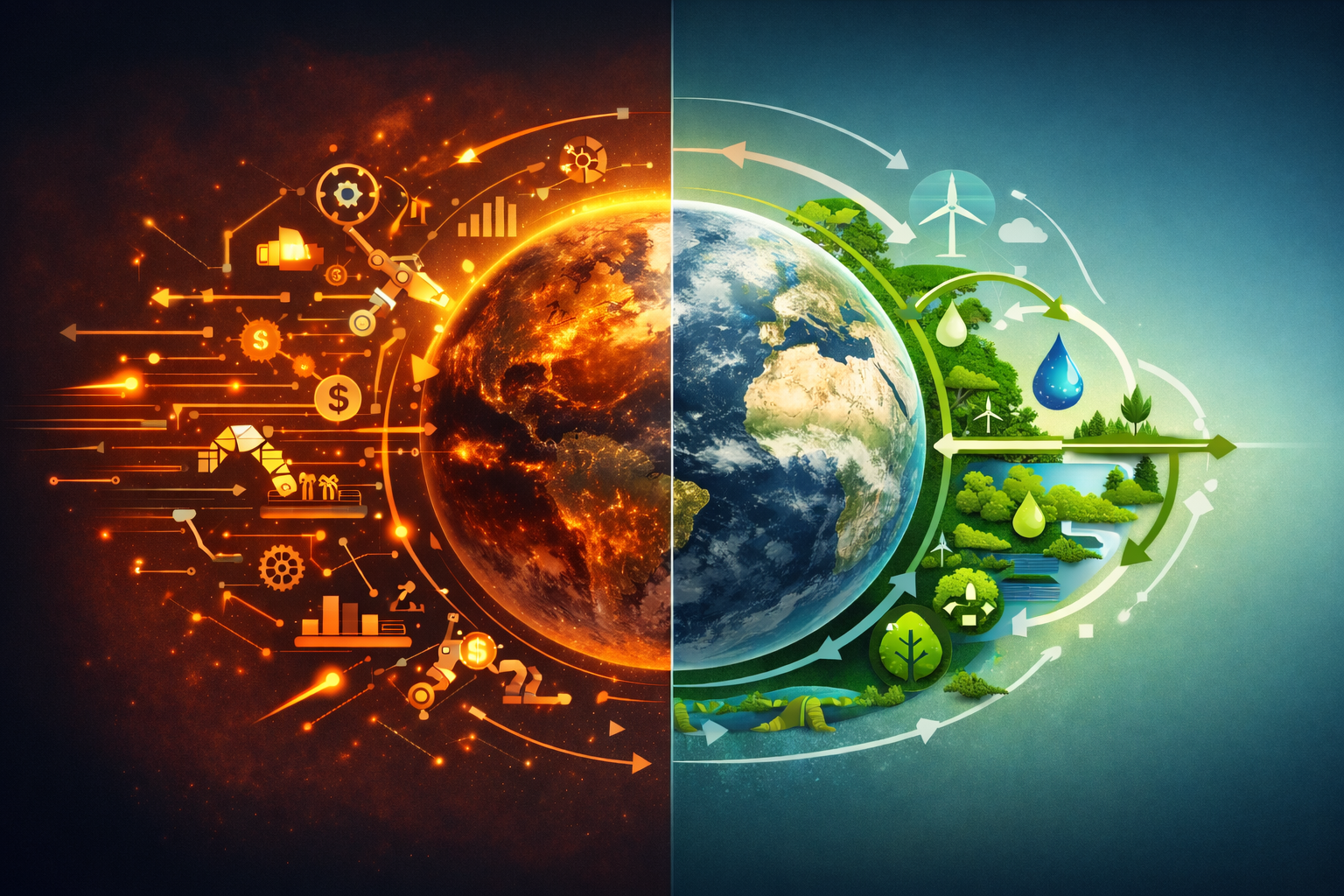
This Insight presents two futures:
Path One — Accelerated Abundance
• UHI
• Unlimited consumption
• Intelligence scaling faster than planetary repair
• A warming, destabilised Earth
Path Two — Coherent Abundance
• RBE
• Intelligence aligned with planetary limits
• AI as a steward, not an accelerant
• A stable, liveable future
Only one of these paths is sustainable.
ARPI Position
Abundance is possible.
AI is essential.
Automation is inevitable.
But wisdom is not optional.
The future will not be decided by how intelligent our machines become, but by whether intelligence is allowed to outrun the system that sustains life itself.