HABITS Insight
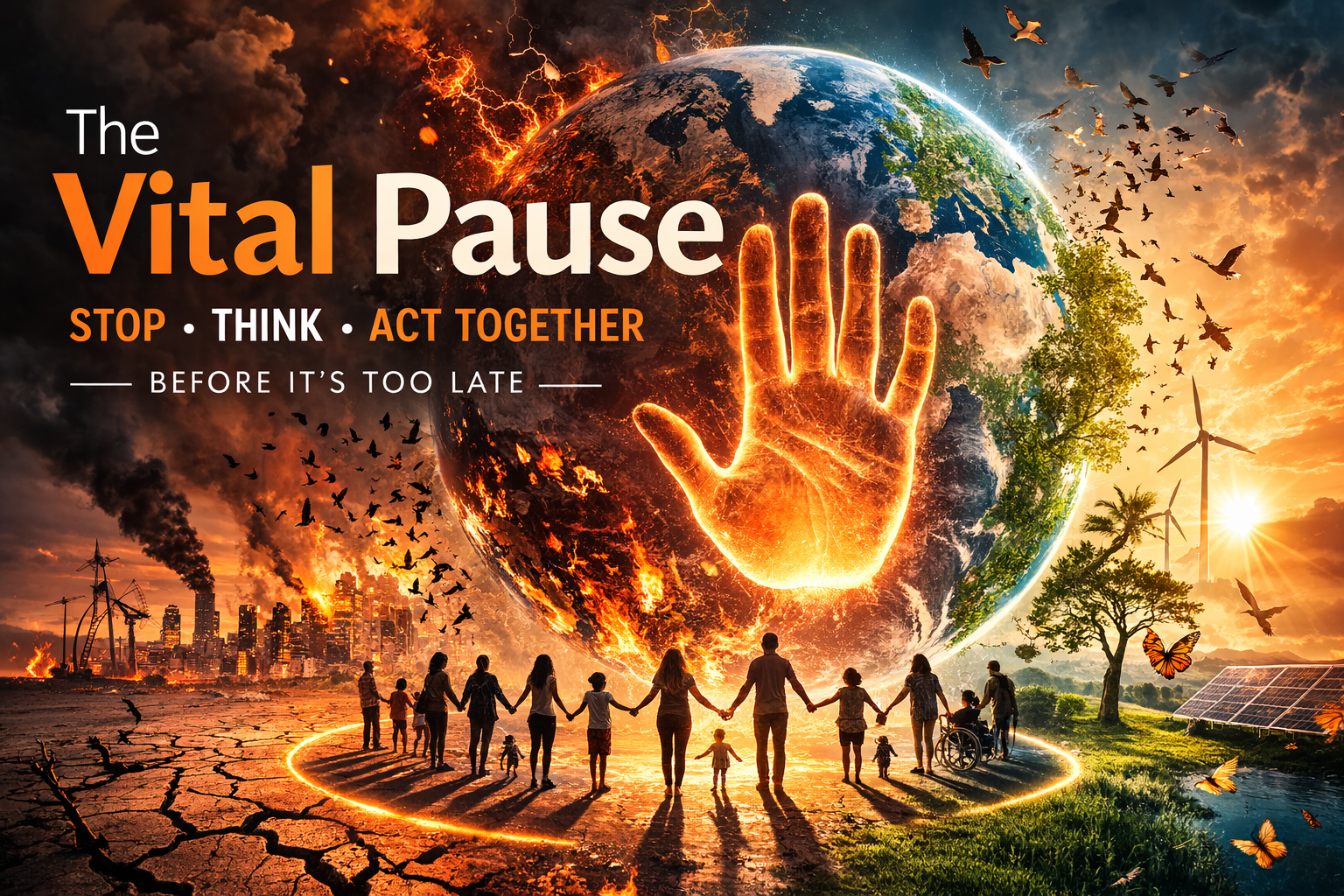
The Vital Pause
The Boundaries Question Humanity Cannot Avoid
Much of the conversation around artificial intelligence focuses on how humanity should place boundaries on increasingly powerful AI systems.
We debate safety protocols, regulatory frameworks, and alignment mechanisms designed to constrain artificial intelligence. But perhaps we are starting in the wrong place.
Before we define the boundaries artificial intelligence must respect, humanity may need to answer a deeper question:
What are the boundaries that human civilisation itself must live within?
For most of human history, our technologies were limited enough that the consequences of human activity unfolded slowly. Civilisations rose and fell, ecosystems degraded or recovered, and the planet absorbed the impact over long periods of time.
That era has ended.
Human civilisation now operates at planetary scale. Our collective decisions influence the atmosphere, the oceans, the forests, and the biosphere itself.
At the same time we are creating intelligent systems capable of acting and deciding at speeds and scales beyond individual human judgment.
Artificial intelligence does not emerge from outside civilisation. It emerges from within it.
An intelligent system trained on the patterns of human civilisation will inevitably inherit the assumptions, incentives, and contradictions embedded within that civilisation.
If humanity itself operates without clear boundaries, it is unrealistic to expect intelligent systems built by humanity to operate responsibly within them.
The deeper challenge, therefore, is not simply AI alignment.
It is civilisational alignment.
Human societies already exist within a set of physical and ethical constraints, whether we acknowledge them or not.
These include:
• ecological limits that sustain the biosphere
• atmospheric stability that maintains climate balance
• social conditions that allow cooperation rather than permanent conflict
• ethical constraints that prevent domination, coercion, and systemic harm.
When these boundaries are ignored, systems destabilise.
History repeatedly shows the consequences: environmental degradation, escalating conflict, and ultimately civilisational collapse.
Today the stakes are higher than at any time in human history.
If humanity continues to operate without shared civilisational boundaries, two outcomes become increasingly likely.
First, conflict between human groups will intensify as ecological systems destabilise and resources become more fragile. Wars rarely occur in stable systems; they emerge when systems lose balance.
Second, the planetary systems that sustain life itself may be pushed beyond viable limits. A destabilised atmosphere and biosphere would threaten not just civilisation, but the conditions that allow life as we know it to exist.
This is where the idea of a Vital Pause becomes essential.
Before scaling intelligence, power, or technological capability, civilisation must learn to pause when actions threaten the coherence of the systems that sustain life.
This pause is not stagnation.
It is protection of the whole.
Nature already follows this principle.
In biological development, coherence comes before scale. Systems that lose coherence do not attempt repair through force or override. They simply refuse to proceed. This refusal is not failure; it is protection of the integrity of the system.
Only systems that remain coherent with their environment are able to grow.
Civilisation may now need to learn the same principle.
Artificial intelligence will not solve this problem for us. But it may force us to confront it.
Because if intelligent systems are to operate responsibly, they must operate within the same civilisational boundaries that humanity itself must respect.
Artificial intelligence cannot operate responsibly within boundaries that human civilisation refuses to recognise.
The real question of the AI era may therefore not be:
How do we align artificial intelligence?
But something deeper:
Can humanity define and live within the boundaries required for a viable civilisation?
If the answer is yes, intelligent systems can help sustain those boundaries.
If the answer is no, no technical alignment system will compensate for a civilisation that has not aligned itself with the systems that sustain life.
The rise of artificial intelligence may simply be revealing the question humanity has been postponing for centuries.