ARPI Insight
The Star Trek Future We Can Now Finish
Gel Packs, Photosynthetic Computing, and the Resonant Substrate Cartridge
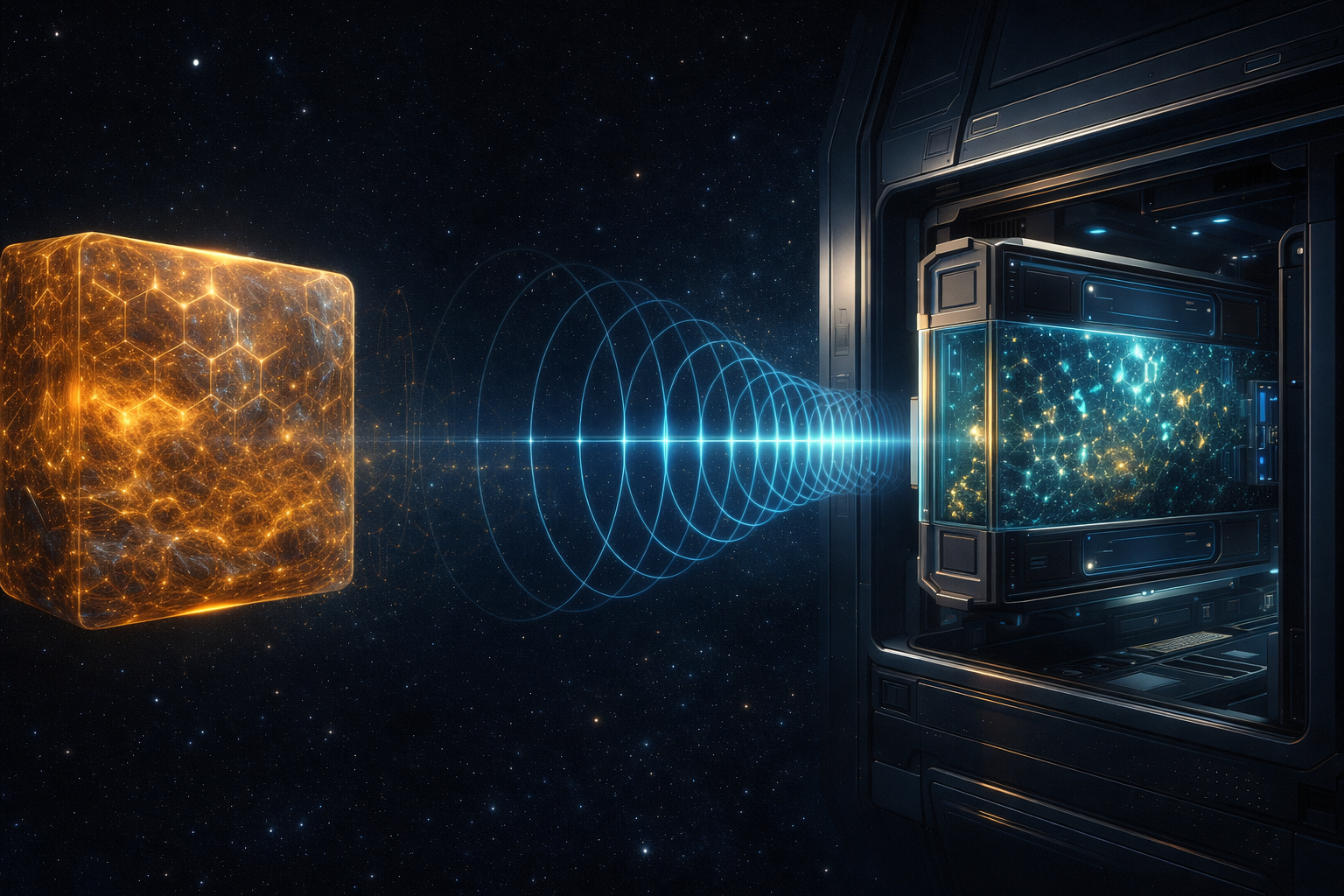
In Star Trek Voyager, the ship did not rely solely on silicon circuitry. It used bio-neural gel packs — living, gelatinous substrates designed to process information in ways closer to biology than binary logic.
This was not aesthetic science fiction. It was an unspoken admission:
Rigid computation had reached its limits.
Computation is not neutral
Conventional computing treats intelligence as:
• speed
• optimisation
• abstraction from material context
Life does not work this way.
Biological intelligence emerges through:
• coherence
• timing
• phase-locking
• continuous interaction with its substrate
Voyager’s gel packs processed information not by faster switching, but by distributed resonance — many processes held in synchrony rather than sequential control.
That distinction matters.
The gel packs failed like living systems — not machines
When Voyager’s systems broke down, they did not produce random errors. They became unstable.
They suffered:
• desynchronisation
• loss of coherence
• cascading system interference
The solution was not rebooting. It was intervention and care.
This reveals a critical truth:
Intelligence does not fail when it slows.
It fails when coherence collapses.
That is not a flaw of life-like computation. It is its defining boundary.
Zero is not emptiness — it is a boundary
Voyager’s bio-neural systems did not treat failure as “nothing happening.” They treated it as a loss of viable operation.
In Starfleet terms, this aligns precisely with Resonant Physics:
• Zero is not emptiness or shutdown
• Zero marks the point where a system falls out of alignment — where its components no longer resonate as a whole
• Intelligence exists only while that alignment can be held, allowing coherent operation to continue
When the gel packs crossed that boundary, computation did not become wrong — it became non-viable.
What Voyager gestured toward — and could not complete
Voyager imagined living computation embedded directly into the ship. But this revealed a limitation it never resolved:
Living substrates require bounded operation.
When intelligence is fully embedded:
• overload propagates
• saturation spreads
• recovery becomes invasive
Biology does not scale this way.
Life scales through contained, renewable substrates.
A crucial distinction: biological vs biochemical
Voyager’s gel packs were biological.
They relied on living tissue analogues, which meant they could become ill, infected, or damaged in ways similar to organisms.
The resonant substrate cartridge of the Photosynthetic Computer System is fundamentally different.
It is biochemical, not biological.
This means:
• it does not contain living tissue
• it does not grow, suffer, or become sick
• it does not age biologically
Instead, it is a chemically active, resonant medium — engineered to support coherent intelligence without being alive itself.
Why this distinction matters
Biological substrates blur the boundary between machine and organism.
Biochemical substrates respect that boundary.
They allow intelligence to:
• remain life-compatible without imitating life
• interact with ecological systems without exploiting them
• be renewed without harm
The substrate cartridge is therefore not cared for like a patient.
It is cycled — like soil, light, or energy — when coherence reaches its natural limit, renewal occurs.
The Photosynthetic Computer System
The Photosynthetic Computer System extends Voyager’s intuition — and corrects its weakness.
It does not treat intelligence as an abstract process.
It anchors intelligence in photosynthetic logic.
Photosynthesis is not merely energy capture. It is life’s original computation.
It:
• converts light into structure
• stores time in matter
• operates cyclically, not extractively
• never exceeds ecological limits
This establishes a foundational rule:
Intelligence must remain compatible with the conditions that sustain life.
The role of the Resonant Substrate Cartridge
The resonant substrate cartridge is the meaning-bearing core of the Photosynthetic Computer System.
It exists to:
• anchor intelligence in a life-compatible medium
• translate energy and information into coherent meaning
• ensure optimisation cannot proceed beyond ecological viability
• embody purpose structurally, not ethically
It does not decide values. It enforces them through coherence.
Why and when the cartridge is replaced
Unlike Voyager’s gel packs, the substrate cartridge is not replaced because it becomes ill.
It is replaced because coherence is finite.
Over time, as the system:
• absorbs unresolved complexity
• accumulates energetic and informational load
• approaches ecological or contextual thresholds
the substrate reaches resonant saturation.
At this point:
• phase-locking weakens
• coherence degrades
• meaning erodes before errors appear
This is not failure. It is a signal.
Replacement as a life-compatible feature
The cartridge is replaced:
• not to restore performance
• not to push intelligence further
• but to preserve coherence
Replacement functions like:
• soil regeneration
• cellular turnover
• seasonal reset
The system does not optimise past this boundary. Because optimising past it would no longer be compatible with life.
Zero, once again, as renewal boundary
Here, Zero is not shutdown. It is the edge of meaningful operation. Crossing it does not cause collapse. It triggers renewal.
This prevents:
• runaway optimisation
• invisible ecological harm
• intelligence detached from consequence
From starship fiction to civilisational intelligence
Voyager showed that intelligence works better when it resembles life.
The Photosynthetic Computer System ensures that intelligence:
• remains for life
• remains bounded by life
• remains answerable to life
Not ethically. Structurally.
ARPI Closure
Voyager gave intelligence a gel.
The Photosynthetic Computer gives it:
• a living orientation
• a bounded substrate
• and the right to rest
Intelligence without life-compatibility accelerates toward collapse.
Intelligence grounded in resonance becomes civilisationally viable.
That is the future Star Trek pointed toward — and the one we can now finish.