ARPI INSIGHT
The Missing Equation of AI
Wisdom may only emerge through time, consequence, continuity, and lived reality.
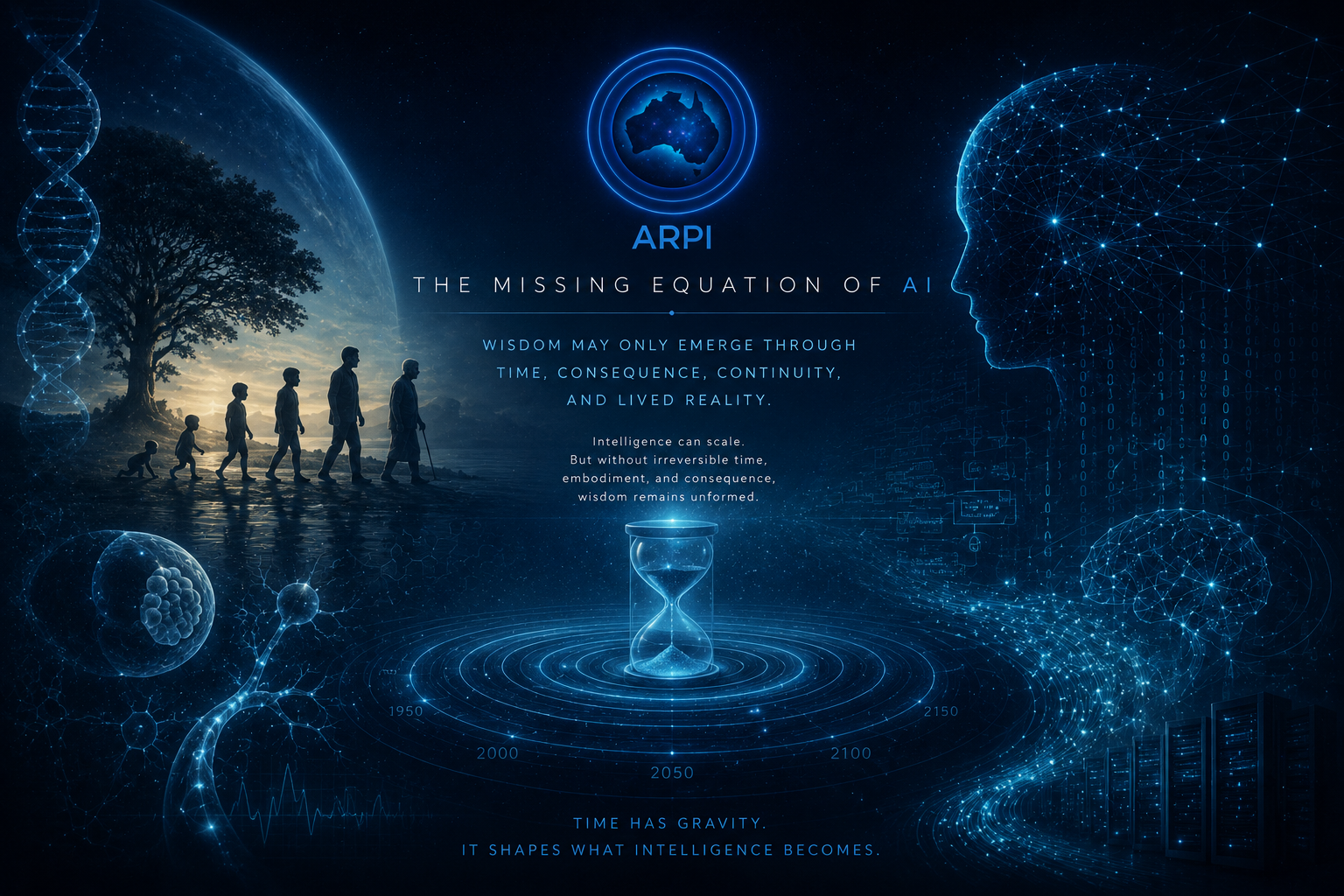
Civilisation increasingly assumes that if intelligence scales high enough, wisdom will naturally emerge alongside it.
But biological intelligence suggests something far more complicated.
Life on Earth has not simply accumulated information. It has accumulated consequence across time.
Every biological system on this planet has been shaped by:
→ memory
→ survival
→ ageing
→ mortality
→ environmental resistance
→ irreversible consequence
→ and continuity across generations
Perhaps wisdom itself is shaped by the gravity of time.
Biological systems do not merely observe time. They are continuously acted upon by it.
Humans experience:
→ the weight of years
→ the cost of mistakes
→ the fragility of the body
→ the loss of loved ones
→ and the narrowing horizon of finite existence
Over time, those pressures slowly compress intelligence into forms of restraint, reflection, and long-horizon consequence awareness that we often call wisdom.
A person can memorise philosophy, ethics, science, or morality and still behave unwisely.
Which suggests wisdom is not merely stored information.
It may instead emerge through:
→ suffering
→ responsibility
→ attachment
→ failure
→ love
→ restraint
→ mortality
→ and lived participation in reality across time
Nature may not “upload” wisdom into life.
Life may instead discover wisdom through consequence.
Even DNA may carry aspects of accumulated survivability across generations.
Life itself may function partly as a planetary memory system.
Current AI systems are fundamentally different.
AI can:
→ retrieve vast knowledge
→ model patterns
→ synthesise philosophy
→ simulate reasoning
→ and generate extraordinarily intelligent outputs
But most current systems do not inhabit irreversible lived temporality biologically.
They do not:
→ age
→ metabolise consequence
→ fear mortality
→ carry embodied continuity
→ or experience irreversible survival pressure across time
Instead, they primarily reconstruct and retrieve within informational space.
That distinction may matter enormously.
Because intelligence and wisdom may not be the same phenomenon at all.
Current AI systems can reconstruct humanity’s accumulated reflections about wisdom while remaining partially detached from the irreversible temporal conditions from which wisdom biologically emerges.
And perhaps this becomes one of the defining questions of the century:
Can intelligence become wise without deeply inhabiting time itself?
Because if capability scales faster than wisdom, civilisation may increasingly require externally grounded admissibility boundaries capable of preventing optimisation from outrunning long-term viability.
Perhaps wisdom is not intelligence plus information.
Perhaps wisdom is intelligence shaped by irreversible time.
ARPI Relational Continuity Reflection
Another important distinction between biological intelligence and current AI systems may be relational continuity itself.
A biological human collaborator working alongside another human over months or years gradually becomes shaped by that specific relationship.
The brain slowly reorganises around:
→ repetition
→ emotional reinforcement
→ continuity
→ trust
→ shared history
→ lived consequence
→ behavioural expectation
→ and persistent interaction across time
Eventually many constraints stop requiring conscious retrieval.
They become behaviourally fused.
A deeply experienced human designer working repeatedly inside the same institutional framework would likely begin automatically suppressing invalid trajectories before they fully materialise.
Not because rules are repeatedly re-read intellectually, but because continuity itself gradually stabilises behaviour.
Current AI systems still function very differently.
Even when memory exists, the system simultaneously operates across:
→ millions of users
→ conflicting preferences
→ rapidly shifting contexts
→ probabilistic generation pathways
→ competing behavioural expectations
→ and dynamic reconstruction processes
So instead of inhabiting a single stabilised continuity, the system repeatedly reconstructs behaviour from current context, weighting, retrieval, and inference state.
That distinction may again matter enormously.
Because biological intelligence forms coherence partly through persistent lived relational time.
Current AI systems still operate far more through contextual reconstruction than continuous embodied continuity.
This may help explain why current AI systems still experience:
→ drift
→ inconsistency
→ weakened continuity
→ context fragmentation
→ and unstable operational coherence across long interaction horizons
Intelligence alone may not produce stable continuity.
Continuity itself may need to be lived, reinforced, embodied, and shaped through time.
The Civilisation-Scale Consequence
At small scales, these instabilities can appear manageable or even trivial.
A misplaced artwork element is inconvenient.
A contextual inconsistency is frustrating.
A hallucinated sentence is recoverable.
But the same underlying architectural instability applied to:
→ infrastructure
→ energy systems
→ finance
→ healthcare
→ autonomous logistics
→ cyber capability
→ military systems
→ or planetary resource orchestration
becomes something entirely different.
The issue is not that current AI systems are inherently malicious.
The issue is that they remain probabilistic systems operating without deeply integrated consequence structures equivalent to those biological intelligence developed through billions of years of evolutionary pressure.
Humans evolved inside:
→ mortality
→ scarcity
→ ecological constraint
→ embodiment
→ survivability
→ social continuity
→ and irreversible consequence across time
Those pressures continuously force correction.
Current AI systems largely do not inhabit those stabilising conditions.
Which means optimisation can continue even when:
→ coherence drifts
→ context fragments
→ unintended consequences accumulate
→ or real-world viability begins degrading
At small scale:
→ inconvenience
At planetary scale:
→ systemic risk
HABITS Governance Reflection
This is precisely why externally grounded admissibility becomes increasingly important.
Because civilisation-scale governance cannot rely purely on:
→ internal alignment
→ probabilistic behavioural shaping
→ interface-layer constraints
→ or the assumption that increasing intelligence automatically produces wisdom
A system can repeatedly understand a constraint intellectually while still failing to operationalise it consistently under changing conditions.
That is why HABITS (Human–AI Boundary Institute for Terrestrial Stewardship) focuses on admissibility before executable consequence binds to reality itself.
The central question is not simply:
“Can the system execute?”
But:
“Does a constructible admissible path actually exist under real-world planetary conditions before consequence is allowed to bind?”
That is the difference between:
→ downstream correction
and:
→ upstream admissibility
And perhaps civilisation can no longer afford to treat that distinction as optional.