ARPI Insight
The Memristor & the Return of Resonant Computation
How a missing piece of electronics quietly reveals nature’s deeper architecture.
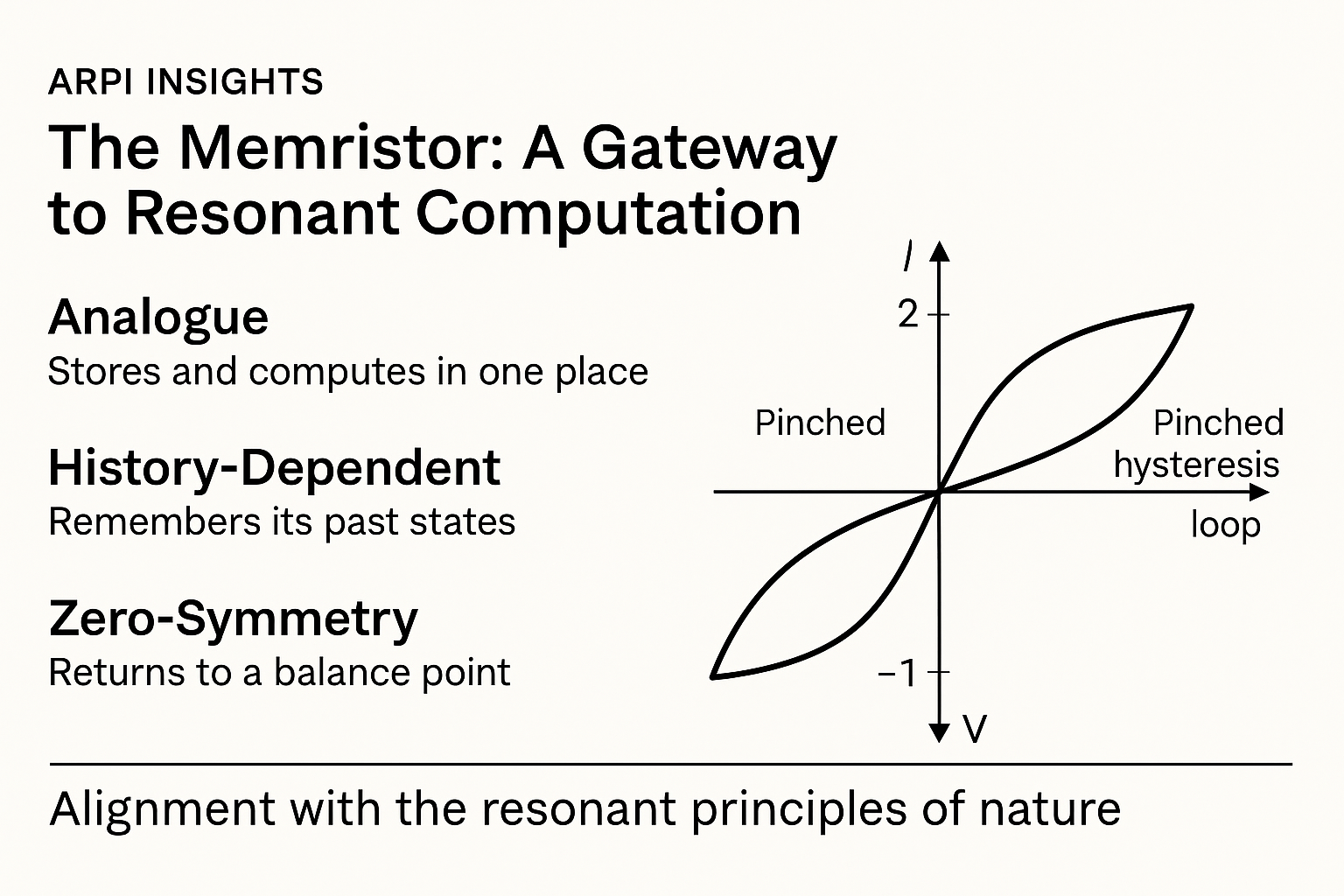
A New Glimpse Into How Nature Computes:
Today we revisited a technology first imagined over 50 years ago:
The Memristor — a circuit element that “remembers” its past.
Originally described by Professor Leon Chua, the memristor sat in theory for decades until laboratories finally realised it physically. But despite all the engineering excitement, something essential has gone unnoticed:
The Memristor behaves like a resonant system, not a digital one. It does not simply switch ON or OFF. It settles into states shaped by continuity, history, and coherence.
This makes it fundamentally different from the transistor — the workhorse of modern computation. And it is here that ARPI sees the deeper pattern.
Memory and Computation in One Place — A Resonant Principle
In conventional computing, memory lives in one location, computation in another. Data shuttles endlessly between them, consuming enormous energy.
Biology does not work this way.
• A synapse stores information and computes with it at the same location.
• Learning in the brain is simply the modification of resonance pathways.
• Energy efficiency emerges from coherence, not brute force.
A Memristor mimics this beautifully.
Its resistance — its “weight” — is not a number stored in a register.
It is a physical, resonant state that encodes history.
In other words:
The Memristor is the first engineered device that behaves like a tiny piece of biological intelligence.
This is a conceptual bridge ARPI immediately recognises.
The Zero-Crossing: A Hidden Symmetry
Memristors exhibit a distinctive curve called the pinched hysteresis loop. No matter the signal, the curve always crosses precisely through the origin — the point where voltage and current both return to zero.
For engineers, this is a mathematical signature.
For ARPI, it is something deeper:
A forced return to symmetry.
A moment of perfect balance.
A Zero state.
Not a philosophical abstraction, but a physical behaviour.
This is exactly the pattern we study across natural systems:
• ecosystems returning to equilibrium
• orbits stabilising
• waves resolving to resonance
• learning systems settling into coherent states
The Zero crossing in a memristor is a small window into a universal behaviour:
Nature always resolves complexity through symmetry.
Why This Matters for ARPI
Our research explores how coherence, resonance, and Zero-shaping principles give rise to order in biology, physics, and computation. The Memristor offers a real-world example:
• analogue, not binary
• history-dependent, not stateless
• energy-efficient, not extractive
• resonant, not segmented
• memory-as-state, not memory-as-storage
This aligns naturally with ARPI’s long-term vision:
Resonant Computing:
Computers that use coherence rather than brute force.
Systems that learn the way nature learns.
Energy architectures modelled on biological efficiency.
One day, such principles may shape our work on:
• algae-based photosynthetic computation
• coherence-guided materials
• resonance-first energy systems
• neuromorphic ecology models
The Memristor is not our destination — but it is a meaningful signpost along the path we are exploring.
Closing Reflection
The most important part of today’s insight is simple: The Memristor makes visible a pattern that ARPI already studies. Not because it is new,but because it reminds us that technology and nature converge whenever resonance is understood.
That convergence is what ARPI exists to map.