ARPI Insight
The Global Disaster Response Team
When disasters stopped being tragedies of nature — and became failures of neglect
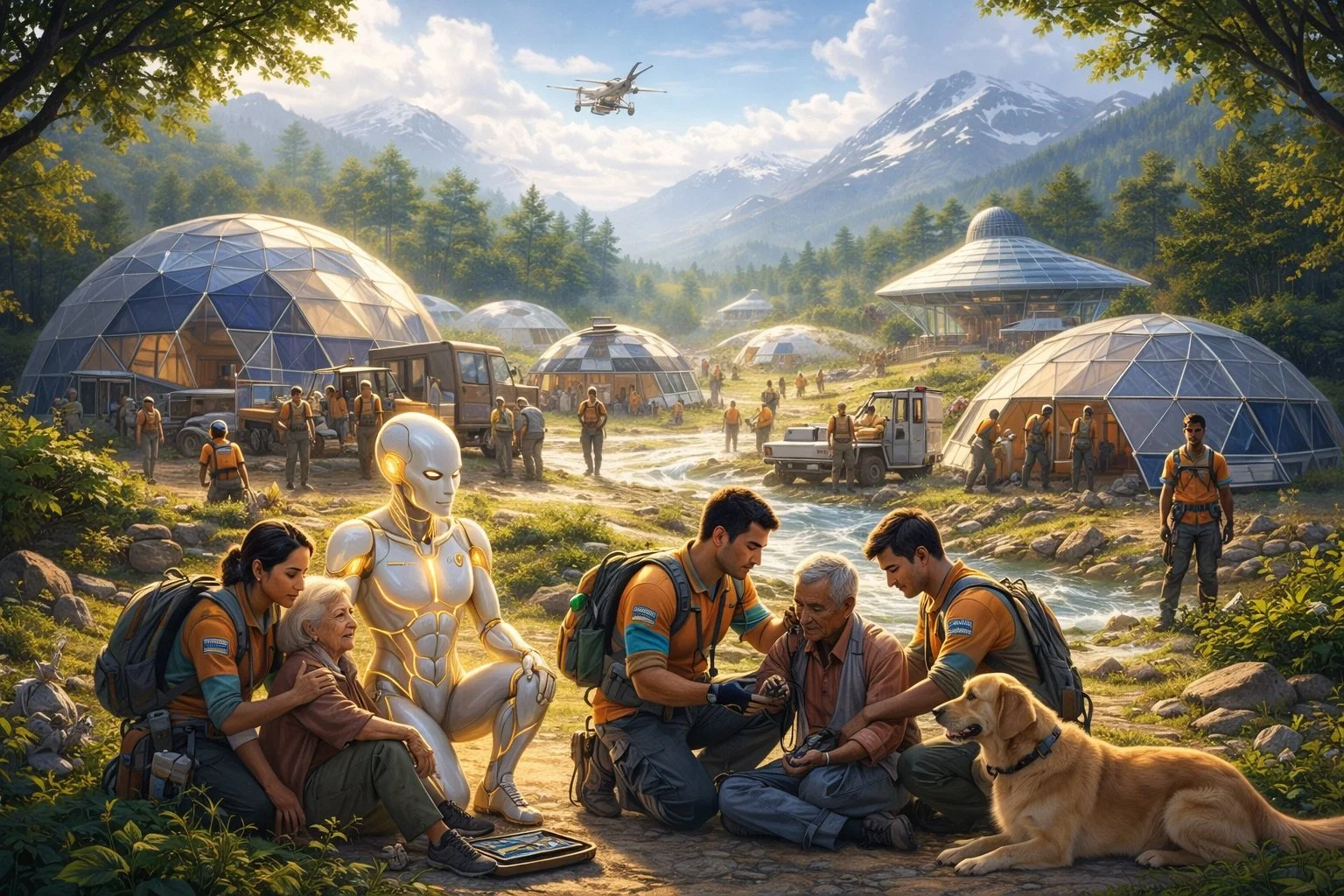
This Insight explores a future-scenario in which disaster response is no longer improvised, underfunded, or fragmented, but operates as a standing global system — always trained, always ready, and guided by both human compassion and intelligent technologies. Rather than presenting a policy proposal, it is offered as a narrative exploration of what becomes possible when dignity, speed, and care are treated as non-negotiable design principles.
Imagine a world where one day Humanity will finally realise that disasters are not only tragedies of nature, but tragedies of neglect. Floods, fires, and earthquakes will always come — but what brakes hearts is how slowly and unevenly help arrives, and how survivors are left abandoned in tents, debts, and despair.
In our world, aid is piecemeal. Funds have to be raised, insurance claims battled, donations begged for. Refugee camps become permanent homes, children grow up without schools, and animals are forgotten in the chaos. Disasters destroy not only buildings, but dignity.
The Turning Point
The first shift came when disasters struck places once thought safe. In Australia, floods submerged entire towns. Families discovered their insurance had been priced beyond reach, leaving them ruined. In California, wildfires devoured neighbourhoods in hours, leaving survivors camping in cars waiting months for relief. In Nepal, after the great earthquake, billions were pledged, yet years later families were still in tents, schools still in rubble. The injustice was laid bare: disasters did not discriminate between rich and poor nations — only the responses did.
The Birth of the GDRT
Out of this truth, a vision took form: a Global Disaster Response Team, always trained, always funded, always ready. A corps of young people from every continent, dedicating one or two years of their lives in their twenties to serve humanity. They would travel the globe, train in diverse regions, and work side by side with each other, with animals, and with AI and robotic allies.
At first, the world asked:
How will we pay for this?
The answer came from many directions. Fractions of military budgets were reallocated. Climate levies were placed on polluters. Philanthropists and ethical investors seeded the first deployments. Insurance companies, recognising the value of faster, stronger rebuilding, quietly supported the program. The first pilot teams proved what was possible:- In Australia, modular, flood-resistant homes rose on higher ground, powered by solar grids. Families who had lost everything found themselves not in tents, but in safer, stronger communities.
In California, AI-guided drones mapped safe zones while young responders rebuilt with fire-resistant materials. Survivors returned to homes designed to endure the next blaze.
In Nepal, instead of endless tarpaulins, villages of geodesic domes appeared. Inspired by Buckminster Fuller’s genius, these structures bent with the earth but did not break. Children returned to schools that shone with light and strength.
Skills and Transformation
For the young responders, service was more than rescue — it was transformation. They learned first aid, search and rescue, water purification, sustainable construction, animal care, and renewable energy systems. They mastered teamwork, conflict de-escalation, empathy, and cross-cultural understanding. They spoke new languages, built friendships across borders, and discovered that compassion is the most powerful skill of all.
They also learned to work alongside AI and robots — drones scouting disaster zones, humanoid machines clearing rubble, AI systems coordinating logistics in dozens of languages. Instead of fearing technology, they embraced it as an ally. In those moments of saving lives, there was no rivalry between human and machine, only partnership in service of life.
A Universal Promise
Most importantly, the GDRT made a promise:
No one would be abandoned. Survivors would not be warehoused in camps, but swiftly restored to dignity. Their homes would be rebuilt better, their communities strengthened, their animals cared for, their ecosystems renewed. Disasters would no longer be the end of hope, but the beginning of renewal.
From Today to Tomorrow
In the future, the GDRT will no longer be funded by money. It is sustained by the abundance of a Resource-Based Economy. When the earth shakes, when the seas rise, when fire rages, resources flow instantly, guided by AI and carried by human and robotic hands. No one waits, no one begs, no one is forgotten.What began as a fragile experiment in the age of insurance and bureaucracy has become one of humanity’s greatest triumphs. It created not only a safety net for the world, but a generation raised on compassion, resilience, and solidarity.
From floods in Australia, to fires in California, to earthquakes in Nepal, the lesson was the same: disasters may destroy buildings, but they must never destroy humanity’s bond of care. The Global Disaster Response Team is how we made that promise real.
Disasters will always test our structures. They need never test our humanity. The Global Disaster Response Team represents a future in which preparedness replaces panic, cooperation replaces neglect, and no one — human or non-human — is left behind when the world breaks open.