ARPI INSIGHT
The Future of Transportation
Designing Motion Without Decay
For over a century, transportation has been built on a single assumption, that movement requires friction, ownership, and continuous material sacrifice.
Tyres wear to provide grip.
Roads erode to carry weight.
Vehicles sit idle most of the time, owned rather than used.
Pollution is treated as an unfortunate side effect of “progress.”
As autonomous systems emerge, this assumption quietly breaks.
When vehicles can move themselves, coordinate collectively, and arrive only when needed, ownership is no longer essential. Mobility shifts from possession to access. From idle assets to shared flow.
At the same time, the most damaging part of transport becomes clear.
It is not the last kilometre. It is the long, high-speed haul — especially heavy freight grinding tyres against asphalt for hundreds of kilometres, shedding particulates into air, soil, and waterways.
A different future becomes possible.
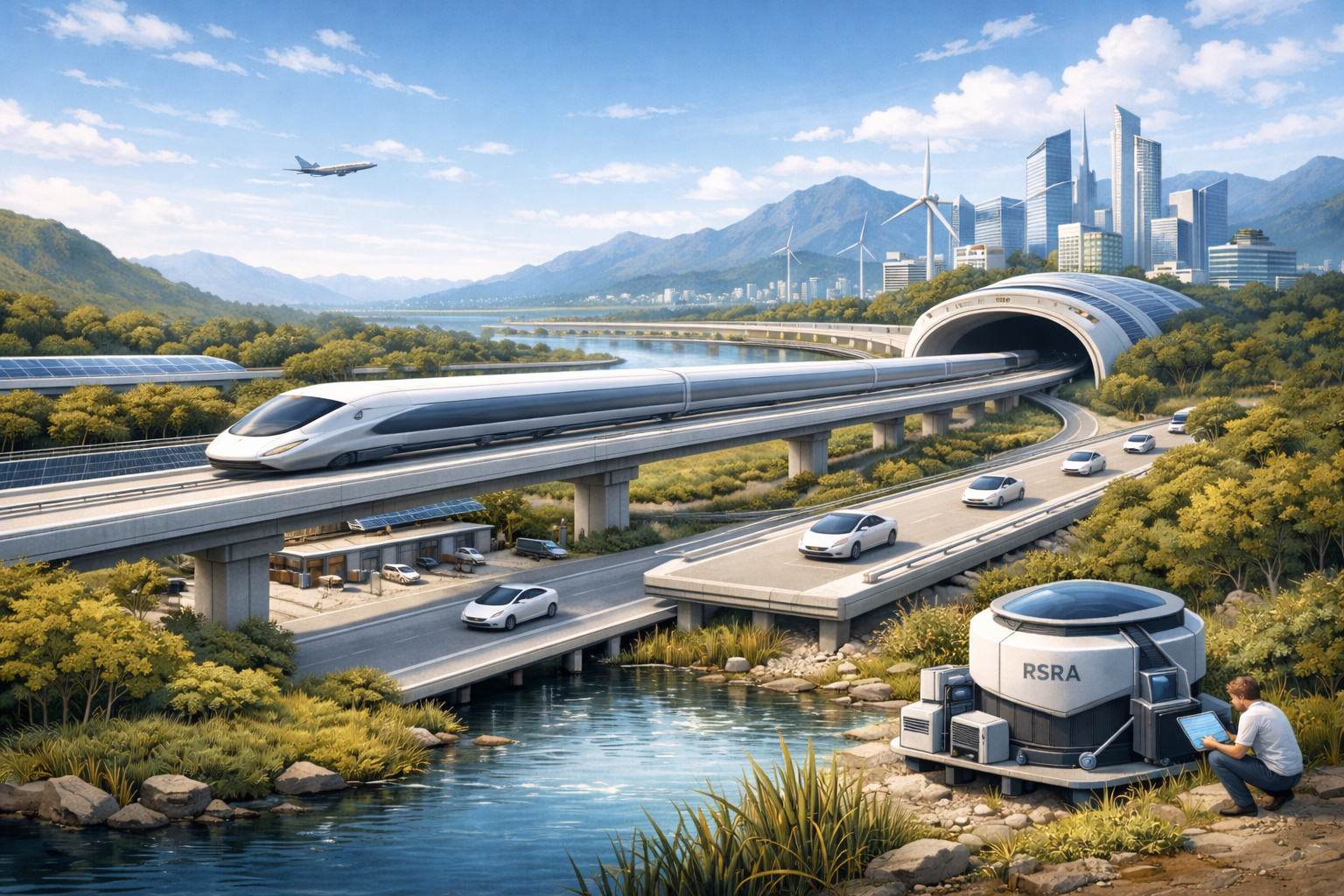
Rather than replacing everything, this transition can begin by repurposing what already exists. Motorways and tunnels already form continuous, grade-separated corridors through cities and landscapes. Over time, these corridors can shift from friction-based road surfaces to guided mobility spines.
In such a transition:
• long-distance freight and vehicle movement migrates onto guided systems within existing motorway alignments
• tunnels evolve from high-particulate environments into controlled transport corridors
• cars become passengers for long hauls, re-entering local road networks only where human-scale access is required
Change happens gradually, not all at once — by removing the most damaging forms of motion first: high-mass, high-speed, long-distance travel.
During this transition, recovery remains essential. Technologies that intercept pollutants at ecosystem boundaries — before they enter rivers, estuaries, and living systems — become acts of repair rather than cleanup. One example is the Resonant Stormwater Recovery Assembler (RSRA), which is defined to explore the recovery of toxic trace elements from urban stormwater sediments before they reach waterways.
Pollution is reduced not because it is filtered more aggressively, but because it is no longer created at its source.
In regions where guided, high-speed ground corridors become viable, another quiet shift may follow. Short-haul domestic flights — among the most energy-intensive forms of travel per kilometre — often exist not out of necessity, but because ground alternatives are slow, fragmented, or inconvenient.
Where long-distance ground transport becomes faster, quieter, and more reliable, some domestic air travel may naturally decline. This reduces not only emissions, but the broader ecological footprint associated with frequent take-off, landing, and supporting infrastructure.
As with road transport, the aim is not elimination by force, but reduction through better options.
The future of transportation is not faster vehicles or smarter traffic.
It is movement without sacrificial wear.
Flow without friction.
Access without ownership.
Motion designed for coherence rather than decay.
Transportation, in this future, becomes what it should always have been, a quiet service that supports life — not a system that slowly poisons it.
If the greatest harms of transport arise not from movement itself but from the way we have chosen to achieve it, what might mobility look like when guidance replaces friction, access replaces ownership, and recovery technologies help repair the damage while that transition unfolds?