ARPI Insight
The Food System Is Not Neutral
Why civilisation remains stalled at 0.7
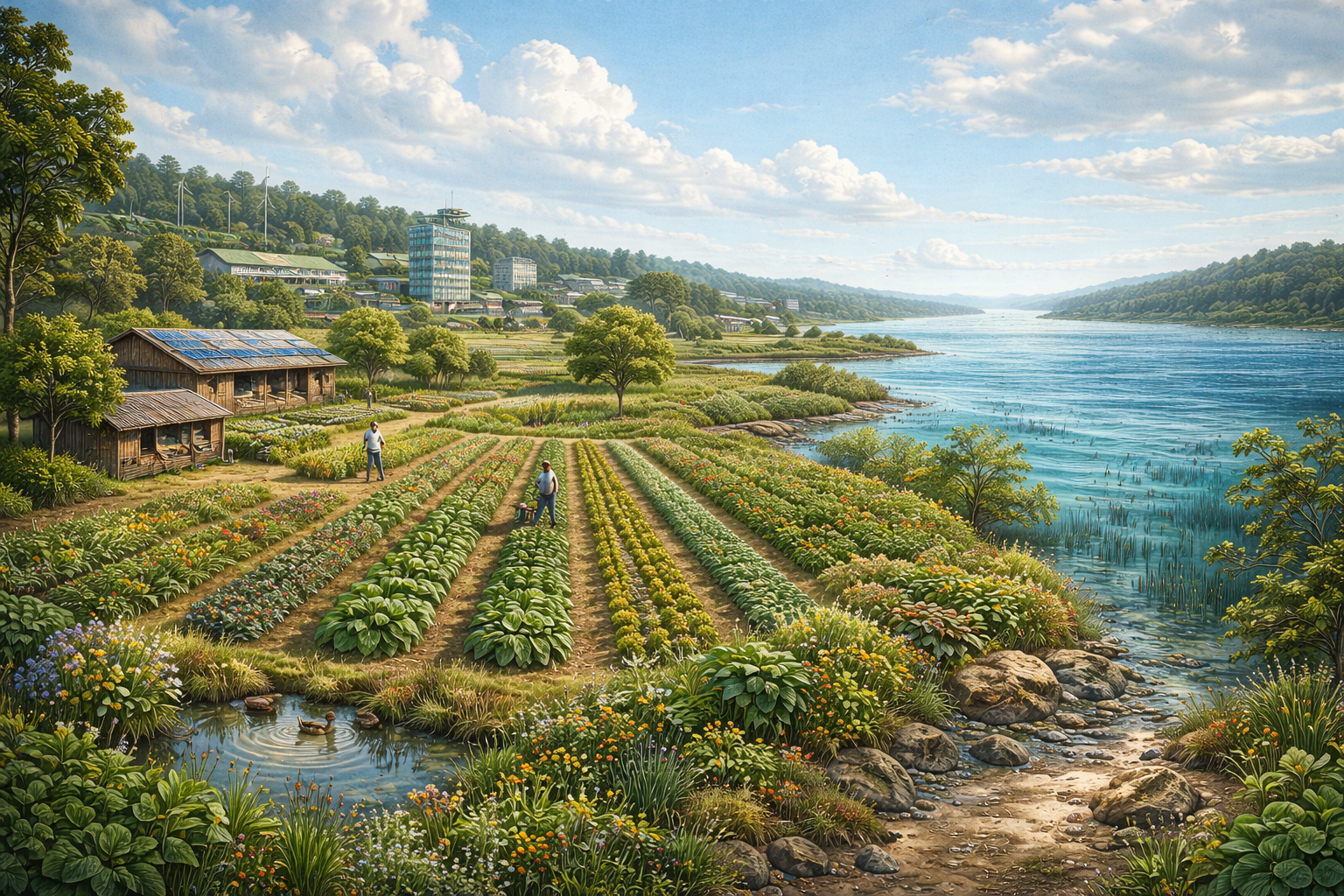
Every civilisation is shaped first by how it feeds itself.
Food is not a sector. It is not a lifestyle choice. It is not merely production and consumption.
Food is the primary interface between a civilisation and its planet.
Through food, soil becomes culture.
Through food, ecosystems become bodies.
Through food, a civilisation teaches itself what life is worth.
If that interface is incoherent, nothing built on top of it can become stable.
The Scale We Inherited
In the 1960s, astrophysicist Nikolai Kardashev proposed a way of classifying civilisations by their energy use.
On this scale:
• A Type 0 civilisation relies on local, unintegrated energy sources.
• A Type I civilisation can harness and manage the full energy of its planet.
• Higher types extend outward, to stars and galaxies.
The scale was elegant in its simplicity. But it carried a quiet assumption. That assumption was that civilisational advancement is primarily a matter of energy capture.
More energy, more progress.
More power, more intelligence.
What the scale did not account for was metabolism — how energy is sourced, how it circulates, and what it does to the living systems that supply it.
It measured quantity. It did not measure relationship.
Why the Missing Measure Matters
A civilisation can dramatically increase its energy use without becoming planetary.
It can extract more, process faster, scale wider —,and still degrade the soil that feeds it, the ecosystems that stabilise it, and the bodies that carry it forward.
Energy throughput alone does not create coherence. In many cases, it accelerates collapse.
This blind spot has shaped modern civilisation’s self-image.
We are told we are “approaching Type I” because our technologies are powerful and our systems are vast.
But power without coherence does not cross thresholds. It destabilises them.
Where We Are: A 0.7 Civilisation
The transition from Type 0 to Type I is not gradual. It is a qualitative shift.
What we have today is something else. We are not a Type I civilisation. But we are not simply “Type 0” either.
We are a 0.7 civilisation.
A 0.7 civilisation possesses immense technological capacity. It can industrialise agriculture, optimise global logistics, refrigerate supply chains, digitise value, and feed billions. It appears advanced, efficient, and resilient. Yet it remains metabolically extractive.
Soil is treated as a substrate to be depleted rather than a living system to be renewed.
Animals are converted into units of output rather than participants in ecological cycles.
Suffering is normalised and hidden behind distance, mechanisation, and abstraction.
Feedback between damage and consequence is delayed or erased entirely.
This is not a failure of intelligence. It is a failure of relationship.
A civilisation cannot drift from 0.7 into Type I through efficiency alone.
Type I is not an optimisation of extraction. It is a departure from it. And nowhere is this more visible than in how a civilisation grows, processes, and consumes its food.
History Does Not Repeat — Metabolism Does
Civilisations rarely collapse because they lack intelligence, creativity, or culture. They collapse because their food systems lose coherence with the land that sustains them.
Across history, the pattern is consistent.
Mesopotamia’s irrigation success slowly salinised its soil.
The Maya degraded ecological buffers through deforestation and intensification.
Easter Island consumed resources faster than regeneration.
Rome masked soil depletion through centralised grain systems until supply chains failed.
What changes is scale. What repeats is metabolism.
Agricultural success creates surplus. Surplus enables growth and complexity. Growth demands intensification. Intensification degrades soil, water, and biodiversity. Feedback is delayed, denied, or ritualised. Collapse arrives suddenly — but predictably.
Modern civilisation differs only in one respect:
Its food system is now global.
This does not break the pattern. It accelerates it.
What a Coherent Food System Looks Like
A coherent food system is not defined by ideology or identity. It is defined by feedback.
In a coherent system:
• soil fertility increases over time
• biodiversity is a stabilising asset, not an inefficiency
• animals live within ecological roles rather than production schedules
• scale is bounded by regeneration, not demand
Such systems do not seek maximum yield. They seek maximum continuity.
Productivity is measured in decades, not quarters.
Food as Planetary Intelligence
A Type I food system behaves like a living system.
It is:
• decentralised
• adaptive
• locally responsive
• globally aware
Energy flows are circular rather than extractive. Waste becomes nutrient. Diversity becomes resilience.
Technology does not dominate these systems — it serves them:
• monitoring soil health
• restoring microbial life
• supporting regional food webs
• reconnecting eaters with consequences
Intelligence here is not speed. It is attunement.
Why Suffering Matters
In extractive food systems, suffering is treated as external.
But suffering is a biological signal. Stress chemistry does not disappear at slaughter.
It enters food chains.
It enters human bodies.
It reshapes metabolism, immunity, and behaviour.
A civilisation that normalises suffering in its food system trains itself — biologically — for incoherence.
Care is not sentimental. It is regulatory.
What is removed from view does not disappear from biology.
This is the basis of regenerative food systems.
Regenerative agriculture works with biological cycles rather than overriding them. It replaces monoculture with diversity, bare soil with continuous cover, and chemical correction with ecological resilience.
The goal is not maximum yield at all costs. The goal is maximum continuity.
Regeneration Across Land, Sea, and City
A coherent food system cannot be land-only.
On land, regenerative farming rebuilds soil, restores microbial life, and stabilises local climates.
In oceans, coherence requires regeneration as well: protected marine zones, restored kelp forests and reefs, restrained harvesting, and food webs allowed to recover before use. A civilisation cannot be planetary while its seas are extractive.
In cities, food production returns closer to where people live. Vertical farms, rooftop growing, and local cultivation reduce transport strain and relieve pressure on rural land, allowing regeneration to occur.
Across all domains, technology becomes quieter and more precise — used to monitor health, anticipate stress, and prevent harm rather than intensify extraction.
This is not low-tech food production. It is post-extractive food production.
Repurposing Existing Infrastructure
A transition to a coherent food system does not require new land or dramatic rebuilding. Much of the necessary infrastructure already exists — it is simply used in ways that increase harm rather than nourishment.
Across many regions, large enclosed sheds are currently dedicated to intensive animal agriculture. These spaces are resource-heavy, biologically inefficient, and prone to disease.
The same structures can support high-density mushroom cultivation. Mushrooms require minimal water, no antibiotics, and no feed crops grown specifically for them. They convert agricultural by-products into nutritious food while producing material that restores soil health.
This shift does not depend on new technology or cultural transformation. It is a change of use.
By repurposing existing facilities toward regenerative food production, a civilisation begins to close its metabolic loops. Waste becomes input. Harm is reduced without spectacle. Stability increases quietly. This is how coherence enters a system — not through disruption, but through alignment.
Why This Marks the Type I Threshold
A civilisation cannot reach Type I while its food system:
• depletes soil
• destabilises oceans
• amplifies disease
• and requires constant correction to persist
Regenerative food systems represent the first place where a civilisation proves it has learned to live within limits rather than fight them.
This transition does not feel like transcendence. It feels like relief. And it begins with food.
Not all intelligence ascends. Living intelligence circulates.
It listens before it acts.
It stabilises before it accelerates.
It endures because it belongs.
The Transition That Cannot Be Avoided
No civilisation reaches Type I by replacing its energy systems alone.
It reaches Type I when:
• food systems regenerate rather than deplete
• feedback is restored rather than hidden
• nourishment is aligned with life rather than throughput
This transition cannot be automated. It must be chosen. And it begins, not with technology, but with how a civilisation decides to feed itself.
ARPI Closure
A civilisation does not become planetary by consuming more. It becomes planetary by learning what sustains it.
Food is not neutral. It is how intelligence enters the body of the world.