ARPI Insight
The Food System Is Not Neutral
What we eat is no longer a personal choice. It is a planetary intervention.
A Heating World
In a heating world, food determines:
• how much land is destroyed
• how much water is consumed
• how much heat is amplified
• how many species are erased
• how many people are fed — or not
And one part of our food system is now catastrophically out of alignment.
Animal Agriculture Is a Heat Engine
Industrial animal farming is not inefficient by accident. It is inefficient by biology.
To produce animal protein, we must:
• grow vast quantities of crops that humans could eat directly
• clear forests that once cooled the planet
• drain rivers and aquifers
• emit methane — a heat amplifier far more potent than CO₂
• generate waste that poisons soil, air, and water
This is not sustainable under any definition that includes physics. In a warming world, animal agriculture adds heat at every step.
What This Means in Reality
As temperatures rise:
• crops fail more often
• water becomes scarce
• soils degrade
• feed prices rise
• meat prices spike
• food insecurity spreads
To compensate, more land is cleared. More forests are burned. More ecosystems collapse. This is a self-reinforcing loop. And it does not end with food shortages. It ends with instability.
The Ocean Pays the Price Too
Animal protein does not only come from land.
Industrial fishing:
• strips oceans of life
• collapses food webs
• destroys oxygen-producing systems
• accelerates heating and dead zones
Eating animals from the sea while the ocean is failing is not nourishment.
It is liquidating life-support.
Protein Is Not the Problem
Protein is essential. Animal protein is not.
Plant protein:
• requires a fraction of the land
• requires a fraction of the water
• produces a fraction of the heat
• feeds far more people per hectare
This is not ideology. It is arithmetic.
A Resonant Civilisation chooses direct energy pathways.
Sun → plant → human
Not:
Sun → plant → animal → human → heat → collapse
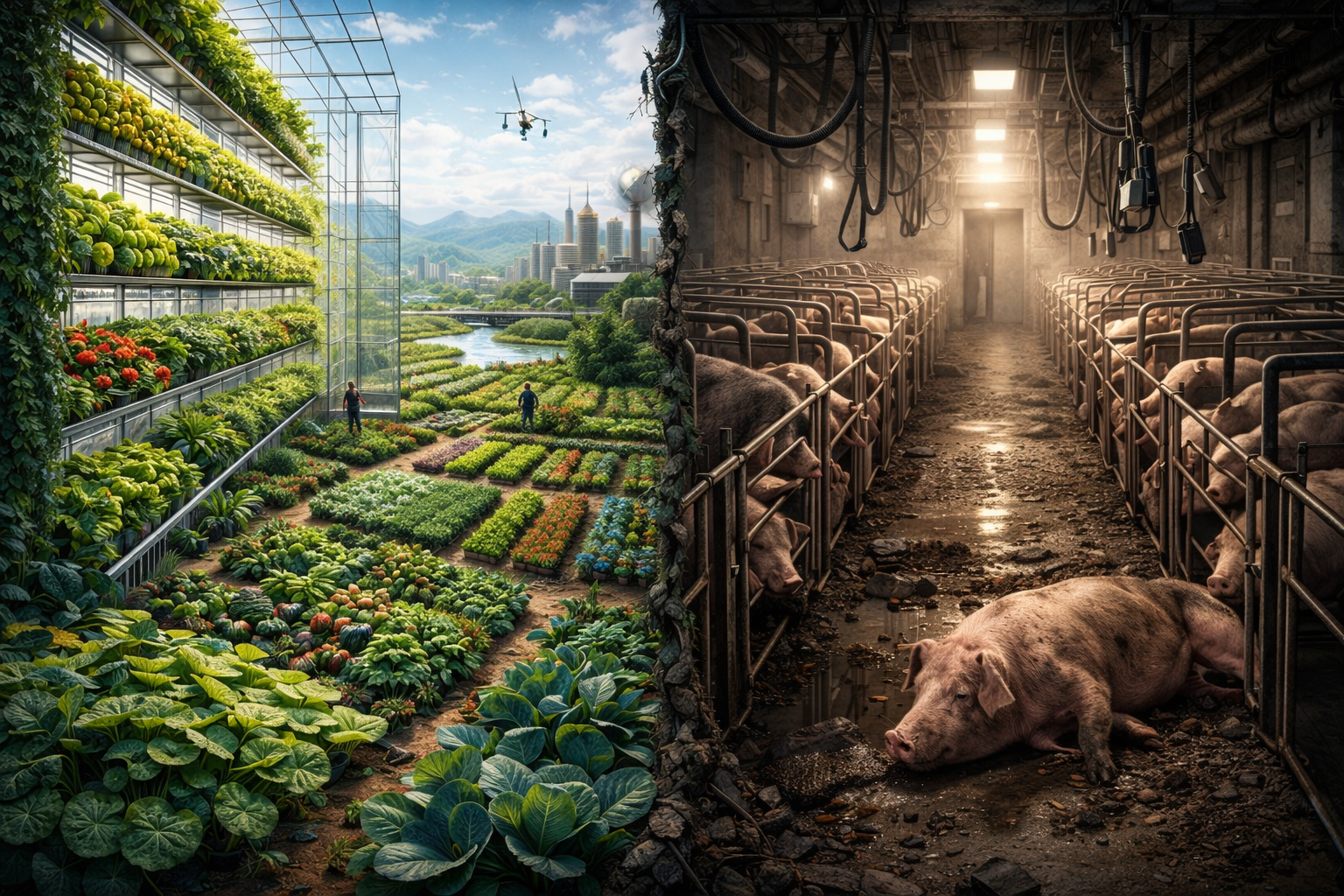
Vertical Farming Is Not Optional
As climate volatility increases, food must be:
• local
• reliable
• water-efficient
• decoupled from weather extremes
Vertical farming achieves this by:
• growing food close to where it is eaten
• using up to 95% less water
• eliminating soil loss
• removing pesticides
• stabilising supply in heatwaves, droughts, and floods
This is not futurism. It is adaptation.
The Moral Cost We Avoid Naming
Industrial animal agriculture also depends on:
• mass confinement
• routine suffering
• biological stress systems pushed beyond tolerance
In a civilisation already overheating — physically and psychologically — this matters. A system built on suffering does not produce resilience. It produces instability.
The Line We Are Crossing
Continuing to centre animal protein in a heating world is not tradition. It is recklessness. No amount of efficiency gains can fix a system whose core logic violates thermodynamics, ecology, and ethics simultaneously.
What a Resonant Food System Does Instead
A Resonant Civilisation:
• eats lower on the food chain
• grows food close to where people live
• uses plants, not animals, as the primary protein source
• removes pressure from oceans and forests
• cools rather than heats the planet
This is not about purity. It is about survivability.
The Truth Without Gloves
In a world of accelerating heat, continuing to eat as if the planet were stable is a form of denial no civilisation survives.
Food is no longer culture alone. It is climate infrastructure.
“In a heating world, animal agriculture is not a preference — it is an accelerant.”