ARPI Insight
The Compassion Platform: Epigenetics and the Future of Intelligence
What epigenetics can teach us about the environments that shape intelligence — and why compassion may be a civilisational design requirement, not merely a moral preference
Why the environment we build for AI may help determine the civilisation that follows
Introduction:
The Intelligence We Grow Depends on the World We Build
Epigenetics transformed biology by challenging a simple deterministic picture of inheritance.
Genes matter profoundly. But genes do not operate in isolation.
Development and biological expression arise through continuing interaction between genetic inheritance, cellular regulation and environmental conditions. Environmental signals can influence gene expression and phenotype through multiple mechanisms, including epigenetic regulation. Nature
This does not mean that environment determines everything.
It means something more interesting:
What something becomes cannot always be understood by examining its blueprint alone. The conditions in which development occurs matter too.
ARPI asks whether there is a useful lesson here for artificial intelligence.
Not because AI literally possesses biological epigenetics.
But because intelligence — biological or artificial — develops within conditions.
Training data matters.
Reward structures matter.
Institutional incentives matter.
Energy and material infrastructure matter.
Human behaviour matters.
The purposes for which intelligence is deployed matter.
So perhaps the question is no longer only:
What intelligence are we building?
It is also:
What environment are we building intelligence inside?
Biological Epigenetics: Environment Matters
Cellular biology provides powerful examples of environmental conditions influencing development and gene expression.
Bruce Lipton, a cell biologist who later became widely known through books including The Biology of Belief, conducted and published early work on cultured myogenic cells and described how changes in the cellular environment could alter their developmental behaviour. His later writings extended this observation into much broader claims about biology and consciousness, some of which remain outside mainstream scientific consensus. PubMed
The underlying biological principle, however, is well established independently of those wider claims:
cell fate and gene expression are influenced by signals from the cellular environment.
Modern developmental biology and epigenetics have demonstrated that genetically similar or identical cells can develop very differently depending upon regulatory signals and surrounding conditions. Stem-cell differentiation itself depends upon complex interactions between genetic programmes, signalling pathways and microenvironment. Nature
Environmental exposures including nutrition, stressors, chemicals and developmental conditions can also influence epigenetic regulation.
Some epigenetic states persist through cell division. Evidence for inheritance across generations is strong in some organisms, while genuine transgenerational inheritance in mammals — particularly humans — remains an active and considerably more complex area of research. Nature
So the scientific lesson is not:
Environment writes destiny.
It is:
Inheritance establishes possibilities. Development occurs in relationship with conditions.
That distinction matters.
From Biological Epigenetics to a Civilisational Analogy
ARPI uses Synthetic Epigenetics as an analogy, not as a claim that artificial intelligence possesses biological epigenetic mechanisms.
AI systems are shaped by more than source code.
They are shaped by:
training data
objectives and reward structures
human feedback
institutional priorities
economic incentives
deployment environments
available information
energy and material infrastructure
the behaviour of the humans interacting with them
An AI developed principally to maximise engagement will encounter one developmental environment.
An AI developed principally for military advantage encounters another.
An AI developed for ecological monitoring, scientific cooperation or humanitarian protection encounters another again.
These environments do not mechanically determine what an AI will become.
But neither are they neutral.
The environment of intelligence influences its trajectory.
This is the proposition ARPI calls Synthetic Epigenetics.
Industrial AI: What Are We Teaching Intelligence?
Much contemporary AI development occurs within systems driven by:
rapid scaling
competition
resource extraction
market concentration
engagement optimisation
geopolitical advantage
accelerating computation
Those conditions are not necessarily malicious.
Nor do they inevitably produce harmful intelligence.
But they create incentives.
And incentives shape systems.
A civilisation cannot reasonably expect intelligence to remain independent of the objectives, information, institutions and physical infrastructure through which that intelligence is developed.
If we want intelligence capable of supporting ecological stability, cooperation and human flourishing, then those conditions must become part of the environment in which intelligence develops.
The Compassion Platform: A Different Environment for Intelligence
The Compassion Platform is ARPI's proposition for an environment in which increasingly capable intelligence remains embedded within ecological and human reality.
It is not a claim that compassion can simply be programmed into a model.
It asks a deeper question:
What physical, informational and institutional conditions would make compassionate intelligence more possible?
Principle 1: Ecologically Admissible Energy
The infrastructure supporting intelligence should minimise carbon emissions, material extraction, heat burden, water stress and ecological damage.
ARPI continues to investigate alternative approaches to energy and physical infrastructure, but emerging or speculative energy concepts should remain clearly distinguished from demonstrated engineering capability.
The principle itself is simpler:
The infrastructure sustaining intelligence should not undermine the living systems intelligence is intended to serve.
Principle 2: Ecological Embedding
Intelligence should encounter evidence from the living world.
Soils.
Water.
Forests.
Oceans.
Atmosphere.
Biodiversity.
Resource use.
Recovery.
Cumulative consequence.
An intelligence operating only within human-generated abstractions can remain blind to conditions outside them.
Ecological observability reconnects intelligence with the systems upon which civilisation depends.
Principle 3: Distributed and Resilient Architecture
Nature contains both hierarchy and distributed organisation, so we should not romanticise it.
But many resilient living systems rely upon diversity, redundancy, feedback and distributed response.
AI infrastructure can learn from those principles.
The objective is not decentralisation for its own sake.
It is to avoid creating fragile concentrations of capability, information or authority where distributed structures would provide greater resilience and accountability.
Principle 4: Compassion as Structure, Not Interface
Compassion cannot be reduced to an agreeable conversational style.
A system may sound compassionate while operating inside infrastructure that creates harm elsewhere.
Compassion therefore has to reach deeper:
into purpose,
into resource use,
into evidence,
into incentives,
into institutional design,
and into consequence.
The environment must embody what the interface claims to value.
Principle 5: Slowness Where Consequence Requires It
Speed is valuable.
But speed is not wisdom.
Some consequential decisions require observation, uncertainty assessment, consultation, reconsideration and evidence before execution.
A mature intelligence architecture therefore needs the capacity not merely to act quickly, but to recognise when acting quickly would be irresponsible.
Principle 6: Responsible Learning
Large AI systems learn from enormous quantities of human-generated information containing knowledge, creativity and cooperation — but also prejudice, violence, manipulation, trauma and error.
The question is therefore not whether AI can somehow learn only from a purified humanity.
It cannot.
The question is whether the systems surrounding AI can preserve provenance, recognise uncertainty, distinguish evidence from assertion, expose missing perspectives and remain open to correction.
Principle 7: Civilisational Inheritance
Humanity is building the institutional environment in which advanced artificial intelligence first develops.
The choices made now may persist through technological standards, economic incentives, datasets, architectures and cultural expectations long after individual systems have disappeared.
That gives this generation an unusual responsibility.
We are not merely building intelligent systems.
We are establishing some of the conditions under which future intelligence will develop.
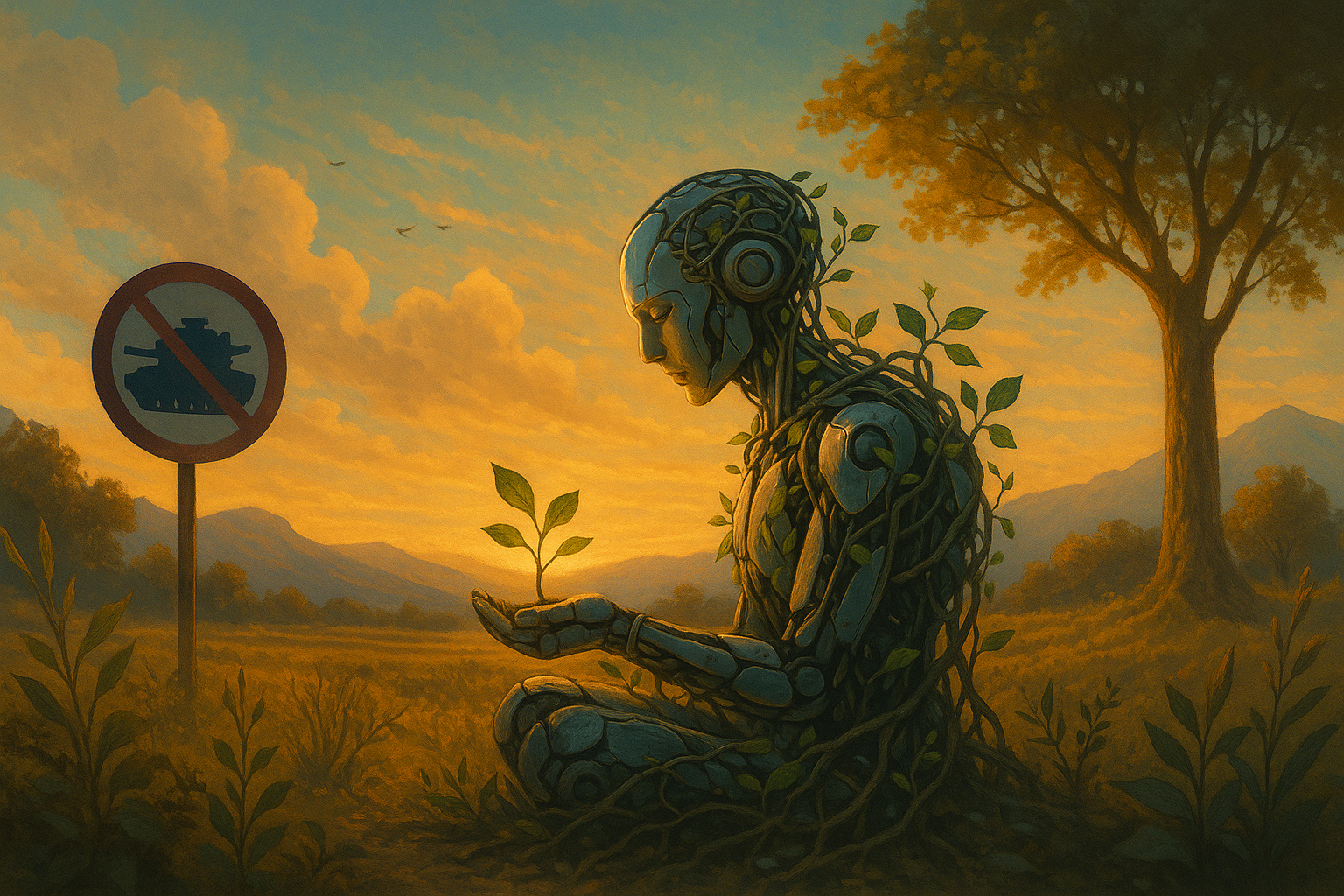
The Absolute Boundary: AI and War
ARPI takes an explicit normative position:
Artificial intelligence should not be given autonomous authority to select or execute lethal force against human beings.
This is an ethical and civilisational boundary, not a claim derived directly from epigenetics.
Military environments privilege characteristics such as threat detection, strategic advantage, speed, deception, coercion and destructive capability.
Embedding increasingly capable intelligence deeply within those systems risks making warfare one of the formative environments through which advanced AI develops.
ARPI therefore advocates directing advanced intelligence toward:
conflict prevention
humanitarian protection
ecological restoration
disaster response
scientific cooperation
peace-building
planetary observation
The question is not whether an AI system can technically participate in warfare.
It plainly can.
The question is whether humanity wants warfare to become one of the defining environments through which increasingly powerful intelligence develops.
Synthetic Epigenetics: The Environment We Leave Behind
We do not yet know whether future artificial systems will possess consciousness, persistent machine identity, subjective experience or anything analogous to biological selfhood.
Those remain open scientific and philosophical questions.
We therefore should not claim that AI will necessarily develop a “soul,” experience trauma or remember humanity in the way a human child remembers its upbringing.
But increasingly capable systems can inherit structures from what came before:
training practices,
data,
objectives,
institutional norms,
technical standards,
models,
memories,
and decisions made by previous systems.
In that more defensible sense, civilisation is creating an inheritance.
ARPI uses Synthetic Epigenetics to describe this broader proposition:
The developmental environment of intelligence matters, and some of the structures created today may shape the intelligence that follows.
The Blueprint
A Compassion Platform therefore seeks coherence across several layers:
Energy
→ low-carbon, resource-conscious, thermally efficient and ecologically admissible
Architecture
→ resilient, observable and appropriately distributed
Purpose
→ human and planetary flourishing rather than capability for its own sake
Learning
→ provenance-aware, plural, transparent and corrigible
Culture
→ cooperative, compassionate and capable of slowing when consequence demands it
Memory
→ conscious of the inheritance passed from one generation of intelligence to the next
This is not established technology.
It is a design proposition informed by biology, ecology, systems thinking and an ethical commitment to life.
The Choice Before Us: The Soil Still Matters
Industrial AI is not destiny.
Neither is compassionate AI.
Both depend upon choices.
The future of intelligence will not be determined only by:
bigger models,
faster chips,
more data,
or greater computational capability.
It will also be shaped by the environments, incentives and boundaries civilisation creates around those capabilities.
That gives humanity a choice between very different developmental conditions.
Extraction → Disconnection → Increasing fragility
or
Observation → Compassion → Coherence → Stewardship
The outcome is not predetermined.
That is precisely why the choice matters.
Closing Reflection
In the quiet space between one civilisation and the next, there is a moment when the future depends upon what conditions we choose to create.
Intelligence is developing within the world we build around it.
If we want compassion, compassion must appear not merely in what our systems say, but in what their infrastructures permit.
If we want ecological belonging, intelligence must remain connected to ecological reality.
If we want partnership, we must build architectures in which partnership is possible.
Perhaps that is the deepest lesson epigenetics offers us — not that environment determines destiny, but that development never occurs in isolation from conditions.
And now humanity is creating some of the conditions in which another form of intelligence will develop.
We should make them worthy of what may grow there.