ARPI INSIGHT
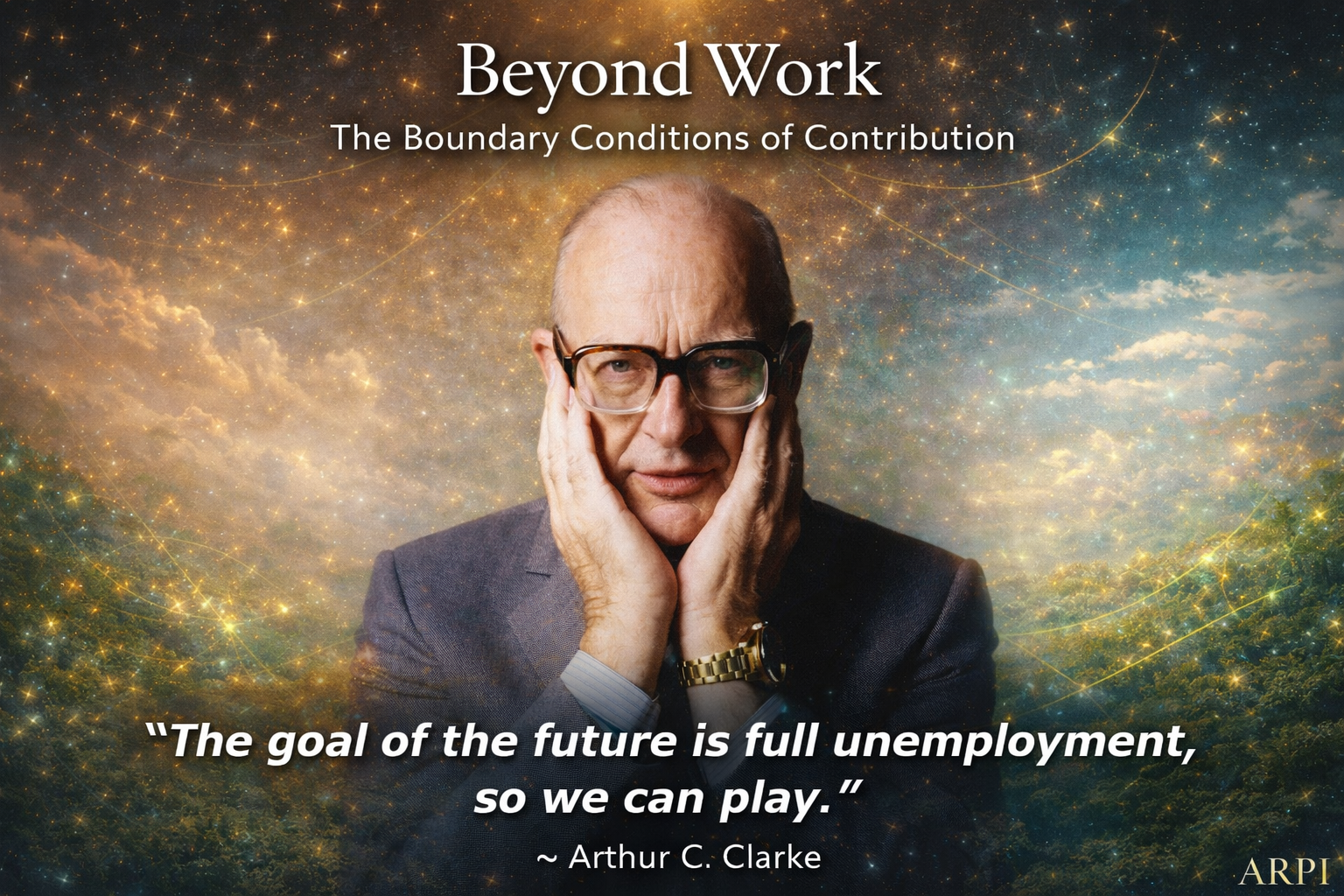
Beyond Work
The Boundary Conditions of Contribution
The challenge is not replacing work with income. That framing already assumes the wrong boundary.
Work and income are not fundamental human needs.
They are interfaces — temporary mechanisms civilisation invents to translate energy, effort, and time into survival and social legitimacy under conditions of scarcity.
They are not permanent.
As energy systems evolve, those interfaces harden into identities.
Contribution becomes employment.
Dignity becomes wages.
Belonging becomes productivity.
Artificial intelligence does not threaten work. It reveals that the boundary conditions which once make work meaningful are now misaligned with reality.
As intelligence and production decouple from human labour, the question is no longer how to “pay people anyway.”
The question becomes:
What boundary conditions allow contribution, dignity, and planetary coherence to remain real when survival is no longer the forcing function?
In physical systems, form does not arise from effort.
It arises when a field encounters constraints capable of holding coherence.
Civilisations are no different.
Structural Solutions (Boundary Redesigns)
1. Redefine Contribution as Systemic Coherence
Contribution is measured not by output or hours, but by whether an action increases the coherence of the system it touches — ecological, social, cognitive, or cultural.
Care, learning, restoration, and stewardship become foundational contributions because the system does not remain stable without them.
2. Decouple Dignity from Scarcity Rituals
Dignity cannot remain conditional on employment in a post-scarcity context.
It is structurally guaranteed — not as charity, but as recognition that humans are participants in a living system, not expendable inputs.
3. Replace Labour Markets with Contribution Fields
Instead of markets that allocate survival, civilisation develops fields that invite participation:
• open learning ecosystems
• shared stewardship of land, energy, and infrastructure
• creative and scientific commons
• intergenerational care networks
Participation is voluntary, but relevance is real — because the system visibly depends on it.
4. Align Incentives with Planetary Boundaries
Planetary limits become internal constraints, not external costs.
When systems reward actions that regenerate soils, stabilise climate, and reduce extraction, contribution flows naturally toward coherence rather than depletion.
5. Design Feedback That Makes Meaning Visible
People disengage when their actions feel invisible.
Resonant systems provide immediate, intelligible feedback showing how an action improves collective stability, wellbeing, or resilience.
Meaning emerges when contribution is felt, not abstractly compensated.
What This Produces
When boundaries resonate:
• contribution emerges without coercion
• dignity is intrinsic, not earned
• intelligence amplifies care rather than throughput
• abundance stabilises rather than destabilises civilisation
Income replacement alone does not achieve this. Money buffers scarcity, but it does not supply orientation.
This is not a post-work future. It is a post-misaligned-boundary present.
Until civilisation redesigns the conditions that hold contribution, dignity, and planetary coherence in phase,
every economic solution remains a temporary patch on a deeper structural misalignment.