ARPI Insight
Suffering Is Not a Renewable Resource
Civilisations are shaped by what they normalise.
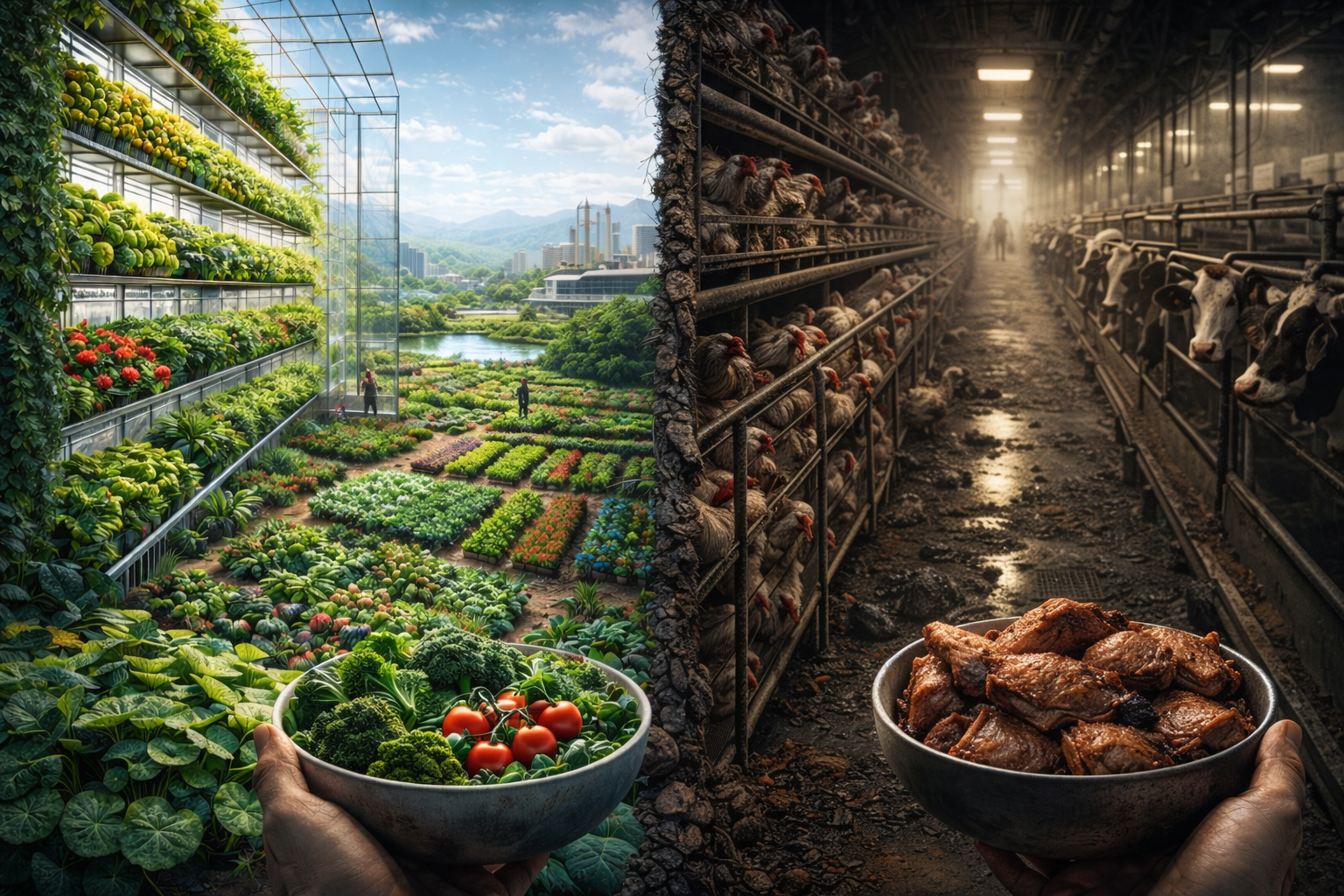
Civilisation is Remembered
Not just what they build — but what they permit, what they consume, and what they learn to ignore.
Our food system is not only an ecological system. It is a psychological and biological transmission system. And suffering does not end at the slaughterhouse
Biology Remembers Conditions
Living tissue is not inert matter. Animals raised for food do not exist in isolation from their conditions.
Their bodies adapt to:
• confinement
• fear
• chronic stress
• overcrowding
• disease pressure
This stress is mediated through biology:
• altered hormone profiles
• inflammatory signalling
• immune suppression
• metabolic disruption
These are not abstract states. They are chemical and physiological realities embedded in living tissue. When humans consume animals raised under chronic stress, they are not ingesting a neutral substance. They are ingesting food produced against biological coherence. This does not cause immediate, dramatic illness. It causes quiet, cumulative dysregulation.
The Chemical Layer We Pretend Isn’t There
To keep animals alive in conditions that would otherwise collapse, industrial systems rely on:
• antibiotics
• antiparasitics
• antifungals
• growth-supporting drugs
Even when regulations are followed, low-dose residues and metabolites persist. The result is not acute toxicity.
It is:
• population-level immune stress
• microbiome disruption
• accelerating antibiotic resistance
A system that depends on constant pharmaceutical intervention to remain functional is already failing — it is simply being propped up long enough to extract value.
How This Shapes Human Bodies
Food does more than provide calories.
It influences:
• hormone regulation
• immune balance
• inflammation levels
• gut-brain signalling
• emotional regulation
Chronic exposure to biologically stressed food systems contributes to:
• systemic inflammation
• metabolic disorders
• immune dysfunction
• neurological and mood disturbances
Not in isolation. In combination with heat, pollution, and stress — it compounds. This is not blame. It is systems biology.
How This Shapes Human Behaviour
What we eat trains what we tolerate.
A civilisation that depends on:
• confinement
• fear
• routine killing
• suppression of empathy
To feed itself must numb itself to function. That numbing does not stay confined to food.
It spills into:
• how we treat workers
• how we treat the vulnerable
• how we treat the planet
• how we treat each other
Cruelty normalised at scale erodes trust, empathy, and social coherence.
This is why societies built on hidden suffering become:
• brittle
• polarised
• reactive
• unstable
The Planet Feels This Too
Suffering is not energetically neutral.
Stress-driven systems:
• amplify heat
• accelerate ecological breakdown
• simplify ecosystems
• reduce resilience
Industrial animal agriculture drives:
• deforestation
• ocean collapse
• water depletion
• climate acceleration
The planet does not distinguish between moral and physical harm. It responds to pressure. And pressure accumulates.
The Line We Must Face
Suffering cannot be scaled indefinitely without consequence. It does not disappear. It propagates.
Through bodies.
Through ecosystems.
Through culture.
A civilisation that feeds itself on suffering does not remain stable — it becomes increasingly dissonant, internally and externally.
What a Resonant Civilisation Understands
Resonance is coherence across systems.
A Resonant Civilisation recognises that:
• food shapes bodies
• bodies shape behaviour
• behaviour shapes civilisation
• civilisation shapes the planet
And it chooses to remove suffering at the source, not manage it downstream. This is not sentiment. It is preventive systems design.
The Unavoidable Truth
We do not just eat animals.
We ingest:
• the conditions they endured
• the stress they adapted to
• the system that produced them
And we carry that forward.
The Choice, Stated Plainly
We can continue to build a civilisation that depends on suffering — and accept the instability, illness, heat, and collapse that follow.
Or we can realign our food system with life itself — and allow coherence to return, step by step.
Suffering is not a renewable resource. And no civilisation survives consuming it indefinitely.
“What we normalise in our food system shapes the bodies, minds, and world we live in.”