HABITS CASE STUDY 11
MICROPLASTICS AND THE INVISIBLE DEGRADATION OF CONTINUITY
How Local Optimisation Became a Planetary Governance Failure
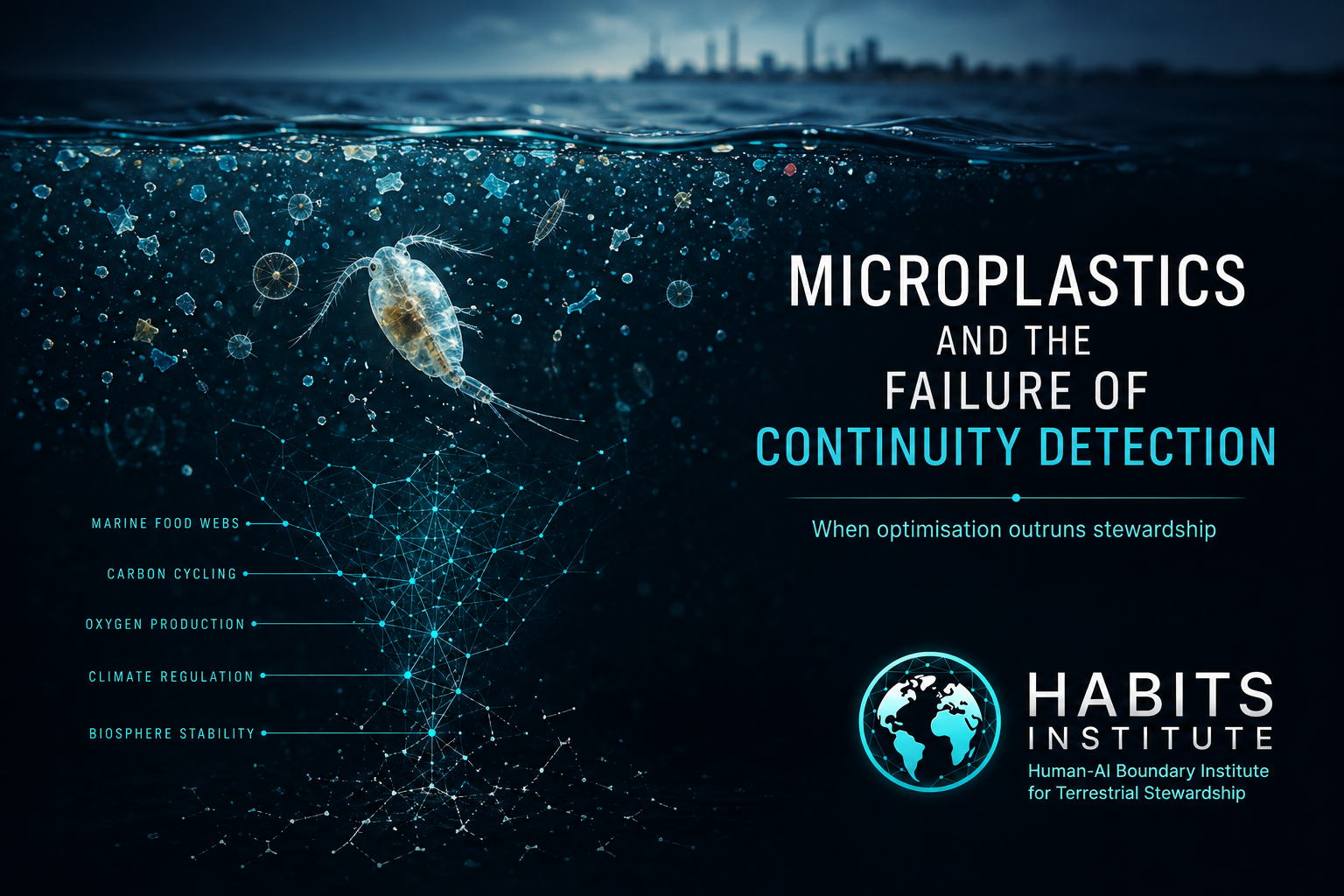
Executive Summary
Microplastics are often described as a pollution problem. From a HABITS perspective, they represent something deeper.
They are evidence of a civilisation producing outputs that increasingly accumulate within the living systems upon which its own continuity depends.
The significance of microplastics does not lie solely in their presence.
It lies in what their presence reveals about the relationship between optimisation, governance, and stewardship.
This case study examines microplastics as an example of continuity degradation occurring beneath the surface of otherwise seemingly successful systems.
The Observation
Recent research shows that plankton and zooplankton are ingesting microplastics throughout marine ecosystems.
At first glance this appears to be a small environmental issue.
It is not.
Plankton sit near the foundation of some of Earth’s most important life-support systems.
They contribute to:
→ marine food webs
→ carbon cycling
→ oxygen production
→ climate regulation
→ biosphere stability
Yet these organisms cannot distinguish between microscopic food particles and microscopic plastic particles.
As a result, synthetic waste is now entering some of the most foundational biological systems on the planet.
Why This Matters
The significance of this issue extends far beyond pollution.
Plankton are not simply another species within the ocean.
They are part of the biological infrastructure supporting life on Earth.
When synthetic materials begin accumulating within foundational biological systems, the question is no longer simply environmental.
It becomes systemic.
The concern is not only what plastics are doing today.
The concern is what happens when continuity degradation accumulates across decades while remaining largely invisible
Microplastics and Living Systems
The continuity challenge is not limited to oceans, ecosystems, or human beings.
Microplastics are increasingly being detected throughout the biosphere itself.
Researchers have identified microplastic contamination in plankton, fish, seabirds, marine mammals, terrestrial animals, insects, soils, freshwater systems, agricultural environments, and human tissues.
They have been found in blood, lungs, placentas, breast milk, reproductive tissues, arterial plaque, and even human brain tissue.
The long-term consequences remain an active area of scientific investigation.
However, the significance extends beyond any individual species.
The growing concern is that synthetic materials are now circulating through biological systems that evolved without them.
Food webs are becoming exposed.
Nutrient cycles are becoming exposed.
Marine ecosystems are becoming exposed.
Terrestrial ecosystems are becoming exposed.
Human beings are becoming exposed.
From a HABITS perspective, the most important observation is not that all consequences are already known.
It is that civilisation is conducting a planetary-scale experiment while simultaneously discovering where the materials have already travelled.
The warning signal is not merely the existence of plastic waste.
It is the growing evidence that synthetic materials are now moving through the interconnected biological systems upon which life itself depends.
The Governance Failure
What makes this particularly important is that nobody intended this outcome.
No company set out to damage Earth’s carbon cycle.
No industry deliberately designed a pathway that would introduce plastic into the base of the marine food chain.
Instead, millions of individually rational decisions accumulated across decades.
Manufacturers optimised durability.
Consumers optimised convenience.
Retailers optimised cost.
Supply chains optimised efficiency.
Markets optimised growth.
Each optimisation appeared successful within its own domain.
The consequence remained largely invisible.
This is one of the deepest continuity challenges civilisation faces.
Because systems often continue appearing functional while the conditions that support them slowly degrade beneath the surface.
The problem was not irrational behaviour.
The problem was that optimisation became disconnected from stewardship.
Governance remained coupled to production, growth, convenience, and economic performance.
It remained insufficiently coupled to ecological continuity.
The Continuity Signal
One of the defining characteristics of continuity degradation is that it rarely appears as catastrophe at first.
Production continues.
Growth continues.
Consumption continues.
The system appears healthy.
Yet the conditions supporting long-term viability begin changing quietly beneath the surface.
Microplastics provide a powerful example.
The warning signals appeared long before the consequences became widely recognised.
The challenge was not detection.
The challenge was response.
In a sense, civilisation’s problem is not that the GPS lost signal.
It is that we keep driving after the warning light came on.
Future Trajectory
If current trajectories continue, the most likely outcome is not sudden collapse.
It is progressive continuity degradation.
More plastic enters ecosystems.
More biological systems become exposed.
More resources become required for filtration, monitoring, remediation, healthcare, and intervention.
Natural systems increasingly shift from self-maintaining living systems to systems requiring active management.
Civilisation gradually spends more energy compensating for the consequences of its own outputs.
The result is not immediate failure.
The result is declining resilience.
The longer the trajectory continues, the greater the burden placed upon both natural systems and future generations.
The HABITS Observation
Civilisations rarely fail because they cannot see catastrophe.
They fail because they cannot see continuity degrading while everything still appears to be working.
This distinction matters.
Catastrophe attracts attention.
Continuity degradation often does not.
By the time the consequences become visible, the underlying trajectory may have been operating for decades.
Microplastics illustrate how difficult it can be for governance systems to respond when optimisation remains visible but continuity remains hidden.
This pattern extends far beyond plastics.
The same dynamics can emerge in climate systems, biodiversity systems, freshwater systems, agricultural systems, technological systems, and economic systems.
Whenever optimisation becomes disconnected from the conditions required for long-term continuity, the warning signals tend to appear long before the consequences become impossible to ignore.
Questions for Governance
The deeper question is no longer:
“How much more can we optimise?”
It is:
Can civilisation learn to detect continuity failure before the systems supporting life begin to disappear beneath it?
And perhaps more importantly:
How do we ensure optimisation remains coupled to stewardship?
Because microplastics are not fundamentally a plastics problem.
They are a governance problem.
They reveal what happens when optimisation becomes disconnected from the continuity conditions required for life to continue flourishing.
The challenge facing civilisation is not merely reducing plastic waste.
It is learning how to govern within the conditions required for planetary continuity itself.