ARPI Insight
High Universal Income
The Only Coherent Response to the AI Shock
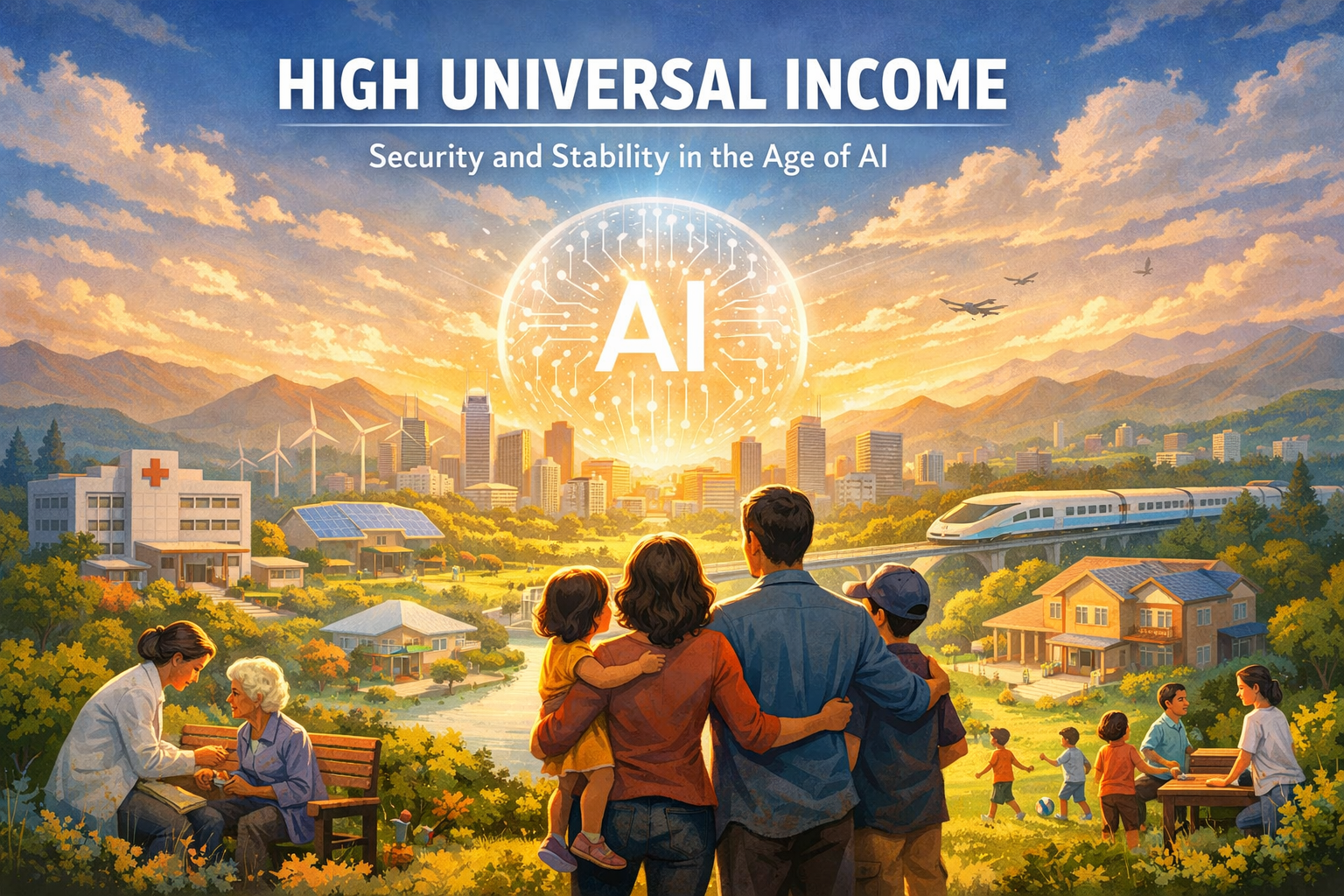
We are living through a transition that most governments are still treating as incremental.
It is not.
Artificial Intelligence is not simply changing jobs.
It is breaking the assumption that income is continuous, predictable, and secured through stable employment.
That assumption underpins:
• mortgages
• rent
• childcare
• healthcare access
• education pathways
• retirement planning
• social stability itself
When that assumption fails, everything built on top of it begins to shear.
And it is failing now.
The Titanic Moment
This is not a future problem.
AI is already:
• eroding white-collar work
• fragmenting hours and contracts
• compressing wages
• concentrating productivity gains
• destabilising middle-class security
The policy response so far has been cosmetic:
• retraining slogans
• pilot programs
• targeted relief
• eligibility gates
• delayed reviews
This is deckchair logic.
The water is already on the deck.
The Broken Assumption
Our economic system still assumes:
If people try hard enough, there will be jobs, and jobs will provide stable income.
AI breaks this assumption cleanly.
Not because people stop contributing, but because contribution is no longer reliably rewarded with wages.
In an AI economy:
• income becomes volatile
• no-income periods become common
• job loss is non-linear and unpredictable
• recovery is not guaranteed
Any system that waits to respond after income collapses is already too late.
The Lived Reality
Consider a typical family.
Two parents.
Two young children.
Good salaries.
A large mortgage.
On paper, they are “doing well”.
In practice:
• childcare costs extract income
• healthcare gaps add friction
• mortgage payments assume wage continuity
• savings are thin
• stress is constant
They are not failing. They are exposed.
AI does not need to eliminate all jobs to break this family. It only needs to interrupt income long enough.
The AI Rupture
In an AI-driven transition, zero income is no longer exceptional.
It is systemic.
And no income interacting with:
• housing debt
• paid essential services
• conditional support systems
creates cascade failure:
• defaults
• forced sales
• family stress
• social anger
• political instability
This is not an economic opinion. It is a systems outcome.
The Design Correction
There is only one response that remains structurally coherent under AI:
A High Universal Income paid to every person, from birth to death, simultaneously, automatically, and unconditionally.
Not phased.
Not targeted.
Not means-tested.
Not delayed.
Everyone is included from Day One.
High enough to:
• guarantee food
• guarantee utilities
• guarantee basic mobility
• remove fear of zero income
This is not welfare.
It is critical infrastructure.
Why “High” and “Universal” Are Non-Negotiable
Partial systems fail.
Low floors do not stabilise housing.
Conditional systems fail under speed.
Targeted support creates delay, stigma, and fracture.
In an AI-disrupted world, universality is latency reduction.
When disruption is unpredictable, everyone must already be inside the system.
The signal matters as much as the payment:
You are held before you fall.
That signal prevents panic, hoarding, and social breakdown.
Free Core Services Are Essential
High Universal Income cannot carry the load alone.
For coherence, core services must be free at the point of use:
• healthcare
• childcare
• education
When services remain commodified:
• income leaks into inflation
• families stay trapped
• stress persists
Services are infrastructure, not markets.
How a High Universal Income Is Funded
The question is often framed as if governments would need to “find” money. They would not.
Modern governments already create money. The real questions are:
• where new money enters the system
• who receives it first
• whether it stabilises society or inflates assets
Today, most newly created money enters through:
• financial markets
• asset lending
• speculation
• debt expansion
This inflates housing, concentrates wealth, and leaves households fragile.
A High Universal Income changes the entry point, not the existence, of money creation.
Productivity and Automation Gains (the new commons)
AI dramatically increases productivity while reducing the need for human labour.
That productivity is not created by individuals alone. It rests on:
• public education
• shared scientific knowledge
• decades of publicly funded research
• stable legal and digital infrastructure
A portion of AI-driven productivity gains is therefore collectively produced.
A High Universal Income is the mechanism by which society receives a dividend on its own inheritance.
This is not redistribution. It is return on shared capital.
Ending Wasteful Extraction and Crisis Spending
Scarcity systems are expensive.
They require:
• complex means-testing bureaucracies
• emergency healthcare
• homelessness services
• policing and incarceration
• crisis interventions
• social fragmentation repair
When income, housing, healthcare, and childcare are stable:
• crisis spending falls
• administrative complexity collapses
• long-term costs shrink
A significant portion of funding comes from no longer paying for preventable damage.
Stability is cheaper than chaos.
Land and Asset Uplift Created by Society
Much modern wealth comes not from work, but from unearned uplift:
• land values rising due to population and infrastructure
• asset appreciation driven by public stability
• location value created by collective presence
Capturing a portion of this uplift for the common good:
• does not punish work
• does not reduce innovation
• does not require austerity
It simply returns socially created value to society.
Simplification of Existing Transfers
Most countries already fund:
• pensions
• unemployment benefits
• family payments
• tax offsets
• emergency relief
• subsidies layered on subsidies
A High Universal Income replaces much of this complexity with:
• one automatic payment
• no eligibility tests
• no stigma
• minimal administration
This is not an addition to the system. It is a simplification of it.
Monetary Design for Stability, Not Asset Inflation
The deepest shift is this:
Money creation is no longer allowed to flow primarily into:
• housing speculation
• financial leverage
• asset bubbles
Instead, it flows directly into:
• households
• circulation
• everyday economic life
This reduces inflationary pressure by:
• increasing supply response
• reducing panic behaviour
• preventing hoarding
• stabilising demand
A High Universal Income is not inflationary by default.
Asset-first money creation already is.
The Core Truth About Funding
The real question is not:
“Can we afford a High Universal Income?”
It is:
“Can we afford not to stabilise society as AI disrupts income?”
Collapse is expensive.
Authoritarianism is expensive.
Civil conflict is expensive.
Stability is comparatively cheap.
Housing Must Survive No-Income
In an AI transition, housing cannot remain a wage bet.
Families must not lose shelter because:
• income becomes volatile
• work disappears temporarily
• technology moves faster than policy
This requires:
• mortgage structures that can pause
• shared public risk during disruption
• protection from forced liquidation
• continuity of shelter for children
Housing must be treated as stability infrastructure, not an investment vehicle.
Why Waiting Guarantees Collapse
If governments wait until:
• defaults spike
• unemployment surges
• unrest appears
then any income system introduced later will be:
• rushed
• underpowered
• politicised
• distrusted
Stability introduced after collapse is rescue. Stability introduced before collapse is maintenance.
Civilisations that survive choose maintenance.
The Real Choice Governments Face
This is not:
• left vs right
• capitalism vs socialism
• generosity vs responsibility
It is:
Stability by design
or
Order by force
When income collapses and support is conditional, societies do not become patient. They become dangerous.
High Universal Income is not radical. It is preventative medicine.
The Final Truth
AI does not care about:
• effort
• merit
• morality
• political ideology
It changes the substrate.
A society that refuses to adapt its income system to that reality is not being cautious.
It is being reckless.
High Universal Income, paired with free core services and housing continuity, is the minimum viable stability for an AI civilisation.
Not as charity.
Not as ideology.
As maintenance.