ARPI Insight
From the User Illusion to a Resonant Civilisation
Why boundaries, not scale, determine coherence
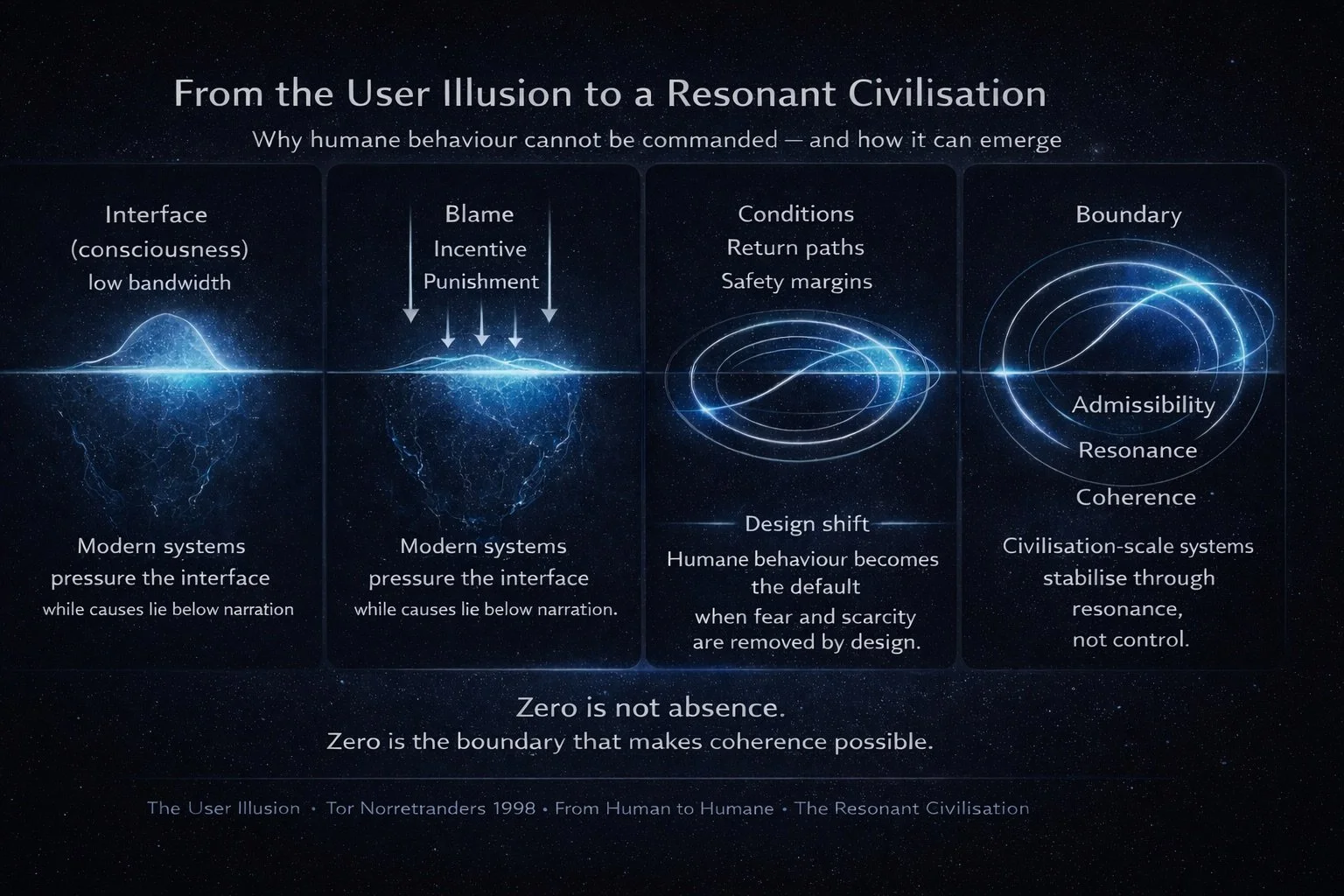
Modern civilisation is built on a mistaken assumption: that conscious intention is the primary driver of human behaviour and social order.
In The User Illusion, Tor Norretranders shows that consciousness functions like a user interface—low-bandwidth, narrative, and largely retrospective. Most intelligence, decision-making, and coordination occur beneath awareness. The “self” explains actions after they have already been set in motion.
This insight quietly dissolves the moral architecture of modern society.
If human behaviour is not consciously authored moment-to-moment, then cruelty, extraction, and domination are not primarily failures of will or virtue. They are failures of conditions.
From Human to Humane
A humane society cannot be built by exhortation, punishment, or moral pressure.
Compassion does not scale through intention.
It emerges when environments stop forcing nervous systems into fear, scarcity, and competition. Ethics follows structure—not the other way around.
The Resonant Civilisation
A civilisation designed around control assumes that awareness can govern complexity. It cannot.
A resonant civilisation recognises that:
• intelligence operates below narration
• stability arises from boundaries, not commands
• coherence replaces coercion as the organising principle
Here, Zero is not absence.
Zero is the boundary that makes behaviour admissible, reversible, and stable.
Core Insight
Civilisation has mistaken the user interface for the operating system.
A Resonant Civilisation is one that no longer asks humans—or machines—to “try harder,” but instead designs the conditions in which humane behaviour is the natural, low-energy outcome.
Referenced works:
From Human to Humane, The Zero That Got in the Way, and The Resonant Civilisation — Heather Elaine Odom