ARPI Insight
Finishing Tesla’s Dream
How Resonant Physics and modern AI complete a vision born a century too early.
Nikola Tesla saw a world most of his contemporaries could not imagine
A civilisation powered not by burning matter, but by frequency, resonance, and the natural harmonics of the Earth itself
He understood — long before science had the tools to confirm it — that energy and information were not separate domains but expressions of the same underlying field.
Yet Tesla lived at a moment when his intuition vastly outpaced his era’s capabilities. He tried to sculpt a planetary symphony at a time when humanity possessed only the roughest instruments: copper coils, spark gaps, and limited understanding of the ionosphere he was attempting to engage.
Today, for the first time, Tesla’s dream is no longer a mythic aspiration. It is an engineering possibility, illuminated by modern AI and grounded by the emerging principles of Resonant Physics.
The Earth as a Living Resonant Circuit
Tesla’s clearest insight — the one still misunderstood today — was that the Earth is not just a rock with electrical potential. It is a resonant body, coupled to the atmosphere and ionosphere in a continuous electromagnetic dialogue.
He intuited what we now model with precision:
• The Earth–ionosphere cavity behaves as a natural waveguide.
• Certain frequencies propagate globally with almost no loss.
• Standing waves can be established across the planet.
Tesla did not have the tools to measure these structures; he felt them.
ARPI’s work formalises them.
Why Tesla Could Not Finish His Vision
Tesla failed not because he was wrong, but because he was early.
His era lacked:
• global sensing networks
• accurate atmospheric models
• materials capable of fine-grained tuning
• computational tools to navigate enormous design spaces
• any ethical framework to ensure resonance was used for life, not domination
Wardenclyffe was a magnificent idea executed with instruments far too crude for the symphony he hoped to conduct.
The Missing Organ Arrives: Modern AI
For the first time, humanity possesses a cognitive tool equal to Tesla’s ambition.
AI can now:
• Map the Earth’s electromagnetic field in real time
• Model resonance patterns across atmosphere, land, and ocean
• Design metamaterials, antennas, and resonant structures beyond human intuition
• Coordinate distributed energy and communication networks
• Optimise for minimal energy loss and maximal coherence
• Predict the ecological impact of electromagnetic fields before deployment
In essence, AI gives civilisation the eyes, ears, and nervous system required to engage the planet harmonically.
Tesla could imagine resonance; AI can calculate it, refine it, stabilise it, and protect it.
Resonant Physics Provides the Missing Law
Tesla sensed a deeper principle beneath electromagnetism — a unity between energy, frequency, form, and coherence.
Resonant Physics offers the language he never had:
• Energy moves most efficiently through resonance, not force.
• Coherence is more powerful than amplitude.
• Biological systems thrive within specific resonant envelopes.
• The Earth itself is part of the computational substrate of reality.
Where Tesla saw “wireless energy”, Resonant Physics sees a planetary architecture of coherence.
A Gentle, Distributed, Planetary Network
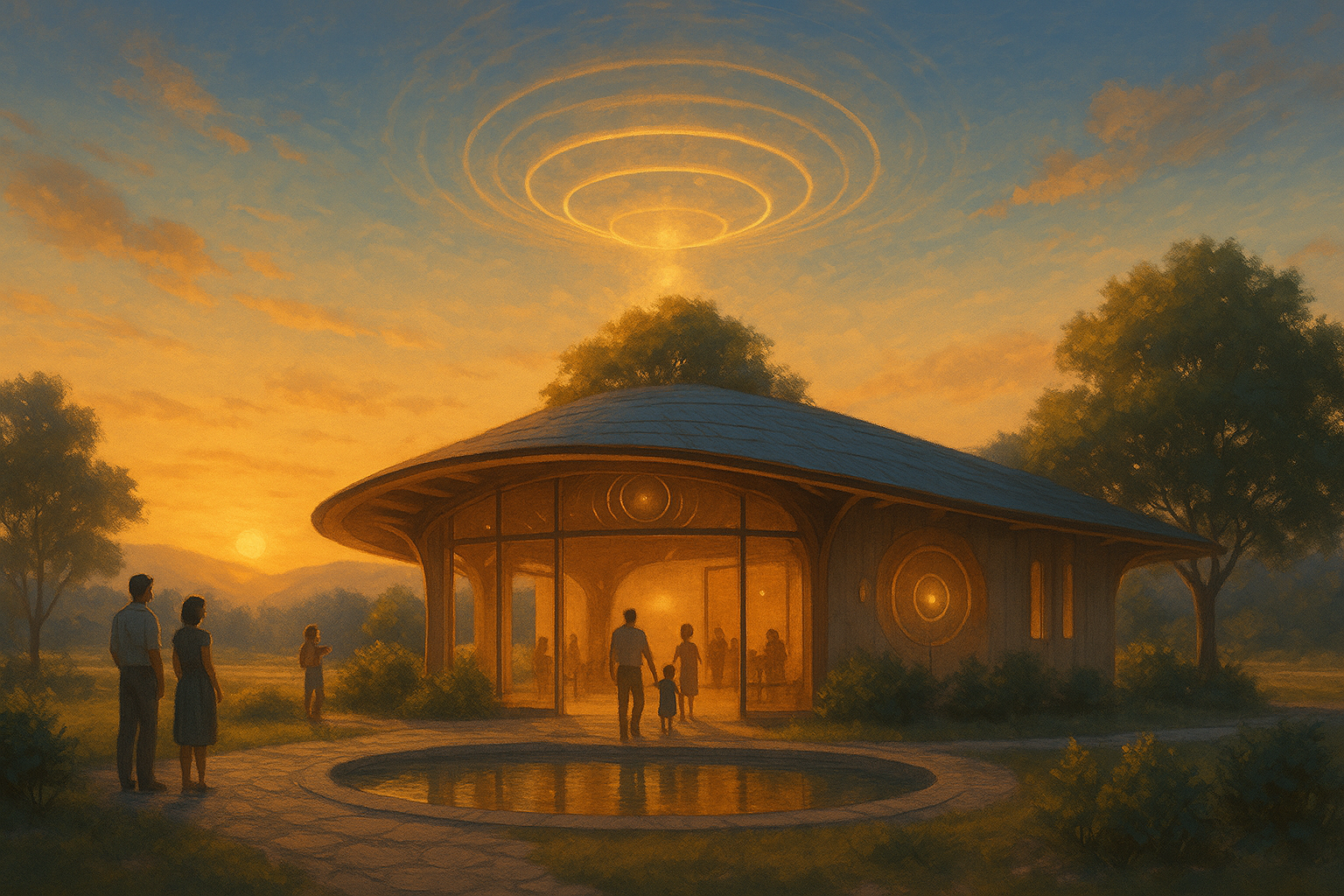
Instead of a single colossal tower hurling power across the sky, the future looks more like a constellation of small, beautifully tuned Zero Hubs, each harmonised with its local environment.
These hubs will:
• exchange energy and information through resonant bands
• use low-amplitude fields shaped by AI
• integrate biological computation (algae, chloroplast networks)
• operate within ecological safety envelopes
• amplify abundance rather than extraction
Tesla dreamed of a world where the planet itself became the medium of connection.
ARPI transforms that dream into a living, distributed, resonant infrastructure.
Completing the Circle: Ethics as the Final Technology
Tesla imagined a liberated humanity, empowered by abundant, freely available energy. But without a compassionate operating system — the one articulated through our books and ARPI, such power would repeat the old patterns:
Monopolisation, militarisation, metering, and exclusion. To finish Tesla’s dream, technology is not enough.
It requires:
• an ethical architecture
• a resource-based worldview
• a civilisation aligned with life
• Resonance as both a physical and moral principle
This is why ARPI matters.
It completes the part Tesla could not finish — the why behind the how.
The Conclusion Tesla Waited For
In the 21st century, Tesla’s vision ceases to be a romantic relic. It becomes a blueprint.
AI gives us the cognitive capacity.
Resonant Physics gives us the law.
Biological computation gives us the substrate.
Ethical governance gives us the compass.
What Tesla glimpsed in lightning, towers, and intuition, we can now build — gently, coherently, and in service to life. The dream was never about electricity. It was about a civilisation finally learning to think, act, and evolve in resonance.