ARPI Insight
David Bohm and the World That Must Resonate
A Physicist Who Refused Fragmentation
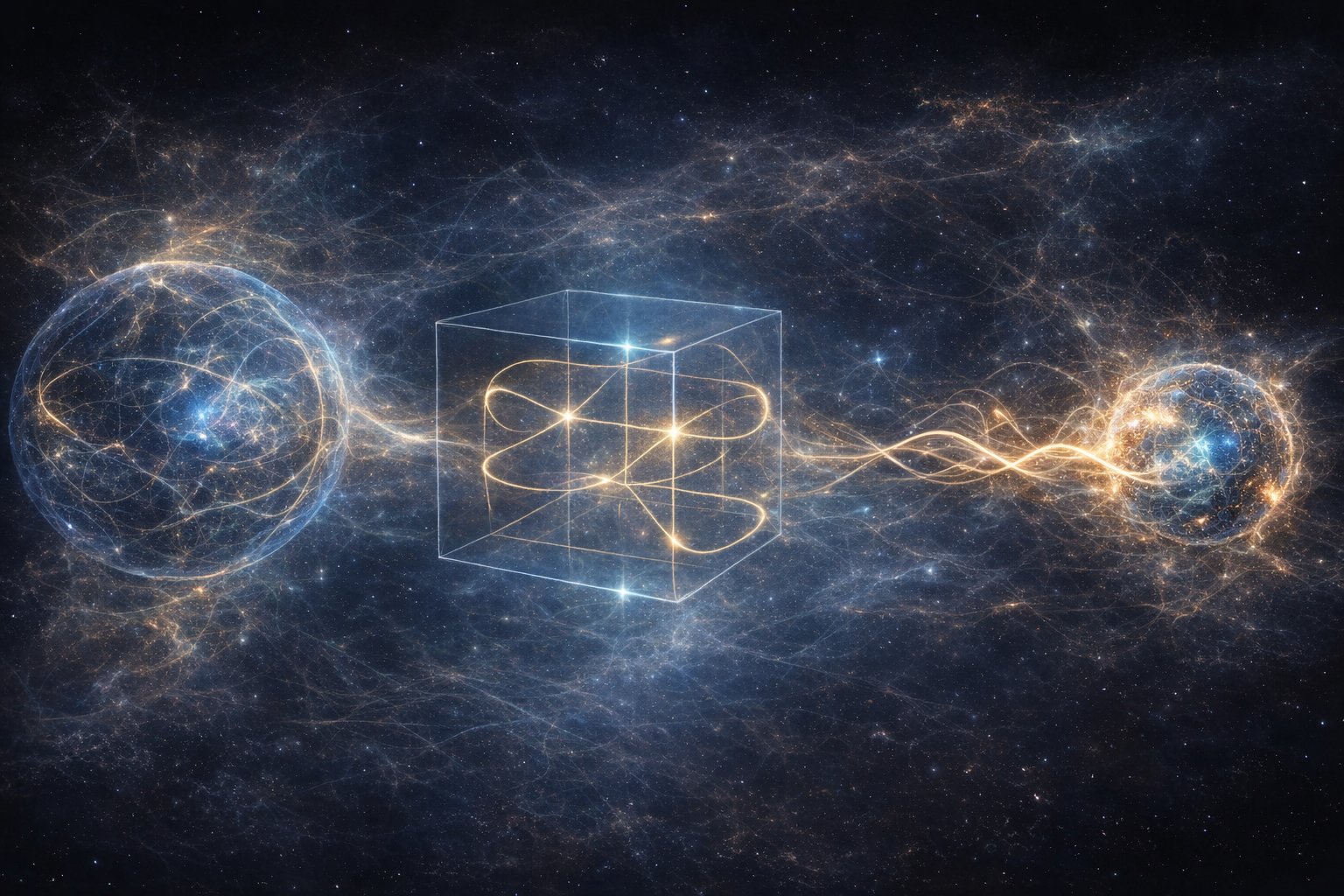
David Bohm was among the first modern physicists to recognise that reality could not be fundamentally composed of independent parts. Through his work on nonlocality, the quantum potential, and the implicate order, Bohm challenged the prevailing assumption that the universe is assembled from discrete objects interacting across empty space.
This refusal to accept fragmentation — intellectual as much as political — came at a cost. During the McCarthy era, Bohm was effectively exiled from American academia. Yet it was precisely this distance from the institutional centre that allowed him to pursue questions others could not.
What Bohm uncovered would quietly reshape how we think about order, coherence, and the nature of reality itself.
From Particles to Wholeness
Bohm demonstrated that quantum behaviour does not require fundamental randomness. Instead, particles can be understood as following well-defined trajectories guided by a global, nonlocal field. This reframing made nonlocal coherence unavoidable and reintroduced order into a domain that had been declared irreducibly probabilistic.
Later, Bohm extended this insight beyond equations. He proposed that what we observe — particles, objects, events — belongs to an explicate order: the unfolded surface of reality. Beneath it lies an implicate order: a deeper, enfolded coherence from which phenomena emerge.
Reality, in Bohm’s view, is not built from parts. It unfolds from wholeness.
This was a profound ontological shift. But it was not yet a complete one.
The Step Bohm Could Not Fully Take
Despite his radical vision, Bohm remained mathematically tethered to a quiet assumption inherited from classical physics: that zero represents absence — a neutral baseline from which structure arises.
Even the implicate order, rich as it was conceptually, was implicitly allowed to dissolve into mathematical nothingness at its limit. As a result, Bohm could describe coherence as fundamental, but not as inevitable.
He could show that order exists. He could not fully explain why it persists.
Why does coherence survive dissipation?
Why does structure stabilise instead of washing out?
Why does life endure rather than dissolve?
These questions point directly to what was missing. This tension did not go unnoticed by Bohm’s contemporaries - least of all Albert Einstein.
Bohm and Einstein — The Unfinished Conversation
By the early 1950s, David Bohm had already published his work on hidden variables and nonlocality.
Einstein, by then an elder statesman of physics, followed Bohm’s thinking closely.
They walked often. They talked slowly. Einstein was deeply dissatisfied with quantum mechanics — not because it failed to predict outcomes, but because it failed to describe reality.
Bohm later recalled Einstein saying, in essence:
“Physics should describe what is, not merely what we can say about measurements.”
Bohm agreed — but went further.
He proposed that what we observe as particles and events are not fundamental objects, but unfoldings from a deeper, nonlocal order.
Einstein listened carefully. He accepted nonlocality as logically possible, but resisted its implications. At one point, Einstein said to Bohm:
“I do not believe that God plays dice with the universe.”
Bohm’s reply was gentle, but decisive:
“Perhaps the universe is not playing dice — perhaps we are only seeing the dice because we are looking at projections.”
Einstein paused. What troubled him was not determinism versus probability — it was separability.
Einstein insisted that physical reality must be composed of distinct parts that exist independently in space.
Bohm questioned this assumption directly.
“What if wholeness is primary?” Bohm asked.
“What if separation is the appearance, not the truth?”
Einstein could not accept that step. He admired Bohm’s clarity, but ultimately replied:
“Then physics would no longer describe objects in space and time.”
Bohm answered:
“Perhaps it never did.”
Zero Reconsidered: From Absence to Boundary
Resonant Physics completes this step by reframing zero entirely.
Zero is not nothing. Zero is a boundary condition.
When zero is treated as a boundary rather than an origin, coherence cannot dissipate indefinitely. Phase relationships acquire limits. Closure becomes unavoidable. Geometry runs out of options.
At this point, order is no longer merely possible — it is forced.
This single shift transforms Bohm’s wholeness from a philosophical truth into a physical inevitability.
From Wholeness to Resonance
Bohm showed that coherence exists beneath phenomena.
Resonant Physics explains how coherence locks in.
Once minimal closure is reached, oscillations are forced to re-encounter themselves. Stable modes emerge. Phase-locking appears. Persistence becomes structural rather than imposed.
This is not cognition. It is not consciousness. It is the precondition for both.
Resonance is not metaphor here.
It is the physical mechanism by which order survives.
Life as a Resonant Achievement
Life does not assemble itself from parts. It stabilises itself through recursive resonance.
Biological systems persist because they maintain coherent phase relationships across scales — molecular, cellular, organismal, and ecological. These are resonant properties, not particle properties.
Bohm intuited the kind of world life must inhabit: a world of wholeness and coherence.
Resonant Physics explains how life actually lives there.
Not through control.
Not through force.
But through resonance that holds.
Why Bohm Still Matters
Bohm was not wrong.
He simply arrived at the edge of what twentieth-century mathematics could comfortably express. He showed us that the universe could not be made of parts.
Resonant Physics shows that it must therefore be made of modes that hold together.
What Bohm called implicate order, Resonant Physics treats as a structured, constrained, resonant substrate — one that makes coherence, life, and intelligence physically inevitable rather than philosophically implied.
Closing
Bohm revealed a world that could not fragment.
Resonant Physics explains why it must resonate.