ARPI Insight
Boundary Failure Is Not a Catastrophe. It Is a Phase Shift.
The Earth does not change by drama. It changes when boundary conditions move.
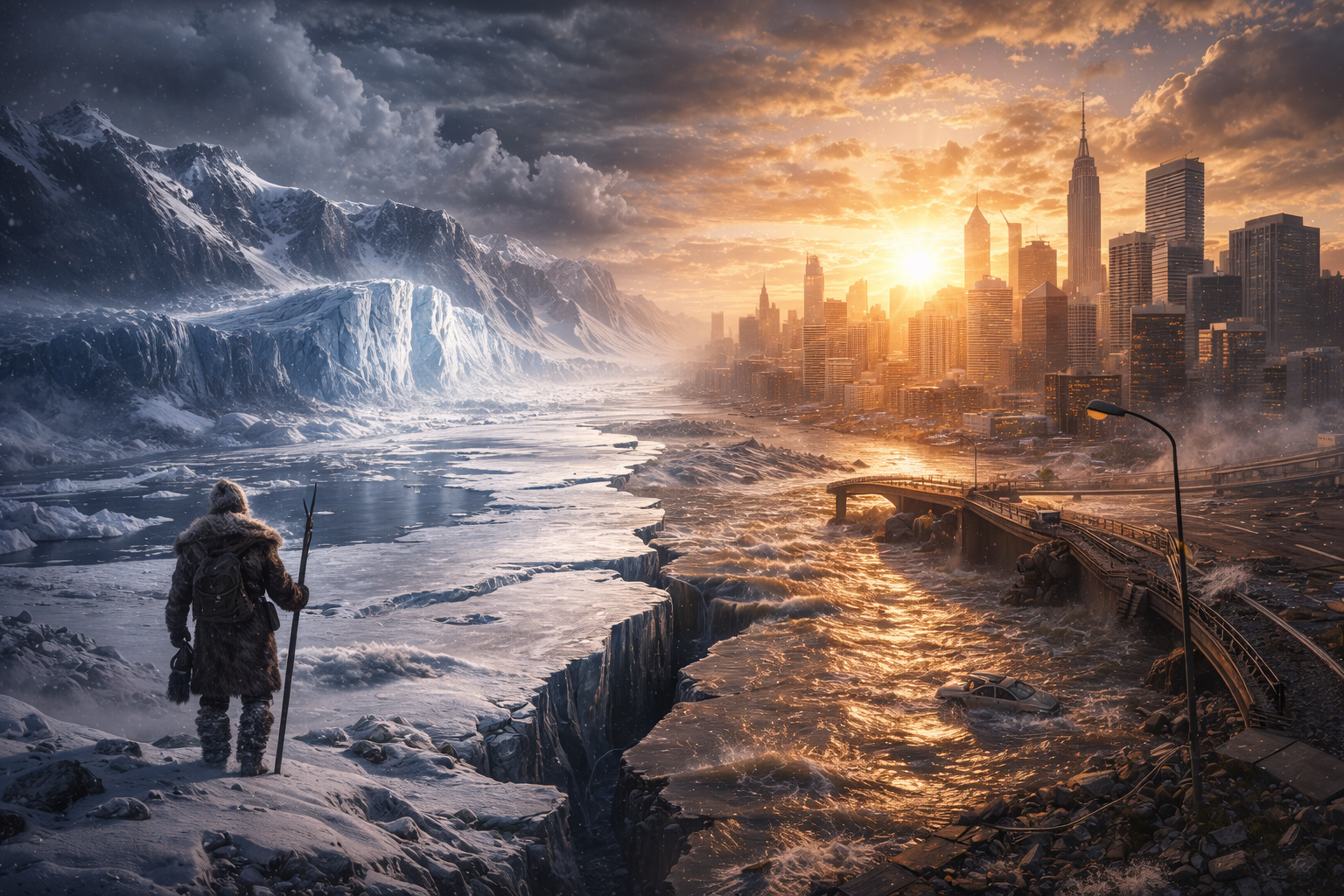
The Ice Ages were not disasters triggered by sudden events, but long periods where orbital cycles, ice albedo, ocean circulation, and atmospheric composition locked the planet into a colder stable mode.
The Holocene was not guaranteed. It emerged because those constraints relaxed into a narrow window of coherence.
Civilisation arose inside that window.
What films like The Day After Tomorrow portray as sudden catastrophe
is, in reality, something more unsettling and more precise:
When boundary conditions cross a threshold,
systems do not warn — they reconfigure.
Climate stability is not maintained by force. It persists only while constraints remain within life-compatible ranges.
We are not facing “the end of the world.” We are approaching the edge of the conditions that made this one possible.
The lesson is simple:
Nature does not collapse. It transitions.
And survival belongs to systems that recognise when the boundaries are moving — and respond before coherence is lost.