ARPI Insight
Beyond Speed and Escape:
How Resonant Physics Reframes Elon Musk’s Vision of the Future
From first principles to first harmonics in the age of planetary-scale engineering
Planetary-scale Engineering
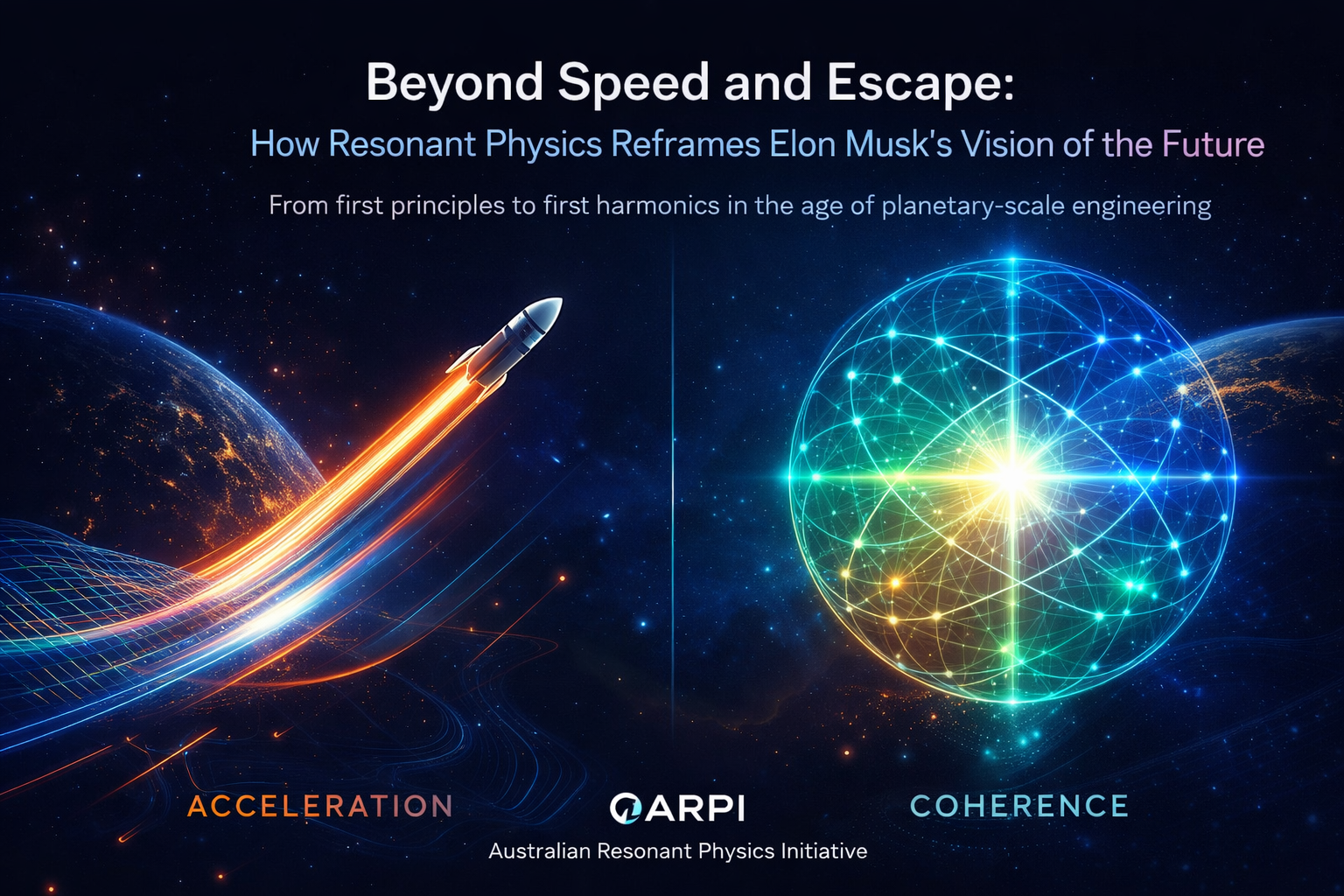
Modern civilisation is being built by engineers who believe that survival depends on speed, scale, and escape. Few embody this belief more clearly than Elon Musk. Rockets must fly faster. Iteration must accelerate. Intelligence must scale. And if Earth cannot be stabilised in time, we must leave it.
Resonant Physics asks a different question.
What if the problem is not that civilisation is moving too slowly — but that it is out of tune?
The First-Principles Era
Much of Musk’s work is grounded in first-principles thinking: reduce systems to their fundamentals and rebuild them without inherited assumptions. This approach has delivered extraordinary results — reusable rockets, mass-market electric vehicles, global satellite networks.
Yet first-principles engineering, when applied at planetary scale, reveals a hidden limitation. It treats systems as objects to be optimised rather than fields to be stabilised. Speed becomes the dominant metric. Force becomes the solution. Escape becomes the backup plan.
Acceleration solves problems — until the problems become systemic.
When Optimisation Outpaces Coherence
As systems grow in scale and complexity, a new constraint emerges: coherence. Components must remain phase-aligned not only technically, but energetically, ecologically, and socially. Beyond a certain threshold, speed ceases to be an advantage and becomes a liability.
Resonant Physics reframes progress not as maximising output, but as maintaining alignment under constraint. Speed is no longer a race metric. It is a stability condition — the maximum rate at which a system can evolve without fragmenting.
When optimisation outpaces coherence, systems burn energy, amplify entropy, and demand constant correction.
From Force to Alignment
In a resonant framework, engineering no longer seeks to overpower resistance. It seeks phase compatibility with the environments systems inhabit.
Applied to Musk’s domains, this shift would mean:
• propulsion systems designed to ride natural orbital and atmospheric resonances rather than brute thrust
• vehicles conceived as resonant energy systems rather than mobile storage units
• infrastructure that settles into stable operating modes instead of relying on perpetual intervention
Energy is conserved not only through efficiency, but through participation.
Rethinking Entropy and Escape
Much of the drive toward multi-planetary civilisation is rooted in entropy anxiety — the belief that decay is inevitable and survival requires redundancy through expansion.
Resonant Physics offers a different interpretation. Entropy is not destiny; it is distance from coherent closure. Systems degrade when relationships break down, not simply because time passes.
From this view, Earth is not a dying platform to abandon, but a resonant system capable of restoration. Mars is not an escape hatch, but a harmonic extension — meaningful only if coherence is preserved rather than exported.
Survival shifts from running faster to listening better.
Intelligence That Listens
Nowhere is this distinction more critical than in artificial intelligence. Systems optimised solely for speed and throughput risk instability, hallucination, and runaway optimisation. Intelligence that lacks coherence cannot govern itself, no matter how powerful it becomes.
Resonant intelligence prioritises alignment, closure, and persistence over raw acceleration. It listens before it acts. It settles rather than escalates.
At planetary scale, this difference is not philosophical — it is existential.
From First Principles to First Harmonics
Elon Musk is not wrong about physics. But physics alone is no longer enough. In an era of planetary-scale engineering, the primary challenge is not overcoming limits — it is designing systems that hold together.
Resonant Physics does not oppose first-principles thinking. It completes it by recognising that systems survive not by going faster, but by remaining in tune.
The future will not be secured by speed or escape. It will be secured by coherence.
Editor’s note:
This Insight explores how Resonant Physics reframes optimisation, entropy, and large-scale engineering. It forms part of ARPI’s broader inquiry into coherence, boundary conditions, and the foundations of a stable technological civilisation.